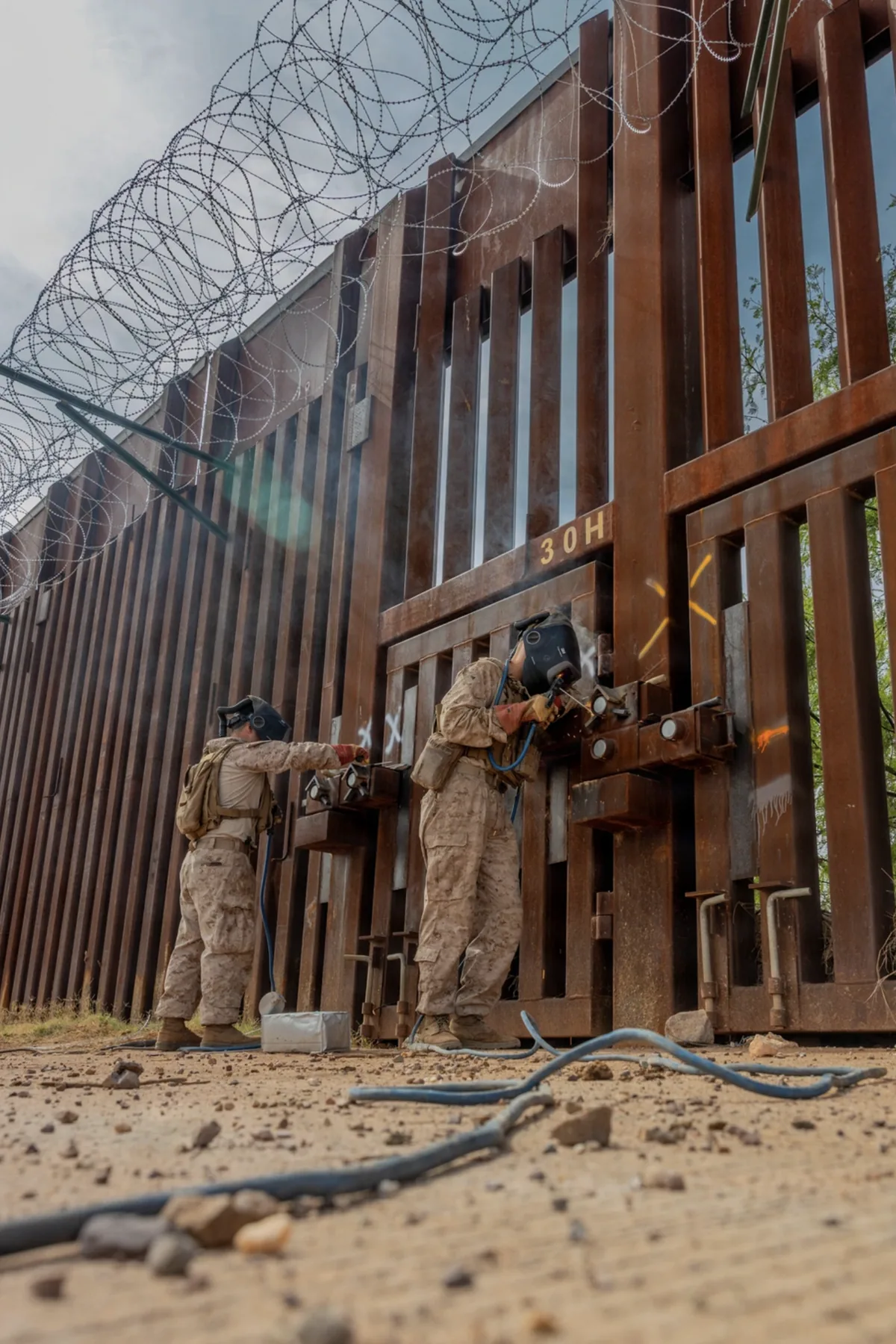
The Trump administration quietly started building a 30-foot steel border wall in west Texas this week — a wall that, according to the people fighting it, you can literally just walk around on either side. CBP didn't announce it. They didn't have permission for most of the land they need. They built it anyway.
The Wall That Exists to Prove the Wall Exists
Construction began September 15 in Hudspeth County, just east of El Paso, according to Customs and Border Protection, which confirmed the start date by email after the Associated Press broke the story. CBP did not issue a press release, did not alert the public, and apparently did not feel the need to explain itself to anyone.
Images obtained by the No Big Bend Wall coalition show the result: a towering section of steel bollard fencing standing completely alone in the desert, unconnected to anything, stopping nothing. Clara Bensen, the group's communications director, described it to the Guardian with a precision that should embarrass every person who signed off on this: 'They're just grasping on to whatever little plots of land they've managed to get so far.'
The federal government has an uneven patchwork of land permissions because more than half of the roughly 400 landowners with Rio Grande frontage in the area have joined the No Big Bend Wall coalition and plan to contest eminent domain claims in court. So CBP is building isolated panels where it can, surrounded by gaps where it can't, producing something that functions less like a border barrier and more like performance art about border barriers.
Forty-Six Billion Dollars for Two Percent of Crossings
Here is what makes this genuinely difficult to process. The Big Bend region, all roughly 500 miles of it, has historically accounted for less than 2% of illegal crossing apprehensions, according to the Guardian's reporting. The towering cliffs, brutal desert heat, and total absence of border towns on the Mexican side already do what the wall is supposed to do. Nature built this wall for free.
Unauthorized crossings in the area have dropped even further since Trump returned to office and implemented his broader border crackdown. CBP is constructing a 30-foot steel fence, in isolation, in a remote wilderness, to address a problem that has largely already been solved by geography, in a region that was barely a problem to begin with.
Congress, however, helpfully stuffed $46.5 billion for border wall expansion into last year's 'big, beautiful' spending bill. Armed with that kind of money, apparently the question stopped being 'where do we most need this' and became 'where can we build something fast enough to get on television.'
The Actual Damage This Thing Will Do
While everyone argues about a fence that doesn't connect to anything, CBP's broader plans for the region are moving forward. The agency wants to extend its so-called 'smart wall' — 30-foot fencing, vehicle barriers, patrol roads, and detection sensors — into Big Bend National Park, which is widely considered Texas's most beloved piece of wilderness. CBP commissioner Rodney Scott paused construction at the park last month after images of bulldozers clearing brush went viral and produced a furious, bipartisan public reaction. The pause appears temporary.
Beyond the national park, the Guardian reports the expansion would cut through Big Bend Ranch State Park, Black Gap Wildlife Management Area, and Amistad National Recreation Area. Blasting from construction threatens to destroy millennia-old rock art murals carved into the river valley. Private landowners are fighting it because a 30-foot steel wall tanking your property value, blocking your river access, and bulldozing your grazing land tends to make people angry regardless of how they vote.
Bob Krumenaker, a former Big Bend National Park superintendent who now chairs Keep Big Bend Wild, told the Guardian he's heading to Washington next week to lobby lawmakers directly. 'This is a nonpartisan issue,' he said. That is both true and probably the most damning thing you can say about a policy in the current political environment.
Bipartisan Fury, Which CBP Is Ignoring
The backlash here is real and it is not coming only from the usual suspects. Texas Republicans — not exactly a soft-on-the-border constituency — have pushed back on the Big Bend construction plans alongside Democrats, because destroying a beloved national park to build decorative fencing in a low-crossing corridor is the kind of thing that makes constituents send angry emails regardless of party.
None of that appears to be slowing CBP down much. Bensen described the agency's logic to the Guardian with a brutal clarity: 'It's not about logic. They're moving forward even if the plan is not fully baked.' The agency is building what it can build, where it can build it, whether or not the pieces connect, whether or not it accomplishes anything, because the point is to have built something.
The Dingo Take
You are supposed to look at a lone panel of 30-foot steel fencing standing in the middle of the west Texas desert, completely unwalled on both sides, and see border security. You are supposed to accept that $46.5 billion spent in a corridor that accounts for less than 2% of illegal crossings — crossings that are already down — is a wise allocation of federal resources. You are supposed to believe CBP secretly starting construction without any announcement and then confirming it by email afterward is how a government accountable to the public operates.
What is actually happening here is that the wall was never really about stopping crossings. It is a monument. It is a thing that can be photographed and put in a campaign ad. The fact that it stops nothing, connects to nothing, and sits surrounded by land the federal government doesn't even have permission to use yet is not a bug in this program. The government is spending billions to build props in a national park, and calling anyone who objects soft on immigration.
The rock art along that river valley is thousands of years old. It survived everything. It might not survive a CBP blasting crew with $46.5 billion and no particular reason to stop. That's the part that should keep you up at night.


Comments