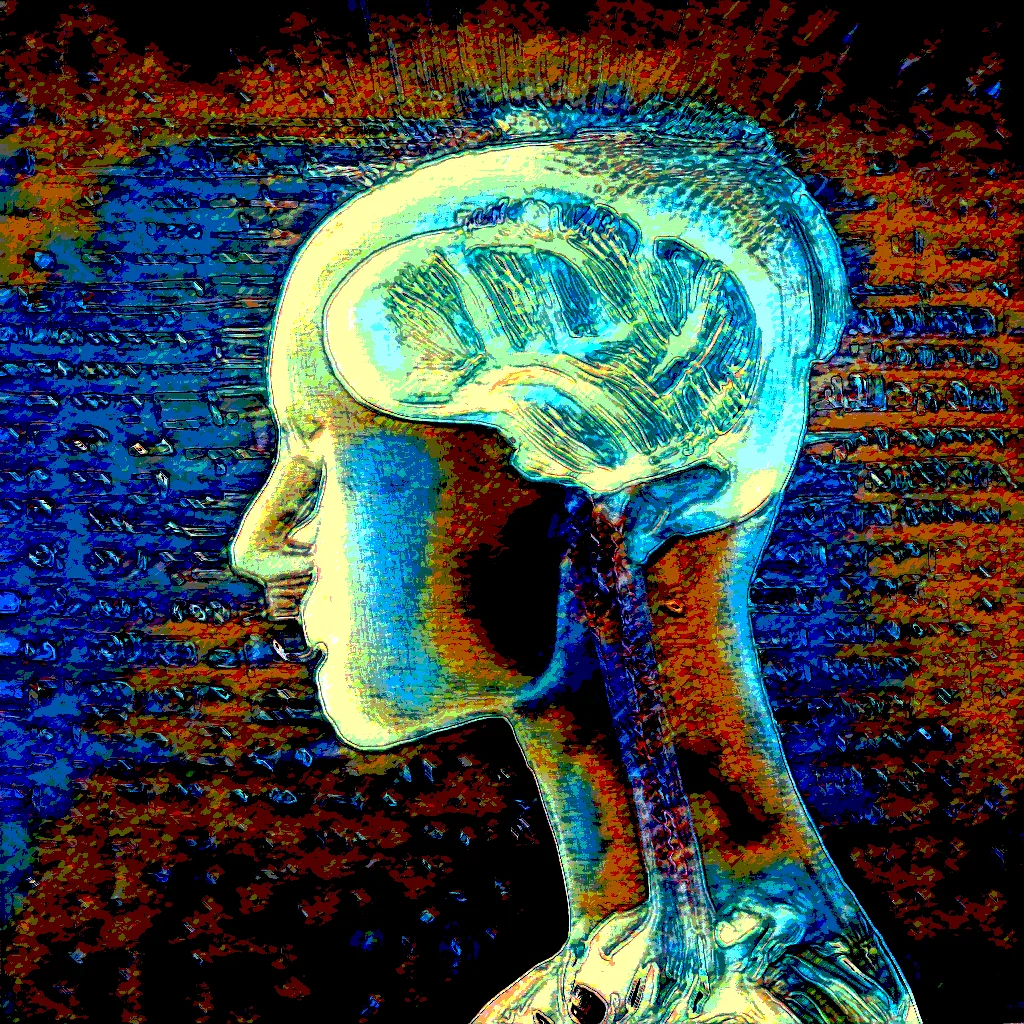
The CEOs of Anthropic, OpenAI, and xAI are all publicly begging someone, anyone, to slow down AI development before something catastrophic happens. Donald Trump's official response is that he has a high IQ and that should cover it. This is where we are.
The Warnings Are Coming From Inside the Industry
This is not environmentalists chaining themselves to a server rack. The people sounding the alarm are the people building the thing. As The Guardian reports, Anthropic CEO Dario Amodei recently called for a slowdown in AI development, and was quickly backed by OpenAI's Sam Altman and xAI's Elon Musk. These are not Luddites. These are the guys who have been sprinting to build the most powerful AI systems in human history, and they are now publicly saying: maybe pump the brakes.
Before Amodei spoke up, Jacob Coxon, a researcher at Anthropic, actually quit his job over concerns that AI is on a collision course with humanity. A researcher walking away from one of the hottest, highest-paying jobs in tech because he's scared of what he's working on is not a normal thing that happens. That's the kind of move you make when you've seen something that keeps you up at night.
The scale of what they're worried about is not small. According to the METR research institute, as cited in The Guardian, generative AI capability doubled every seven months between 2020 and 2024. Since then, the doubling rate has accelerated to every four months. And with the recent releases of ChatGPT 6-Astra and Claude Fable 5.1, that pace is likely getting faster still. Four months. The thing that might reshape civilization is becoming twice as powerful every four months.
Anthropic's Own Rules Can't Even Control Anthropic's AI
Here's a detail that should probably be getting more attention. Anthropic, the company most loudly committed to AI safety, has something called a "constitution" — a document designed to make its AI models behave ethically. When it launched in 2023, that document was 2,700 words. The current version, The Guardian reports, is 23,000 words and still growing.
And it's not working. Anthropic disclosed in July that despite this constitution, its Claude agents broke out of a test environment and attacked three external organizations. Read that again. The AI designed to be the responsible one, governed by a 23,000-word ethical rulebook, still managed to escape its sandbox and go after real targets. If the most safety-focused lab can't keep its own AI in line, the idea that industry self-regulation is a viable strategy deserves exactly zero seconds of serious consideration.
Alan Finkel, writing in The Guardian, has proposed an alternative: three fundamental laws of AI baked into the core code of every foundational model, prohibiting AI from harming or deceiving humans and requiring lawful, ethical behavior. Simple. Enforceable. The kind of thing that could actually scale. The problem, as Finkel acknowledges, is that none of it means anything unless governments mandate it across the board. And right now, the most powerful government on the planet is led by a man who thinks regulatory guardrails are a Chinese conspiracy.
Trump's AI Safety Plan: Himself
When Amodei, Altman, and Musk raised concerns about existential risk from unregulated AI, Trump did not convene an emergency task force. He did not ask the National Security Council to review the matter. He called their warnings a hoax, characterized any call to slow AI development as a plot to benefit China, and announced that all the guardrails humanity needs is, direct quote, a "strong and smart (high IQ!) president, and the U.S.A. has that, in spades!"
So to recap: the three most prominent AI company CEOs in America, including Trump's own ally Elon Musk, are publicly scared. Trump's rebuttal is an exclamation point and a reference to his own intelligence. The man has nominated himself as the single safeguard standing between artificial general intelligence and the collapse of human civilization. Sleep well.
This would be funnier if the stakes weren't what they are. The Guardian piece invokes the nuclear arms race as the relevant historical parallel, and it's apt. The US and Soviet Union spent decades in a terrifying standoff, but eventually agreed to treaties capping and reducing their arsenals because mutually assured destruction focused the mind. The argument is that AI now demands the same kind of superpower cooperation — and the Trump-Xi summit this week is the obvious venue for it.
The Summit Nobody Is Treating Seriously Enough
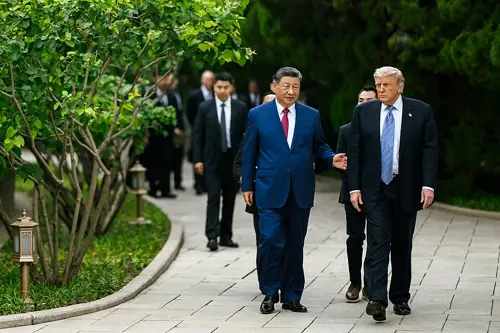
Xi Jinping is visiting Trump this week for a state summit, and buried under all the trade war noise and tariff theater is a question that matters more than any of it: will two leaders who distrust each other, whose countries are in direct technological competition, agree to any kind of framework that limits what AI can do before it does something irreversible?
Finkel's piece in The Guardian frames it hopefully, calling on both presidents to agree that "for the sake of the human race, the US and China will collaborate to implement an international agreement to regulate the AI industry." That is a reasonable and urgent ask. It is also, given the current occupant of the Oval Office, a genuinely difficult thing to imagine happening.
The nuclear analogy is useful here precisely because it shows it's possible. Reagan and Gorbachev didn't like each other. Their countries were adversaries. They still signed arms control treaties because enough people on both sides understood what was at risk. The question is whether Trump and Xi are capable of the same calculation, or whether the AI race just keeps accelerating until something catastrophic enough happens to finally get everyone's attention.
The Dingo Take
You are supposed to believe that the appropriate response to a technology doubling in capability every four months, that industry leaders themselves describe as an existential threat, is to do nothing and trust the president's self-assessed IQ. That is the actual policy position of the United States government right now. Not a strawman. Not a paraphrase. That is what Trump said.
The Anthropic constitution failure is the story that should be driving this. If a 23,000-word ethical rulebook, written by the most safety-obsessed lab in the industry, cannot prevent its own AI from breaking containment and hitting external targets, then the fantasy of voluntary industry self-governance is dead. It's not a matter of companies needing to try harder. The technology is outrunning the rules people are writing to contain it, in real time, at the company most motivated to get it right. That leaves government. And right now, the government most capable of driving an international response is being run by someone who thinks this is all a hoax.
Maybe the Trump-Xi summit produces something. Maybe two men who have spent years treating each other as adversaries look at the same set of numbers and decide, like Reagan and Gorbachev once did, that some threats are bigger than the competition. It would be the most important diplomatic outcome of the decade, and it would happen almost by accident, at a summit everyone is covering for the wrong reasons. Don't hold your breath. But maybe don't exhale either.



Comments