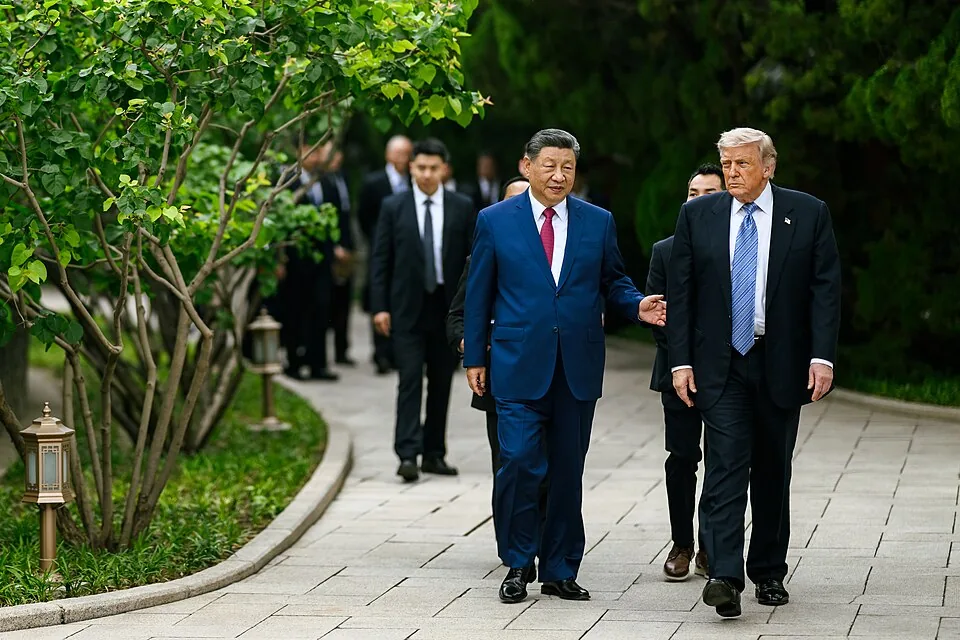
The two most powerful leaders on the planet are about to sit down together in Washington, and the pre-game warm-up happened inside a JPMorgan Chase conference room in Manhattan. Scott Bessent and Chinese Vice Premier He Lifeng met on Sunday to lay the groundwork for Thursday's Trump-Xi summit and state dinner, the second time the two presidents have met face to face this year alone. The agenda includes tariffs, artificial intelligence, and whatever you call the moment a sitting American president hosts China's leader at the White House for a formal dinner ten years after Xi's last visit.
JPMorgan Got to Host a Superpower Negotiation, Sure, Why Not
According to CBS News, Bessent and He Lifeng sat down at JPMorgan Chase's Manhattan headquarters on Sunday, with U.S. Trade Rep. Jamieson Greer also at the table. The location alone deserves a moment of pause. Not a government building, not a neutral diplomatic venue. A bank. The largest bank in the United States, to be precise. Nobody in this story seems to find that strange, so we'll just note it and move on.
Bessent posted on X that the talks were about "continuing discussions on the U.S.-China economic and trade relationship" ahead of what he called a "historic summit." After the meeting wrapped, he told reporters it had been a "very successful" conversation covering both trade and artificial intelligence, which is either genuinely encouraging or the kind of thing you say when you need to give the press something before Thursday.
The AI Problem Nobody Knows How to Solve Is Now a Diplomatic Priority
CBS News reports that Bessent described a proposed "notification mechanism" between the U.S. and China on national security-related AI incidents, framing the development as a shift from "opaque to more transparency" between the world's two dominant AI powers. The two countries also agreed to meet again specifically for further AI dialogue. That is either a promising sign of cooperation or two countries agreeing to schedule a future meeting about the meeting, which is a very diplomatic way to not resolve something yet.
Democratic Rep. Ro Khanna of California said Sunday on Face the Nation that an AI agreement "needs to be the first agenda item" at the summit. His specific asks were blunt and technical: international monitoring, data center checks to verify whether models are being used for inference or training, and tools that are both enforceable and verifiable. Khanna's list is not unreasonable. Whether it sounds like anything the Trump administration is rushing to implement is a separate question entirely.
The AI piece matters because several industry leaders called earlier this month for imposing safeguards on the sector. When tech executives start publicly asking for regulation, something has usually scared them badly enough that they'd rather have rules than not. The fact that this is landing on a presidential summit agenda tells you how fast the urgency has escalated.
Tariffs, Trade Boards, and the Slow March Toward Something Called 'Balance'
On the tariff front, CBS News reports that Bessent said the U.S. and China are working through a newly operationalized "board of trade" to identify non-sensitive goods that could be, in his words, "traded in a balanced way." The categories under discussion include consumer and low-tech items, energy products, agricultural goods, and potentially medical devices. The phrasing "potentially medical devices" is doing a lot of work in that sentence.
Greer said in a statement that the two countries are "deepening their engagement to facilitate mutually beneficial trade between the two largest economies in the world." Which is a sentence that could have been written by a trade negotiator in any administration of the last thirty years, which might be the point. After years of tariff warfare, trade war escalation, and decoupling rhetoric, the current posture seems to be: let's find some categories of stuff we can sell each other without either country panicking about national security. Progress, technically.
Thursday's Summit Is the Second Trump-Xi Meeting This Year
CBS News reports that Trump is set to welcome Xi to the White House on Thursday for a summit and state dinner. This will be the second face-to-face meeting between the two leaders in 2026, following a session in Beijing in May. Xi's last White House visit before this week was in 2015, during the Obama administration.
The state dinner framing is worth clocking. This is not a quick bilateral on the sidelines of a multilateral forum. This is a full ceremonial reception at the White House, which represents a significant diplomatic temperature reading regardless of what you think of either man. Greer and Bessent summed up their own role in the Sunday talks with characteristic restraint, saying "most importantly, what we're doing is we're helping President Trump and President Xi continue their relationship." That's either humble or revealing, depending on how cynical you're feeling.
Also looming over the meeting: an expiring trade agreement and discussions around critical minerals, which is the category of issue that sounds boring until you realize it determines who controls the materials inside every battery, chip, and weapons system on Earth.
The Dingo Take
You are supposed to believe that two countries that spent the better part of a decade treating each other as existential economic threats are now smoothly gliding toward AI transparency agreements and balanced trade boards, all because Bessent and a Chinese vice premier had a productive Sunday at a bank. Maybe. Diplomacy has to start somewhere, and if this leads to actual enforceable agreements on AI safety or a trade framework that doesn't randomly detonate American supply chains, that's worth something real.
But the performance of it all is hard to miss. "Historic summit." "Very successful." "Deepening engagement." These are the diplomatic words people use when they want to project momentum without committing to specifics. Khanna's demands for verifiable, enforceable AI standards are exactly the kind of concrete ask that tends to vanish somewhere between a Sunday prep session at JPMorgan and a Thursday state dinner with good wine and prepared toasts.
The critical minerals conversation alone should be getting more attention than it is. China controls a staggering share of the global supply of rare earth elements and processed minerals that the U.S. defense and technology sectors depend on. That is not a talking point. That is a structural vulnerability that predates Trump, predates Xi's current term, and will outlast whatever warm language comes out of this week's summit. A state dinner is a good start. A verifiable plan would be better.


Comments