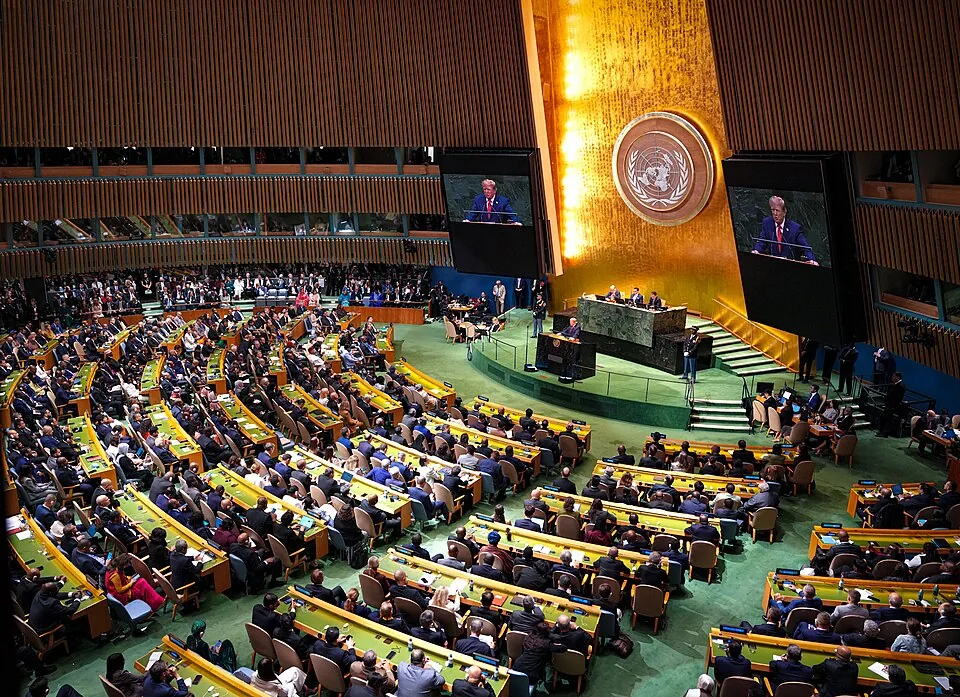
Donald Trump walked into the United Nations Tuesday, an institution he openly despises, and proceeded to threaten to annihilate a sovereign nation, declare a neighboring country's government will 'fall,' and rename artificial intelligence because the word 'artificial' made him feel some kind of way. All in one speech. In front of the people whose countries he was threatening.
The Monroe Doctrine, But Make It Unhinged
Trump opened by reasserting what he called American power, telling assembled world leaders that 'The United States will no longer permit threats to America to gain a foothold anywhere in the Western Hemisphere.' Cool, normal thing to say to a room full of sovereign nations.
According to the BBC's North America editor Sarah Smith, who was in the room, Trump simultaneously claimed the mantle of peacemaker while issuing a string of pointed threats. Iran might be annihilated. Drug smugglers will continue to face lethal strikes. Cuba may be toppled. Trump has apparently decided that the best way to present yourself as a man of peace is to list everything you're willing to destroy.
This is the 'America First' pitch in its purest form: we're still here, we're still armed, and we are absolutely going to use it. The United Nations was founded after World War II specifically to prevent this kind of rhetoric from becoming policy. Trump used its stage to deliver that rhetoric to its member states' faces.
Cuba Gets the Full Treatment, Then Walks Out
Trump called Cuba 'an absolutely failed state' and told the room, flatly, 'It will fall.' The Cuban delegation did not stay to hear the rest. They walked out of the hall, which, honestly, seems like the correct response to being told your country is about to collapse by the man who has spent a year applying pressure to make that happen.
As the BBC's White House reporter Bernd Debusmann Jr. noted, Trump has grown increasingly vocal about Cuba's communist government over the past year, telling the UN it is under 'enormous pressure' and 'failing like never before.' What he did not provide, and what the US has not provided at any point, is any coherent picture of what American-approved 'change' in Cuba would actually look like.
Cuba's foreign minister Bruno Rodriguez posted a response on X, accusing Trump of spreading 'falsehoods' and writing that 'The US government is incapable of accepting that Cuba is and has the right to be a full sovereign and independent country.' That is a pretty mild response to being publicly threatened with regime collapse at the United Nations, but Rodriguez presumably had a flight to catch.
Iran Gets the Bluntest Threat
The sharpest moment in the speech, and the one that will likely draw the most scrutiny from international lawyers, was Trump's warning to Iran. According to the BBC's Persian correspondent Khashayar Joneidi, Trump gave Iran two options: cut a deal with Washington and rebuild, or face the rapid 'annihilation' of the Islamic Republic. He then predicted a deal would probably come after the November midterms, which is a hell of a way to structure a negotiating timeline.
The language Trump used went further than most. References to leaving Iranians with 'no chance of survival' and 'no hope' for future generations are the kind of phrases that international law experts have flagged before. The BBC notes those experts previously expressed alarm at what they called 'alarming rhetoric' from US officials, including Trump's earlier social media post suggesting the US might 'obliterate' Iran's power plants.
Here is what makes it complicated: Joneidi points out this was not a declaration that diplomacy has failed. Trump still appears to want a deal. He just wants that deal to be signed under the shadow of an existential threat. Whether that is a negotiating strategy or a genuine statement of intent is a distinction that matters enormously, and Trump has shown little interest in clarifying it.
Greenland Deal Gets a Victory Lap
Trump also used the speech to celebrate a new security agreement with Greenland, under which the US will build two military bases in the Arctic territory. As Debusmann reported, a joint signing ceremony involving the US, Denmark, and Greenland followed the address at the UN itself.
This is the diplomatic resolution to a saga that began with Trump threatening to take Greenland by force, a threat that rattled the NATO alliance and strained the US-Danish relationship for the better part of a year. Some analysts are quietly calling this a win for diplomacy. Trump called it something that 'very much enhances' NATO. Both of those things can be true simultaneously, which is one of the stranger facts of the current moment.
Greenland is a semi-autonomous territory within the Kingdom of Denmark, which handles its foreign policy. Denmark and Greenland are presumably hoping the base deal closes the chapter on the annexation threats. Whether Trump sees it that way, or whether this is simply the next step, remains an open question.
AI Is Now Called 'Super Intelligence,' Per the President
And then, because this is the timeline we live in, Trump rebranded artificial intelligence. 'The use of the word artificial makes it sound fake,' he told world leaders. 'It's not fake, it's actually amazing. But we have to be careful.' He then announced that going forward, he would be calling it 'Super Intelligence,' abbreviated to SI.
As the BBC's New York correspondent Nada Tawfik reported, Trump has form on this kind of branding exercise. He declared last week that 'Whoever wins AI, wins,' and his administration remains firmly opposed to government regulation or any new guardrails on the technology. That position puts him in direct conflict with the significant portion of the UN membership that has been pushing for exactly that kind of oversight.
The irony of delivering an anti-regulation pitch for the world's most consequential emerging technology at the United Nations, in the same speech where you've threatened to annihilate a country, does not appear to have registered. Trump was simply in his element: big room, global audience, no notes, no guardrails.
The Dingo Take
You are supposed to believe this was a normal address to the United Nations General Assembly. A sitting US president threatened to annihilate a country, predicted the collapse of another government, unveiled military bases in territory he spent the previous year trying to acquire by force, and coined a new term for artificial intelligence, all in sequence, at a podium built for the purpose of preventing exactly this kind of thing. And then he flew home.
The Iran portion of this speech should be getting more attention than it is. 'No chance of survival' and 'no hope for future generations' are not standard diplomatic warnings. They are the kind of language that gets flagged in international law classrooms and war crimes tribunals. Trump framing it as a negotiating posture does not make it less alarming. It arguably makes it more alarming, because it means he's decided this is an acceptable thing to say out loud in that room as an opening bid.
What you are watching is a president who has fully internalized that norms are only real if someone enforces them, and that no one is going to enforce them on him. The UN condemned nothing. Denmark shook his hand. The Cuban delegation walked out, which is the diplomatic equivalent of a one-star review. The world is adjusting to Trump, not the other way around. That adjustment has a cost, and we are all paying it whether we've noticed yet or not.

Comments