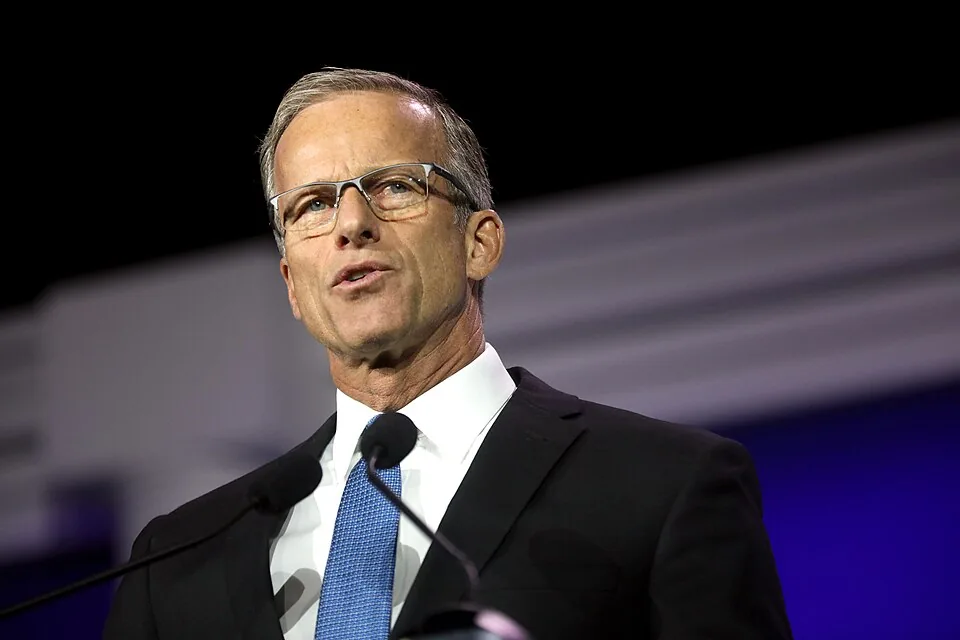
The President of the United States has been loudly and publicly crusading against AI regulation for months. According to the Senate's top Republican, that position is not really a position. It's more of a vibe. John Thune told Axios that Trump is 'not really dug in' against AI guardrails, which raises an obvious and alarming question: is anyone in charge of this country actually steering, or are we just watching the wheel spin?
What Thune Actually Said
Here's the setup. Trump has made opposition to AI regulation a public centerpiece of his tech agenda, framing guardrails as overreach and painting safety concerns as fearmongering from people who want to strangle American innovation. It has sounded, publicly, like a firm ideological stance.
Then Thune went and talked to Axios. The Senate Majority Leader said he pulled Trump aside privately a few weeks ago when the AI debate was getting 'pretty hot,' and came away with a notably different read. His conclusion: a significant chunk of Trump's bluster is directed at what Thune called 'paranoia and noise around the subject' rather than any genuine, principled opposition to all forms of AI oversight.
So the public-facing policy position of the executive branch on one of the most consequential emerging technologies in human history is, according to a senior Republican who talked to him directly, mostly reactive noise management. Fantastic.
The 'Let the Companies Handle It' Theory of Government
Thune's more charitable interpretation of Trump's actual preference is that he wants tech companies to develop their own security measures rather than having Congress or the White House impose rules from the top down. Industry self-regulation. The companies police themselves. What could go wrong.
To be fair, there is a real and legitimate debate about whether heavy-handed federal AI regulation could kneecap American competitiveness, particularly against China, which is not exactly waiting around for a Senate subcommittee to finish its deliberations. That argument has serious people on its side.
But 'let the companies figure it out' is not a policy framework. It's an abdication dressed up as a philosophy. The same companies being asked to 'secure their systems' voluntarily are the ones racing each other to deploy those systems as fast as possible because the financial incentives to slow down are approximately zero. Self-regulation in a competitive market where the first mover wins is not regulation. It's a suggestion.
The Gap Between the Speech and the Briefing
What makes this Axios report genuinely newsworthy, beyond the behind-the-scenes texture, is what it reveals about the distance between Trump's public posture and whatever is actually happening in private conversations.
Thune didn't say Trump secretly loves regulation. He said Trump's public opposition is at least partly performance, a reaction to what he perceives as hysteria rather than a worked-out governing philosophy. That is a meaningful distinction. It means the loudest signals coming out of the White House on AI policy may not reflect where there's actually room to move.
It also means that legislators, industry groups, and foreign governments trying to read American AI policy by watching Trump's public statements are potentially misreading the situation. Which is either slightly reassuring or deeply unsettling depending on how much comfort you take from 'the President doesn't entirely mean what he says.'
Where This Leaves Actual AI Policy
Congress has been wrestling with AI legislation for years now, and the pace of actual lawmaking has been embarrassingly slow relative to the pace at which the technology is changing. The Senate has held hearings. There have been frameworks floated. Very little has moved.
If Thune is right that Trump isn't as dug in as his rhetoric suggests, that could theoretically open space for some kind of bipartisan AI legislation that establishes at least basic guardrails without going full European Union on the whole sector. The EU's AI Act, for reference, is already in force and applies to American companies operating in Europe whether the Trump administration likes it or not.
But 'there might be room to negotiate with the President if you catch him on a good day' is not exactly a legislative strategy. And with an election cycle perpetually looming, the appetite for any Republican to push AI safety legislation that could be branded as anti-business in a primary is limited, whatever Trump privately thinks about the paranoia and noise.
The Dingo Take
You are supposed to take comfort in this. That is the intended read. The Senate Majority Leader chatted with Trump, sensed some flexibility beneath the bluster, and passed that information along to Axios. The message is: relax, the grownups are talking, it's not as bad as it looks. Do not take comfort in this.
The reason it's not comforting is that the technology isn't waiting. AI systems are being deployed in hiring, in healthcare, in financial decisions, in weapons targeting, in everything — right now, today, at scale — while the most powerful government on earth is operating on a policy framework that its own Senate Majority Leader describes as a reaction to 'noise.' The question of how to govern AI is the most important regulatory question of the next fifty years. 'The President isn't really dug in' is not an answer to that question.
Thune probably meant this as reassurance. What it actually is, stripped of the spin, is a confession that nobody is driving. The car is moving fast. The road ahead is not well-mapped. And the guy nominally at the wheel is mostly honking at people who seem worried about it.

Comments