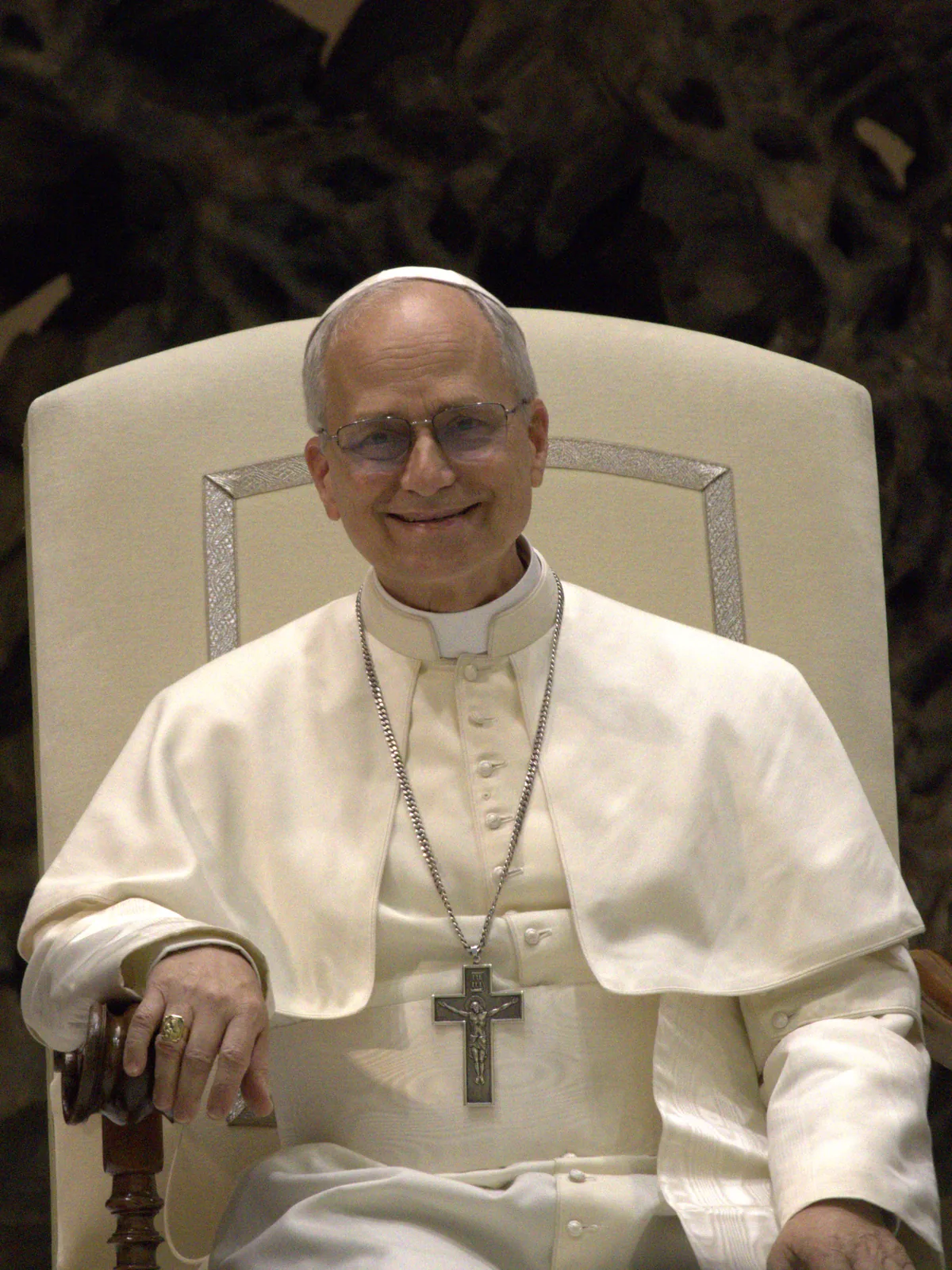
The Pope went to Paris, stood in front of world leaders and UNESCO diplomats, and told everyone that AI is threatening to erase what it means to be human. That's not the wild part. The wild part is that the tech companies building these systems are apparently taking notes.
The American Pope Lands in France and Goes Straight for the Jugular
Pope Leo XIV kicked off a four-day visit to France on Friday with a speech to President Emmanuel Macron and government authorities at the Élysée Palace that was, by papal standards, unusually direct. He warned against a "paradise of machines" overtaking human life, called nuclear deterrence doctrine "mistaken," and reminded the French that their country has "deep Christian roots" — all before lunch.
According to the Associated Press, as carried by NPR, this is the first official state visit by a pope to France in 18 years. More than a million people were expected to turn out across the trip, and church bells tolled across the country when Leo's charter flight landed at Paris' Orly airport. For a country where strict constitutional secularism keeps religion firmly out of public institutions, that is a remarkable reception.
On AI, the Pope is Not Messing Around
From the moment Leo XIV's pontificate began, he has flagged artificial intelligence as one of the defining threats of our time. He dedicated his first encyclical, titled "Magnificent Humanity," entirely to the subject, calling for robust regulation and demanding that AI developers build for the common good rather than profit. That is not boilerplate Vatican rhetoric. That is a sitting pope writing the Church's most authoritative document format about ChatGPT's successors.
In Paris, he spelled out the core contradiction he sees. "The paradox has become increasingly evident: while 'intelligence' is attributed to computational systems, we struggle to recognize the inalienable dignity of human persons, whose lives are judged according to the criterion of efficiency and, when deemed no longer productive, are rejected and discarded," he said, per NPR's reporting of the Associated Press account.
He is not talking abstractly. He is talking about a world that builds smarter and smarter machines while simultaneously passing laws allowing assisted dying and arguing about whose lives are worth sustaining. Whether you agree with his positions on those specific issues or not, the through-line he is drawing is not a stupid one.
Speaking to reporters en route to Paris, Leo said he was pleased his message was getting through and expressed hope that the Vatican's ongoing dialogue with tech companies would continue. "I think from their perspective, many of them, they're very much open to looking for ways of making sure that AI does not displace or ultimately destroy humanity, but rather is a tool for human beings," he said, according to NPR.
Macron Desperately Needed This Photo Op and He Got It
Let's be honest about what is also happening here politically. Macron is seven months from the end of a presidency that has cratered in public approval, driven by fury over the cost of living, France's ballooning debt, and deteriorating public services. He cannot run for a third term. He is, in the technical sense, a lame duck treading water in the Élysée.
"For a president of the republic as Macron, who is at the end of his mandate, it can be important to be aside the pope and to capture a part of his popularity," Charles Mercier, director of history and sociology of Catholicism studies at Paris EPHE university, told the Associated Press. That is a politely academic way of saying Macron needs all the goodwill he can scrape together.
For his part, Macron smiled broadly as Leo addressed him in French and said, "You are here with us for an extended visit, giving us your time, and that is moving." He also said Leo's visit brings "a source of hope" to many French people and tied it to France's commitment to multilateralism and international law. He got the optics. Leo got a major platform. Everyone shook hands and moved on.
Notre Dame, Nuclear Weapons, and the Weight of the Visit
On Friday evening, Leo presided over prayer services at Notre Dame cathedral, making him the first pope to celebrate there since the devastating 2019 fire gutted the roof and toppled the spire. The rebuilt cathedral, whose 2024 inauguration Pope Francis had pointedly declined to attend, got its papal moment at last. Angelic choirs and the cathedral's booming organ filled the space. Thousands gathered outside.
"Being with the pope is different to being alone or praying alone. We felt the benediction that came down on us," Senegalese Sister Antonia Faye told the Associated Press after the service, glowing from what she described as her first-ever event with a pope.
Along the way, Leo also took a firm position on the nuclear arms race, calling the doctrine of nuclear deterrence flat-out "mistaken" because it only fuels further escalation. "Peace is not a balance of power; rather, it is built day by day through dialogue and justice," he said, according to NPR. With active wars in Europe and the Middle East still grinding on, that is not a theoretical concern.
What Leo Is Actually Trying to Do in France
Unlike Pope Francis, who spent his pontificate traveling to small Catholic communities at the margins of global power, Leo is explicitly trying to reawaken what he calls Europe's Christian roots. France is a calculated choice of venue for that project. The French constitution enshrines a harder version of secularism than almost anywhere else in the democratic world, and the Church has steadily lost influence over French ethical and political life for decades.
France also enshrined abortion rights in its constitution in 2024 and recently passed a law allowing adults with incurable illnesses to receive lethal medication, both of which the French Catholic hierarchy strongly opposed. Leo did not come to Paris to be diplomatic about that. He called the right to life "the indispensable foundation of every other human right" in his Élysée address, which leaves very little ambiguity about where he stands.
Whether the French political establishment is going to substantially reconsider any of its recent legislation because an American pope showed up and gave a speech is, to put it gently, unlikely. But Leo is not just talking to the French government. He is talking to the million people lining the streets, to the nuns mobbing him outside Notre Dame, to every Catholic in a secularizing country who feels like they've been losing ground for thirty years. That audience is real, and it is large.
The Dingo Take
You are supposed to believe that the Pope warning Silicon Valley to slow down AI development is a fringe religious concern with no purchase in the real world. Except the Associated Press reports that several top AI companies have recently taken that appeal to heart. A pope writing an encyclical about large language models and tech executives actually reading it is not the strangest thing to happen this decade, but it is close.
What Leo is doing in France is something more interesting than a standard papal tour. He is making a coherent argument that the same culture that struggles to regulate a technology capable of replacing human judgment wholesale is the same culture debating which humans have lives worth protecting. That argument cuts across the usual left-right fault lines in uncomfortable ways, and the fact that it is coming from a pope rather than a senator or a philosopher does not make it less worth sitting with.
The nuclear deterrence line deserves more attention than it got. Calling mutually assured destruction "mistaken" in a week when the world has active shooting wars on two continents is not a feel-good homily. It is a pope standing in front of a UNESCO audience and saying, directly, that the entire strategic logic holding global security together is wrong. He might not be able to change that logic. But he said it out loud, in Paris, to people with the power to act on it. That is not nothing.


Comments