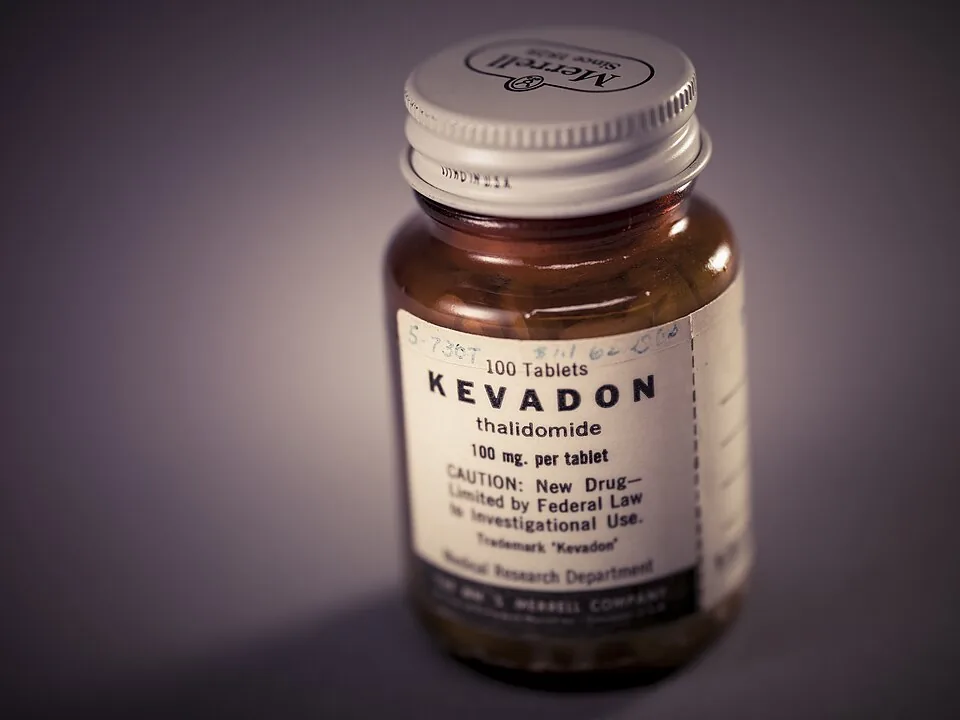
The United States government has spent six decades telling thalidomide survivors they don't exist. The survivors, many of them now in their sixties with deteriorating health and truncated limbs, would like to respectfully disagree. They're asking Congress to formally acknowledge them and pay each one $150,000 — which is the least this country can do, and also apparently too much to ask.
The Drug That Wasn't Supposed to Happen Here
Here is the official American story: A heroic FDA pharmacologist named Dr. Frances Oldham Kelsey blocked thalidomide from hitting U.S. shelves in 1960 and 1961. President Kennedy praised her publicly for sparing the country from the catastrophic birth defects ravaging families in Germany and Britain. America got lucky. Crisis averted.
Except, as NPR reports, that story has a significant hole in it. Thalidomide was already inside the United States. The Cincinnati-based pharmaceutical company William S. Merrell had handed out thousands of unlabeled doses to American doctors before Kelsey ever stopped the formal approval. Those doctors gave it to their patients, including pregnant women, to treat everything from insomnia to morning sickness — without telling the women what they were taking.
According to Jennifer Vanderbes, whose book Wonder Drug covers this history in full, Merrell didn't require doctors to track who got the drug or report back on side effects. No labels. No paper trail. No consent. What many of those women did have, nine months later, were children born with severely shortened limbs, a condition called phocomelia that is thalidomide's calling card.
The Cover-Up That Lasted Generations
John Swann, a retired FDA senior historian, told NPR that when the agency traced Merrell's records, the amount of thalidomide that simply couldn't be accounted for was alarming. The company itself admitted that enormous quantities were unaccounted for. That's not a rounding error. That's a pharmaceutical company losing track of a drug that was, at that very moment, deforming babies.
And then it got worse. Even after the babies were born with truncated limbs, even after the scientific community understood what thalidomide did, the doctors stayed quiet. Vanderbes told NPR that some women were specifically told they had not taken thalidomide. Their children grew up being told the same thing. They couldn't possibly be survivors, doctors said, because everyone knew the United States had dodged the thalidomide disaster.
This is one of the quieter outrages in American medical history: not just that a pharmaceutical company ran a sloppy, undocumented clinical trial on unsuspecting pregnant women, but that the medical establishment then closed ranks and denied it happened. For sixty years. To the faces of the people it happened to.
Seventeen. The Government Says Seventeen.
The FDA formally acknowledges 17 American thalidomide survivors. Seventeen. Vanderbes estimates the real number is closer to a hundred. Swann, who spent his career at the FDA, told NPR it was certainly more than 17, but the documentation is so deliberately incomplete that pinning down an exact figure is nearly impossible. That incompleteness is not an accident of history. It is the direct result of doctors who didn't document, a company that didn't track, and a government that found it more comfortable to celebrate Kelsey's heroism than to account for the damage done in the meantime.
Gwen Riechmann was born with phocomelia in the early 1960s after her mother was given a new sedative to help with pregnancy nausea. Her mother had no idea she was part of an unregulated clinical trial. Riechmann told NPR that she encounters doctors today who flatly tell her thalidomide didn't happen in the United States. "Oh yeah, it did," she said.
What They're Actually Asking For
In 2018, Riechmann co-founded USA Thalidomide Survivors, an advocacy group of roughly 100 people, including allies and survivors. They are pushing Congress to pass a bill that would do two things: officially acknowledge that American thalidomide survivors exist, and pay each survivor $150,000, with the possibility of additional compensation down the road.
Riechmann told NPR that the United States is the only country that has provided no support and no recognition whatsoever. Germany, Britain, and other affected countries have long since acknowledged their survivors and provided compensation. The U.S. has offered a press conference in 1962 and sixty years of institutional silence.
The survivors are aging. Their health is getting worse, which is predictable when you consider that the congenital limb differences caused by thalidomide don't get easier to live with as a body gets older. Riechmann is clear-eyed about the urgency. They can't wait much longer, she said, but they can't give up either. That is a brutal position for the government to have put them in.
The Dingo Take
The United States will spend $150 billion on defense contracts with barely a committee hearing, but cutting checks to roughly a hundred elderly disabled people that the government's own pharmaceutical negligence helped create is apparently a bridge too far. The math here is not complicated. If every single survivor got their $150,000, the total payout would be $15 million. That's a rounding error in a federal budget that measures its waste in the billions. The holdup isn't fiscal. It's just that acknowledging these people means admitting the Kennedy-era triumphalism about dodging the thalidomide bullet was incomplete, and Washington has never been good at admitting things.
Vanderbes calls thalidomide probably the most iconic toxic drug of all time, and she's right, but the iconic version of the story is a European one. The American version is quieter and messier: a pharmaceutical company that ran an undocumented trial on thousands of women, doctors who kept their mouths shut when the babies came out wrong, and an FDA origin myth that required everyone to look away from the collateral damage. The heroes of the story got their medals. The victims got sixty years of being told they don't exist.
These are real people. They are in their sixties now. They have spent their entire lives navigating a world that was not built for bodies like theirs, caused by a drug their mothers were never told they were taking, in a trial nobody was supposed to know about. The bill before Congress asks for recognition and $150,000. If that's too heavy a lift for the country that gave the world the FDA's modern drug approval process, built explicitly on the wreckage of this very scandal, then the word unconscionable needs to be retired because we are clearly not using it correctly.


Comments