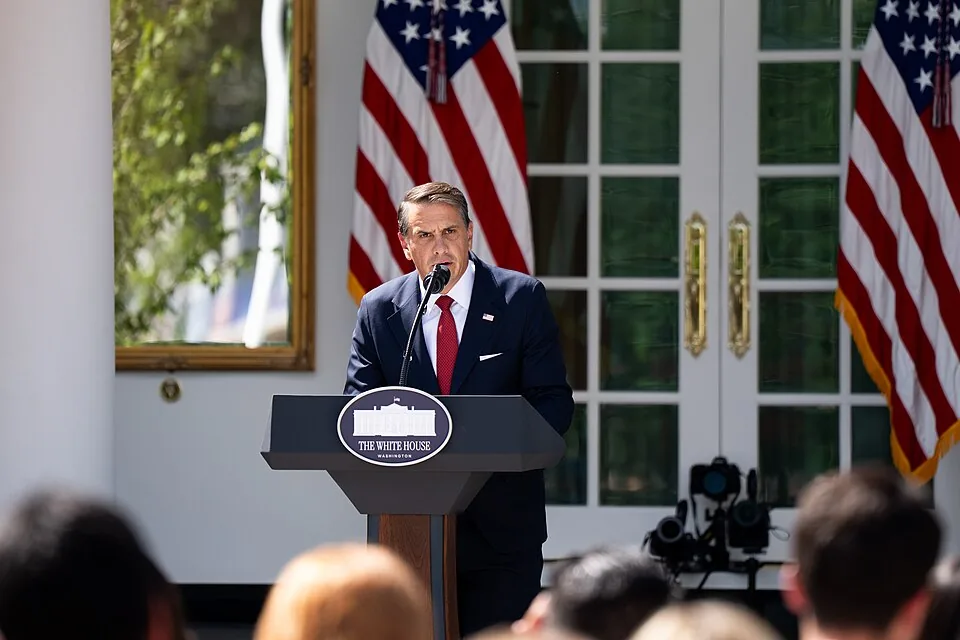
The Attorney General of the United States went on national television Sunday and argued, with a straight face, that the fact CNN's coverage is almost entirely negative toward Donald Trump is proof the network is lying. Not evidence of a pattern. Not a symptom of a problem. Proof. Todd Blanche would like you to accept that criticism and inaccuracy are the same thing, and he'd really appreciate it if you didn't ask any follow-up questions.
What Blanche Actually Said Out Loud
Appearing on ABC's This Week, Blanche defended the White House's decision to ban CNN, MS Now, and Politico from White House access starting September 19th. His argument, boiled down to its essence: the president was "sick and tired" of negative coverage, negative coverage is inaccurate coverage, therefore the ban is justified. That's it. That's the whole legal theory from the top law enforcement officer in the country.
When host Martha Raddatz pressed him to name a single specific report the administration considered inaccurate, Blanche didn't produce one. Instead, according to The Guardian, he replied: "Wait, give you an example of when CNN doesn't report accurately? You cannot be asking me that. There's not even a real dispute that the information coming out of CNN and some of these other networks is wholly and completely, almost 100 percent negative toward the president." He said this as though it answered the question. It did not answer the question.
This is the logical equivalent of a restaurant owner banning a food critic because every review mentions that the food tastes bad. The reviews might be completely accurate. The food might just be bad. These are different things, and the nation's chief law enforcement officer appears genuinely unable to tell them apart.
The 'Privilege, Not a Right' Argument
Blanche's other main line of defense was that White House access is "a privilege and not a right," and that it is therefore the president's prerogative to decide who gets in. He repeated this framing multiple times on ABC, presenting it as though it settles the matter entirely.
What he left out is the minor detail that a federal judge already looked at this argument and was not especially moved by it. US District Judge Timothy Kelly issued a temporary restraining order on Thursday requiring the White House to restore the credentials of the banned journalists for 14 days. The Guardian reports that Kelly wrote in his ruling that there was nothing in the record suggesting the credential revocations were motivated by national security concerns, which was the other excuse Blanche offered on ABC. Kelly pointed out that Trump himself, when announcing the ban, said it was because the outlets "purposely write negative news" to damage Republicans. That's not a national security rationale. That's a man who doesn't like his reviews.
By Saturday, CNN was blocked again anyway, this time from the Air Force One press pool. Blanche told ABC this was perfectly normal and that "the White House routinely decides who can go on Air Force One." What he did not mention, and what The Guardian reports, is that before Trump's second term, the decision about which correspondents covered presidential travel belonged to the White House Correspondents' Association and the broadcast networks themselves. Trump changed that. Calling his own rule change "routine" is a neat trick.
The Press Solidarity Play and What It Bought
Before CNN got blocked from Air Force One on Saturday, it briefly looked like the standoff might be defusing. Other outlets had stood in solidarity with the three banned organizations by temporarily refusing to provide any pool TV feeds of the president. That's a significant move. Pool coverage is the mechanism by which one outlet's cameras become everyone's cameras, so when the networks say they won't play, it creates real logistical headaches for an administration that very much wants its image broadcast.
The solidarity held long enough to get the temporary restraining order and a brief return of credentials. Then came Saturday, and CNN was out of the Air Force One pool again. The Guardian describes this as the continuing dispute "appearing to be resolving" before it visibly wasn't. Two steps forward, one ban backward.
The Numbers Behind the Noise
The Trump administration is picking this fight at a politically inconvenient moment. A recent Reuters/Ipsos poll found Trump's overall approval rating sitting at 32%, an all-time low, with federal midterm elections roughly a month away. Banning news organizations from the White House is the kind of move that tends to generate the sort of coverage that drives approval ratings further south.
Blanche and the White House are likely betting on a different number. A 2025 Gallup survey found only 28% of Americans express a "great deal" or "fair amount" of trust in newspapers, television, and radio to report the news fully and accurately. If you're looking for a constituency that will cheer the press getting roughed up, that 72% of skeptics is your target market. The base loves it. The courts, so far, do not.
Bill Clinton offered a rare moment of bipartisan clarity at the Clinton Global Initiative 2026 summit, according to The Guardian. "There were lots of times when I wanted to ban the White House press corps," Clinton said. "And there's a reason we have a constitution, because none of us are immune from being pissed off. But I'm glad I never did, and I'm glad I couldn't."
What Blanche Says the First Amendment Means
Raddatz asked Blanche directly what the First Amendment meant to him. His answer deserves to be read carefully. "The law says, what the free press can do is they are free to report whatever they want," Blanche said, per The Guardian. "Of course, they can. But when it comes to the White House, it is the people's house. It is a privilege and not a right to be there."
He also said, and this is the part that should be bolded and laminated, that "it is absolutely the president's duty to make sure that the American people are hearing accurate news." The president's duty. To control what news Americans hear. From the Attorney General. On a Sunday morning show. Out loud.
The Dingo Take
You are supposed to believe that the Attorney General of the United States went on ABC News, refused to name a single inaccurate report, and instead argued that relentlessly negative coverage is itself the proof of dishonesty, and that this represents a serious, good-faith legal position from a serious person. Todd Blanche has a law degree. He has argued cases in federal court. He knows what evidence is. What he did on Sunday was not present evidence. It was perform grievance for an audience of one, with a news anchor forced to sit across from him and pretend this was a normal interview.
The federal judge who issued the restraining order read the actual record and found no national security justification for the ban. The president himself said publicly he banned the outlets because they write negative things about Republicans. The Attorney General went on television and said negative equals inaccurate without blinking. This is not a legal argument. It is the logic of someone who has never received feedback they didn't deserve and has decided feedback itself is the problem.
A president at 32% approval, one month from midterms, is banning news organizations from the White House, getting overruled by a federal judge, and then immediately finding new ways to block the same outlets anyway. The White House is betting that the 72% of Americans who distrust the media will cheer this on and never notice that the administration's definition of 'accurate news' is 'news that makes Trump look good.' Some bets pay off. This one is going to be litigated in federal court while the midterm clock ticks down, which is exactly the kind of outcome you get when the nation's top lawyer confuses criticism with lying.


Comments