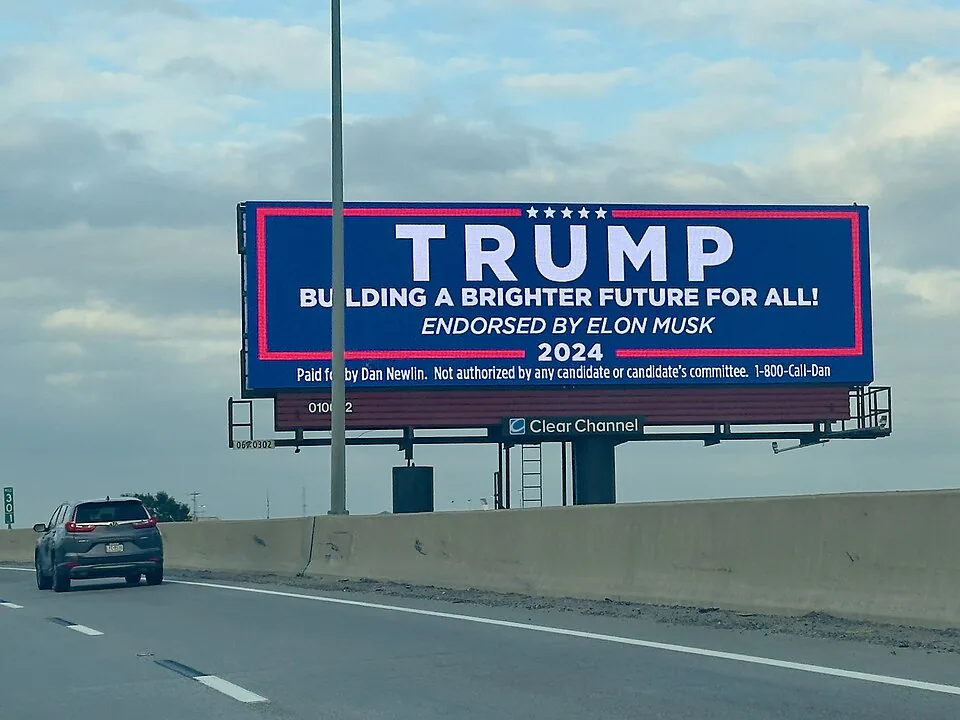
The Trump White House is spending your tax dollars to broadcast Donald Trump's 2023 campaign ads on national television, weeks before the midterm elections. One of the ads was literally shown at the Republican National Convention and identified as material provided by the Republican National Committee. They are now calling it a public service announcement.
What Is Actually Happening Here
Let's be precise about this, because the details matter. According to The Guardian, the Trump administration has been paying to air multiple pro-Trump ads across major broadcast and cable networks. One 30-second spot features a highlight reel of Trump's second presidency, on-screen text pushing his political agenda, and a suggestion that Democrats are communists. It ends with the words 'Paid for by the US Government.'
The second ad is even more brazen. It shows Trump in moody black-and-white, staring into the camera while an audio clip plays from a campaign speech he gave dozens of times in 2023 and 2024. 'We will demolish the deep state,' Trump says in the ad. 'We will expel the warmongers from our government.' According to The Guardian, this exact ad was posted on his Truth Social account in 2023 and 2024 with a direct plea for campaign donations. It was shown on giant screens at the 2024 Republican National Convention. When C-SPAN broadcast it during the convention, it was identified as material provided by the Republican National Committee.
That ad aired this past Saturday during a college football game on Fox, and again on Fox News Sunday, according to Medium Buying, a company that tracks airtime purchases for Republican candidates. The White House bought that airtime. With your money.
The Senator Who Noticed and Then Did Absolutely Nothing
Enter John Kennedy, Republican senator from Louisiana, a man with law degrees from both the University of Virginia and Oxford, who went on CBS Face the Nation on Sunday and said, out loud, that this spending is 'probably' illegal, and then went straight home and introduced exactly zero pieces of legislation to stop it.
Kennedy called out Kristi Noem earlier this year for spending $220 million in government funds on ads starring herself, describing it as 'masterclass dumb.' CBS host Margaret Brennan reminded him of this, and then asked him to weigh in on the Trump ads. To his credit, Kennedy didn't pretend not to see the problem. 'I don't think any public official, including President Trump or Kristi Noem or John Kennedy, should spend public money on private ads for themselves,' he said.
Then came the lawyer brain. 'There ought to be a rule that you can't,' Kennedy said, before catching himself. 'Well, there probably is a rule. You can't spend public money to promote yourself.' A sitting senator, on national television, talking himself into acknowledging that a sitting president is probably breaking the law, and treating that as a mildly interesting observation rather than something requiring any kind of action. Kennedy also said, almost as an afterthought, that he opposes Trump putting his own name on federal buildings. Brennan told him she'd watch to see if he introduces legislation. Everybody in that studio knew she'd be waiting a long time.
The Hatch Act Has a Word for This
The law Kennedy was dancing around is the Hatch Act, which bars government employees from engaging in partisan political activity. Democratic congressman Jamie Raskin, who is also a constitutional law scholar, has already argued, as The Guardian reports, that any government employees who worked on the first Trump ad, or used government resources to produce it, may have committed a felony violation of that statute.
This is not a gray area invented by liberal lawyers. The Hatch Act has been federal law since 1939. It exists specifically to prevent the machinery of the executive branch from being turned into a campaign operation. Taking a video that was used to fundraise for a presidential campaign, stamping 'Paid for by the US Government' on it, and buying airtime during football games six weeks before a midterm election is a fairly clean example of what the law was written to prevent.
The White House's position is that these are 'public service announcements.' A public service announcement about what, exactly? About how the communists are losing and Trump is the most resilient person someone has ever met? That is not a public service. That is a campaign ad with the serial numbers filed off and the bill sent to every American taxpayer.
The Midterm Timing Is Not a Coincidence
The November midterm elections are weeks away. The Trump administration is running ads on broadcast television during college football games. These are not subtle facts.
Presidents have used the bully pulpit forever. Nobody is shocked that a president wants to talk to voters. What is different here is the product. This is not a White House communication about a new policy. This is a professionally produced campaign video, built for rallies and donation appeals, with a crowd cheering in the background, running on a government budget. The crowd noise in the ad, The Guardian notes, was recorded at a campaign rally before Trump started a war with Iran that left some of his own supporters feeling betrayed. They did not update the ad. They just bought more airtime.
The Dingo Take
You are supposed to believe this is normal government communication. A 30-second video produced for the 2024 presidential campaign, used to raise money, played at the Republican National Convention, identified at the time as RNC material, is now a public service announcement. The same administration that screams about wasteful government spending took that video, bought airtime during Ohio State vs. Illinois, and billed the American public. If a Democrat did half of this, Republican senators would be holding emergency hearings by Monday morning.
Kennedy's performance on Sunday is its own kind of story. He is a smart man. He knows exactly what the Hatch Act says. He knows that calling something 'probably illegal' and then flying back to Baton Rouge is not a profile in courage. But this is the defining characteristic of the Republican Party in 2026: they will tell you privately, sometimes even publicly, that something is wrong, and then they will do nothing, because doing something costs more than saying something. It is a very tidy arrangement, if you are not the one paying for the ads.
Raskin is right. If government employees produced or facilitated this material, that is a potential felony, not a talking point. Congress has oversight powers. The Hatch Act has an enforcement mechanism. Someone should use one of them. Instead, we got a senator musing that there 'probably' is a rule against this, and a White House that will have another ad ready for next weekend's games.

Comments