
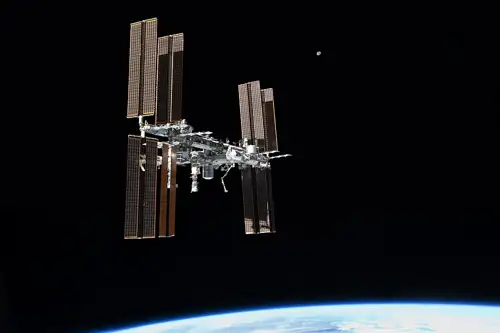
Google just strapped four of its own AI chips to a refrigerator-sized satellite and shot it into orbit, because apparently building data centers on Earth — where land is flat, air is breathable, and gravity works predictably — is no longer ambitious enough. Project Suncatcher, the company's research initiative for solar-powered orbital AI infrastructure, went live on October 1st. The future is weird, and it is circling 400 miles above your head.
What Google Actually Launched Up There
According to NPR, the satellite carries four Tensor Processing Units, the specialized AI chips Google already uses in its terrestrial data centers. Due to heat management constraints, those chips will run a version of Google's Gemma AI model for 15 minutes at a time, answering simple queries while Google monitors how the hardware holds up against radiation and the thermal extremes of space.
The satellite rides in a sun-synchronous orbit, which means its solar panels are almost never in the shade. No shade, no batteries needed, no backup power systems eating up precious weight. A SpaceX rocket carried it up, aerospace company Planet Labs is handling operations, and Google says the mission should stay active for roughly a year.
Next year, Google plans to launch two more satellites to test whether they can talk to each other via laser. Eventually, the company envisions clusters of satellites forming full orbital data centers, each one carrying dozens of TPU chips and beaming data between themselves and Earth through laser communication. That is the actual plan. That is a real sentence about the real plan.
Why Anyone Would Do This
Here is the thing that puts this in context. At Google's developer summit in May, CEO Sundar Pichai said demand for AI services now outpaces supply, and he projected capital expenditures for the year at $180 billion to $190 billion — more than six times the company's infrastructure spending in 2022. Six times. In four years.
That trajectory runs directly into a wall. Data centers eat power at a scale that is turning entire communities against them. As NPR reports, opposition to new data center construction on Earth is growing, and Google is one of a small group of companies quietly concluding that the path forward might be to leave the planet entirely.
Travis Beals, senior director of Project Suncatcher, put it plainly to NPR: 'The sun puts out almost all of the power in our solar system. All of the other power sources that humanity has tapped into are just a tiny fraction of a percent.' His pitch is that space is essentially one enormous free power source, and humanity has barely touched it. Hard to argue with the physics.
The Part Where the Experts Pump the Brakes
Brandon Lucia, a professor of electrical and computer engineering at Carnegie Mellon University, told NPR the concept sounds 'very sci-fi' but has research-level proof behind it. Then he immediately listed several reasons it could go sideways.
Heat is the central problem. On Earth, you cool a chip with air or water. In the vacuum of space, there is nothing to carry heat away from the hardware. Google acknowledged this in its own blog post, calling chip cooling 'a crucial research challenge,' and Beals told NPR the radiators are currently one of the heaviest components on the satellite — a serious drawback because heavier things cost more to launch.
Then there is the maintenance problem. When a chip fails in a data center on Earth, a technician walks over and replaces it. When a chip fails in low Earth orbit, you have essentially no good options. Lucia put the difficulty multiplier at somewhere between ten and one hundred times the complexity of a ground-based fix. 'There has to be a big payoff,' he told NPR. That is a very polite way of saying this has to actually work at scale or the economics collapse.
Google Is Not Alone in This Race
Last November, a venture-backed startup called Starcloud launched a spacecraft carrying an Nvidia H100 chip and demonstrated a version of Google's Gemini AI from orbit, according to NPR. This is already happening. Not in a conceptual whitepaper sense — in a 'we launched a chip into space and ran an AI model on it' sense.
Elon Musk's SpaceX has said it expects to start deploying 'orbital AI compute satellites' as early as 2028. Musk himself has called space 'the only way to scale' data centers, which tells you something about the direction this industry thinks it is heading.
The competitive dynamic here is straightforward: whoever figures out the heat problem, the maintenance problem, and the launch cost problem first gets to own the infrastructure layer of AI at planetary scale. That is the prize. A refrigerator in orbit right now is Google's first move at the table.
The Environmental Footnote Nobody Wants to Talk About
To be fair, the environmental pitch for space data centers is real. Solar power is unlimited. There is no local grid to strain, no community water source to overheat, no neighbors to organize against construction permits. On those metrics, orbit wins.
But NPR flags the catch, and it is a good one. The rockets launching these satellites run on carbon-based fuels. And when the satellites eventually deorbit and burn up in the atmosphere, they add their own pollution load on the way down. The clean energy story gets murkier the moment you account for the full lifecycle of putting hardware into space and eventually getting it back.
Nobody in the press release is leading with that part.
The Dingo Take
Ten years ago, 'AI data center' was a phrase used almost exclusively by infrastructure nerds at enterprise tech conferences. Five years ago, it was a growth business. Today, Google is launching satellites because it cannot build data centers on Earth fast enough to meet demand, and even if it could, people keep showing up to fight the permits. The speed of this is genuinely disorienting.
The honest version of this story is that we built AI into the core of the global economy before we had any coherent plan for where to put the machines that run it, and now the answer being seriously proposed by multiple major companies is: space. Orbit. The vacuum of the cosmos. The technical challenges Lucia described are real and substantial — heat dissipation alone could kill this whole vision — but the fact that Google has done the math and concluded the obstacles are worth clearing tells you exactly how trapped they feel by earthbound constraints.
What nobody in any of these announcements is slowing down to ask is whether 'AI demand exceeds supply, so we will spend $190 billion this year and shoot chips into orbit' is a healthy trajectory for anything. Not for the power grid, not for the climate, not for the communities being steamrolled by data center construction on the way to this orbital future. The sun does put out almost all the power in the solar system. It also puts out enough light to read the fine print.



Comments