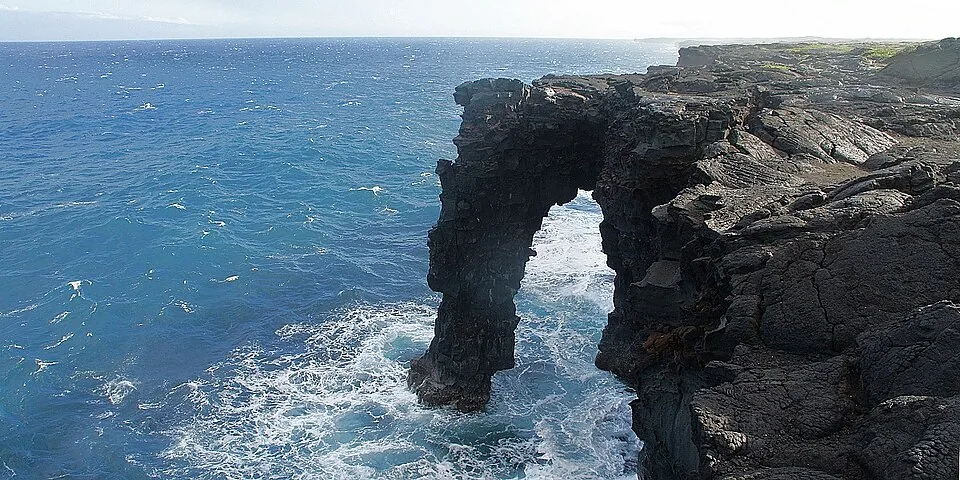
Sometime in the last week of September, a 90-foot arch of volcanic rock that had been standing since before Columbus reached the Americas quietly fell into the Pacific Ocean, and no one was there to see it go. The National Park Service confirmed Thursday that the Hōlei Sea Arch at Hawai'i Volcanoes National Park on the Big Island had collapsed, probably while the park was closed for Tropical Storm Nolo. Google Maps has already updated the listing: "Permanently closed."
Half a Millennium, Then Gone in a Wave
The arch was not some scrappy little coastal rock formation. According to NBC News, it was a 90-foot structure rooted in lava flows roughly 550 years old, slowly carved into its dramatic bow shape by centuries of Pacific surf hammering basalt. The U.S. Geological Survey described it plainly in its entry for the arch: "Every day the ocean crashes against the pillar of the arch, eroding it a little more. One day, it will be gone."
That day was apparently sometime between September 23 and September 28. The National Park Service said in a statement that the exact timing is unknown, but the collapse likely happened while the park was temporarily shuttered during Tropical Storm Nolo, which sent significant swell into that stretch of the Big Island coast. Nobody was watching. Nobody filmed it. It just fell.
This Had Been Coming for a While
The arch's death was not sudden so much as it was a slow-motion inevitability that finally caught up with itself. NBC News reports that the 2018 Kīlauea eruption shook the surrounding cliffs hard enough to cause measurable damage. By early 2020, new cracks had appeared in the feature and the rock around it, and park officials responded by moving the viewing area farther back from the edge.
Then, later in 2020, Tropical Storm Darby broke off a chunk of the lower arch. So the score going into Nolo was: two tropical storms, a major volcanic eruption, and 550 years of relentless surf erosion versus one very tired arch. The arch did not win.
The NPS noted in its statement that the collapse was "a long time coming," which is as close as a federal agency gets to saying "yeah, we saw this one." The structure had been weakening for years. What Nolo provided was the final shove.
People Are Already Trying to Fall Into the Ocean About It
Here is where the story takes its predictable human turn. The arch is gone, but the crumbling cliff it used to anchor is still there, and people are walking up to the edge of it to get a better look at the rubble. The National Park Service, which apparently has to say this out loud, warned visitors this week to keep a safe distance from the coastline.
According to NBC News, the park service specifically flagged social media posts showing sightseers stepping too close to the cliff edge, and issued a statement warning that such behavior puts "themselves and first responders at great risk of falling and drowning off the rough, wave-swept coast." The cliffs, it noted, "drop off vertically into the ocean and present a serious falling hazard."
In fairness, this is the same species that crowds the edge of active lava flows for Instagram content, so none of this is surprising. The arch took 550 years to fall. A tourist in Crocs will apparently attempt the same feat in an afternoon.
What's Actually Left
The NPS said it is mourning the loss of the natural feature, which had been one of the most photographed landmarks in Hawai'i Volcanoes National Park. The park service statement called it "picturesque," which is the kind of word a federal agency uses when it is genuinely sad about something but has to stay professional.
The viewing area for the arch's remains is still accessible, just from a safer distance than some visitors apparently prefer. The cliffs surrounding the collapse site are still actively eroding. The Pacific is still doing what it has always done. There is more coastline to come down, and the USGS's description of how the ocean methodically works through basalt cracks suggests the Big Island's shoreline is not done reshaping itself anytime soon.
The Dingo Take
The Library of Alexandria burned, the Colossus of Rhodes fell into the sea, and now the Hōlei Sea Arch has crumbled into the Pacific while a tropical storm kept the cameras away. These things happen. The ocean does not care about your travel bucket list or your Google Maps pin. What the arch's collapse actually illustrates is something the USGS was kind enough to write down years ago: the process was always going to end this way. The surf finds the weak points in the rock, works them open, and eventually the structure fails. That is not a tragedy. That is geology.
What is a little embarrassing is the immediate human response, which was to walk to the edge of the unstable, vertically-dropping cliff to get a better look at where it used to be. The park service is now spending real staff time and real public money reminding adults that standing on the lip of a crumbling sea cliff is dangerous. This is the world we live in.
The arch stood for roughly five and a half centuries. It outlasted empires, pandemics, and the entire recorded history of European contact with the Hawaiian Islands. It did not outlast the combination of a 2018 eruption, two tropical storms, and the grinding arithmetic of daily wave action. Google has already marked it permanently closed. The Pacific is already working on whatever comes next.



Comments