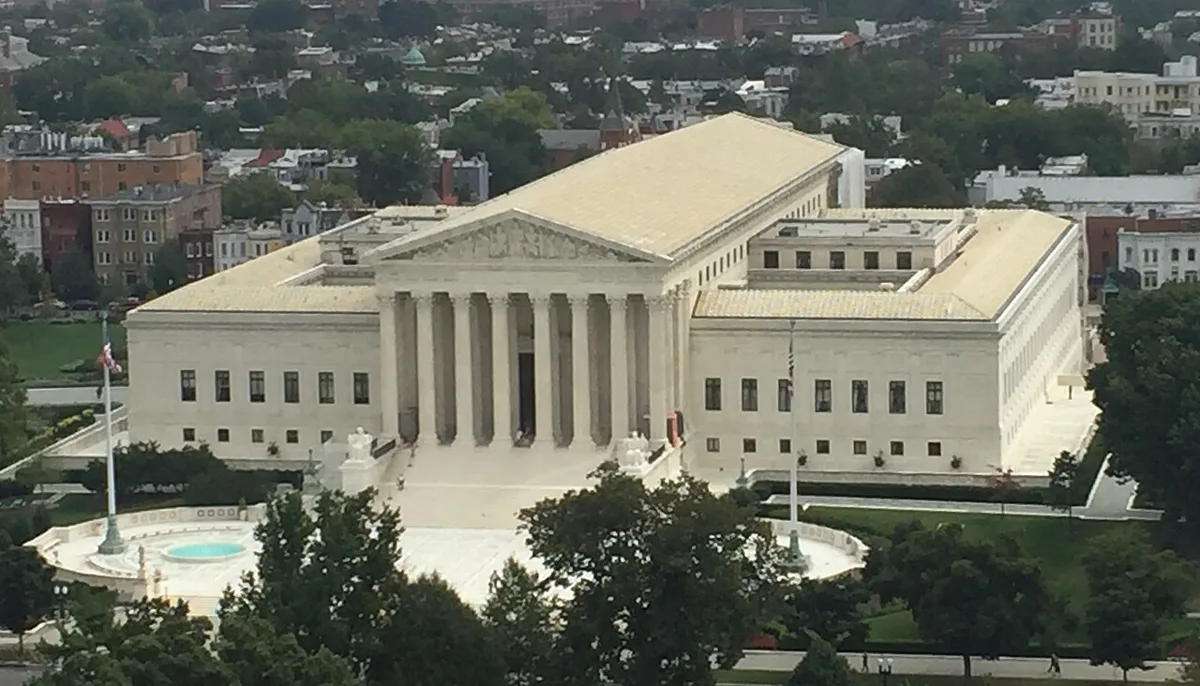
The Supreme Court kicked off its new term Monday by hearing arguments over whether the city of Boulder, Colorado can even be allowed to make its case that Exxon Mobil and Suncor Energy helped cook the planet and should pay for it. The Trump administration showed up to back the oil companies. And Samuel Alito, who personally owns stock in two fossil fuel companies, quietly excused himself without explanation.
What Boulder Is Actually Asking For
According to CBS News, Boulder's lawsuit dates to 2018 and was filed in state court. The city and county argue that Exxon and Suncor's production and allegedly deceptive marketing of fossil fuels led to unchecked greenhouse gas emissions, which in turn caused extreme heat, larger and more frequent wildfires, and serious ecosystem damage across the region.
Boulder raised five claims under Colorado state law. Nothing exotic here. Standard tort logic: you made the mess, you help pay to clean it up. The suit is still in its early stages, and the question before the Supreme Court right now isn't even whether Boulder wins. It's whether Boulder gets to show up.
"This is not a judgment about whether these cases will succeed. It's a judgment about whether folks get to make their case," Jonathan Adler, a law professor at William and Mary who filed a brief supporting Boulder, told CBS News. That's the whole ballgame, at least for now.
The Oil Companies' Argument, and It's a Real One
Exxon and Suncor aren't just stonewalling. They have a legal argument that deserves to be taken seriously before you reject it. According to CBS News, the companies contend that the Constitution and the Clean Air Act preempt any state-law claims over harms caused by interstate greenhouse gas emissions. The Clean Air Act, they say, was never meant to open the door to fifty different states running fifty different climate policies through their local courts.
"It would authorize all fifty States, the tens of thousands of municipalities, and even the hundreds of millions of individuals in our country to ask local courts to establish countless, conflicting climate policies for the Nation," their lawyers argued in Supreme Court filings, as CBS News reports. That's not an insane concern on its face. Regulatory chaos is real.
Twenty-six states, led by West Virginia, filed briefs backing Exxon and Suncor. West Virginia's solicitor general Michael Williams put it plainly to reporters: "It's a national problem, so it requires a national solution." Which would be a compelling point if the federal government had ever gotten around to providing one. It has not.
The Trump Administration Picks Its Side
CBS News reports that the Trump administration weighed in on this case, and surprise, it sided with Exxon and Suncor. The administration's argument is that lawsuits like Boulder's threaten the government's control over foreign affairs, because greenhouse gas emissions come from everywhere on Earth and can't be separated or traced back to individual sources.
"Such lawsuits would create an end-run around the United States' existing diplomatic channels for addressing climate change in favor of innumerable state judicial ones," Exxon and Suncor's lawyers argued, with the administration's blessing. The diplomatic channels argument is particularly rich coming from an administration that has spent years torching every international climate agreement it could reach.
This is the same government that pulled out of the Paris Agreement. Twice. The one currently dismantling the EPA's regulatory authority. Now it wants you to know it's very concerned about protecting orderly diplomatic processes for addressing climate change. Sure.
Alito's Stock Portfolio and the Quiet Exit
Let's talk about Justice Samuel Alito for a moment, because CBS News buried something important. Alito recused himself from Monday's arguments. No reason given publicly. His 2025 financial disclosure shows he holds individual stocks in ConocoPhillips and Phillips 66, two fossil fuel companies. He does not hold individual shares in Exxon or Suncor specifically.
So technically, maybe he's fine. Or maybe a Supreme Court justice who personally profits from the fossil fuel industry decided on his own, with no formal ethics process, to sit this one out. Either way, his absence has real consequences. Eight justices means a 4-4 split is possible, and if that happens, CBS News reports, the Colorado Supreme Court's ruling stands by default, which would be a win for Boulder.
The Supreme Court's voluntary ethics system, where justices largely decide for themselves whether they have a conflict of interest, is doing exactly what critics have always said it would do. Which is almost nothing.
What Happens If Boulder Wins This Round
CBS News is careful to note that a victory for Boulder at the Supreme Court would not mean Boulder wins the case. It would mean the case proceeds in Colorado state court. That's it. Exxon and Suncor would still have every opportunity to beat the underlying claims, and Adler told CBS News the scope of what Boulder can pursue could be narrowed significantly even if the justices let the lawsuit move forward.
But the stakes extend well beyond Boulder. Dozens of similar suits have been filed by states and local governments across the country, all trying to hold fossil fuel producers liable for climate damages in state courts. A ruling that shuts down the procedural door in this case could slam it shut on all of them.
The question of jurisdiction is also live. Boulder's lawyers urged the court to dismiss the appeal entirely on the grounds that the justices don't have the authority to review the Colorado Supreme Court's decision in the first place. If the court agrees, Boulder wins this round without the justices ever touching the bigger questions.
The Dingo Take
The people shoveling ash off their porches after a wildfire season that keeps getting longer, the homeowners watching their flood insurance rates climb, the city workers calculating what it costs to retrofit infrastructure for a climate nobody voted to destroy: they filed this lawsuit. That's who Boulder represents here. Not environmentalists in the abstract. Actual municipal governments that have to balance actual budgets while dealing with actual damage caused, at least in significant part, by companies that knew what they were doing for decades and kept doing it anyway.
The oil companies' legal argument isn't stupid, and a regulatory free-for-all across fifty state court systems is a legitimate concern. But here's what that argument requires you to ignore: the federal solution those companies say is necessary has been systematically blocked, defunded, and dismantled, often with the direct lobbying support of Exxon and Suncor themselves. You don't get to spend thirty years killing the federal regulatory process and then point at the empty chair and say only the federal government can handle this.
Alito sitting on a portfolio that includes fossil fuel stocks and quietly recusing himself without explanation tells you everything about why this court can't be trusted to handle the question fairly. Eight justices, no formal ethics, and a presidential administration that picks energy production over climate accountability every single time. Boulder might get to make its case. Whether it gets a fair hearing is a different question entirely.



Comments