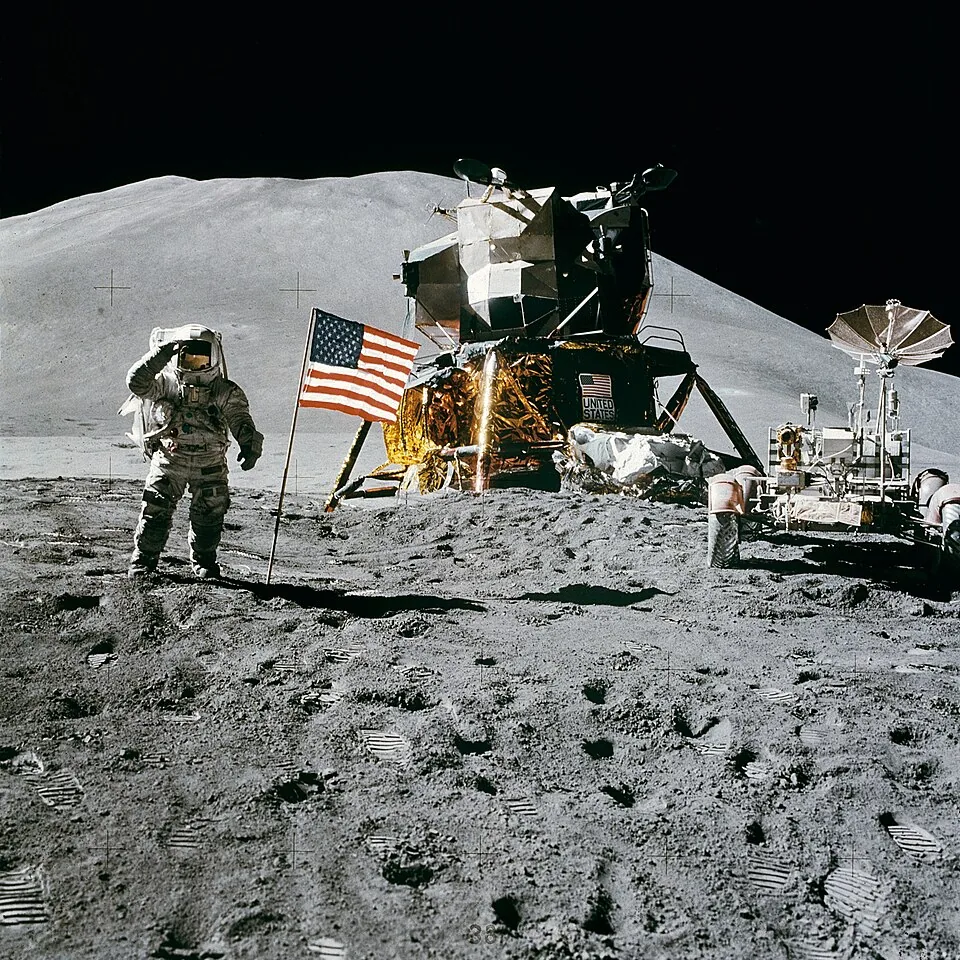
Somewhere right now, an American is standing in a Costco parking lot holding their phone toward the sky, begging for one more bar. Meanwhile, NASA and Nokia's Bell Labs are about to put a cellular network on the Moon, 238,000 miles away. The Moon is about to have better coverage than rural Montana.
Yes, Really, 4G on the Lunar Surface
Here's the setup, according to Good News Network. NASA wants to bring terrestrial 4G to the Moon, partnering with Nokia's Bell Labs to build a simple cellular device out of off-the-shelf components. The pitch is that children of astronauts could someday video call their parents in space.
The gear is set to launch aboard a SpaceX Falcon 9 rocket later this year, though the report says the launch window is undetermined. It will reach the surface aboard a lander built by the US company Intuitive Machines.
Once it's down there, the network will connect the lander by radio equipment to two small rovers sent off in search of water ice. So the first cell network on another world will be serving two little robots with a very specific scavenger hunt.
The $14 Million Question of Who Gets a Signal
Good News Network reports that Bell Labs was handed a $14 million grant back in 2020 to develop the network and its transmitters. That's real money, and it's worth asking what it buys. In this case, it buys a space-qualified piece of cellular equipment that meets tight size, weight, and power limits and can be deployed without a technician.
That last part matters more than it sounds. As Walt Engelund, deputy associate administrator for programs at NASA's Space Technology Mission Directorate, told CNN, the first challenge is building cellular equipment that survives all this and runs without a human standing next to it. Nobody is sending a Verizon guy to the Moon to restart the router.
Every one of us has unplugged a modem and plugged it back in. On the lunar surface, that option does not exist.
Why the Moon Needs Better Comms Than Your Apartment Does
Current missions, including Artemis II, which launched earlier this year per Good News Network, lean on traditional radio telecom systems. They work. They're also not built for what NASA wants next.
The agency wants communications powerful enough to stream high-resolution video and upload huge science datasets. Engelund told CNN the effort could eventually let explorers beam scientific data home, confer with mission control, and talk to their families "as if they were walking down the street on their cellphones."
Picture that for a second. An astronaut on the Moon, crater dust everywhere, doing a FaceTime with a kid who wants help with fractions. It's the most 2026 sentence imaginable, and it's also kind of lovely.
The Real Prize Is Water Ice
Strip away the video-call charm and the actual mission is about resources. The two rovers aren't hunting for ice to settle a scientific debate. According to the report, they're checking whether the water is usable for a lunar base.
Water ice could, through electrolysis, provide breathable oxygen, spacecraft fuel, and drinking water at much lower prices than resupply missions launched from Earth. Hauling water out of Earth's gravity well is brutally expensive. Digging it up locally changes the math on staying there.
The Artemis Program isn't just about returning humans to the Moon, Good News Network notes. It's about investigating whether anyone can stay. That's the real reason a network matters: you don't build infrastructure for a visit. You build it for a move-in.
The Digital Economy Goes Off-World
Because of course it does. Good News Network reports that 4G networks enable the digital economy, and the idea is to extend that network, and therefore that economy, to space. Lunar astronauts or non-astronaut visitors would have the same apps, messaging platforms, and network options they'd have on Earth.
So the Moon gets group chats. It gets whatever app your cousin keeps spamming you about. Humanity finally reached another world and our first move is making sure it has notifications.
Still, there's an upside Bell Labs is pushing. Networks that survive conditions on the Moon should transfer to Earth's own harsh environments, like the Sahara Desert or Antarctica. If that holds, a telecom built for lunar dust could end up serving people in places where the ordinary kind gave up.
What Counts as a Win
The best-case scenario for the test landing, per the report, is that Intuitive Machines' rovers find water ice and send high-resolution video and images of it back to Earth over the Bell Labs network. That would be a world-first.
Note the "at least on paper" hedging in the reporting, and the undetermined launch window. Space is hard. Landers tip over, schedules slip, and plans meet physics. Nothing here is guaranteed, and nobody should pretend otherwise.
But it's a refreshingly sane use of public money: modest hardware, commercial partners, a clear scientific and economic goal, and a payoff that might also help people in the Sahara.
The Dingo Take
In 1876, Alexander Graham Bell spoke into a contraption and asked Watson to come here because he wanted him. The whole thing sounded like a parlor trick. Within a generation, the telephone was strung across the continent and nobody could imagine life without it. A 4G box bolted to a lander is the same trick, just with a bigger commute.
Here's what we like about this story. It's boring in the best way. No billionaire ego project, no mystery contract, no vague promise of a golden age. Just a modest piece of hardware, a $14 million grant from 2020, two rovers looking for water, and a plan that could make staying on the Moon cheaper. That's what government science is supposed to look like when it works.
So go ahead and enjoy the idea of a kid getting a video call from a parent standing on the Moon. We could all use one piece of news this month that doesn't make us want to scream into a pillow. Just don't ask who's paying for the roaming charges.




Comments