
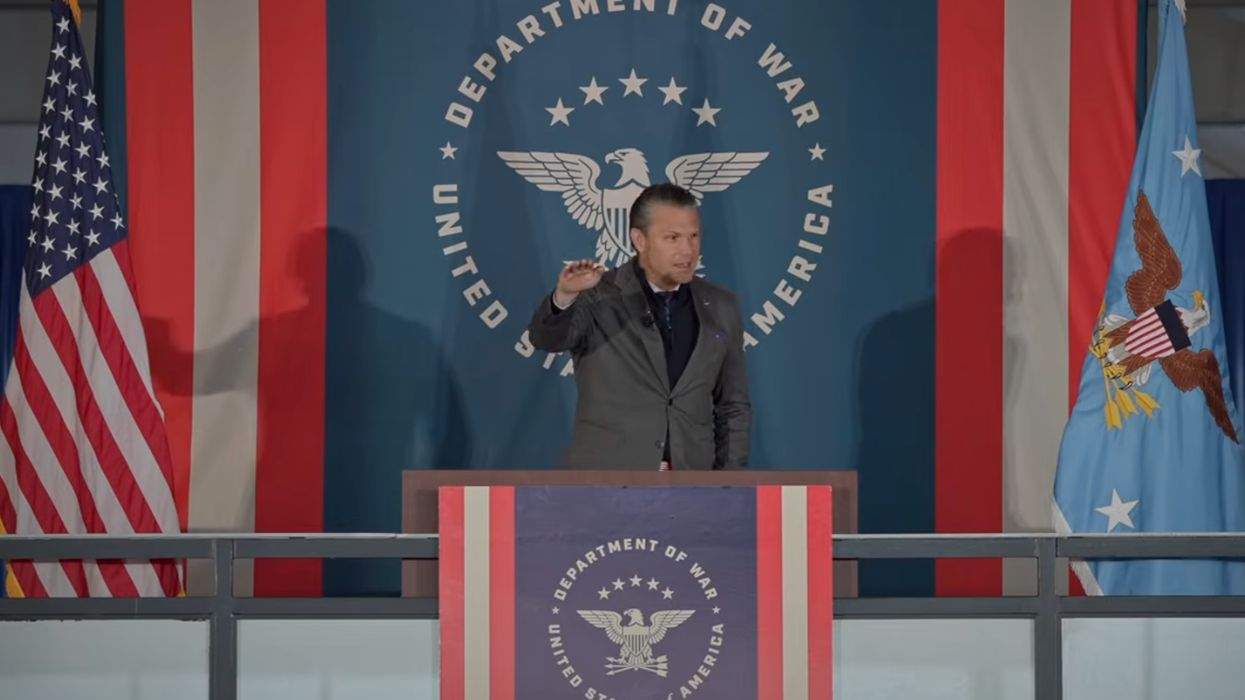
Defense Secretary Pete Hegseth went on Real America's Voice and told the public they will be able to watch the execution of Fort Hood shooter Nidal Hasan by firing squad. The United States hasn't held a public execution in 90 years, and the man in charge of the Pentagon seems to be treating that as a feature rather than a warning label.
The Announcement, As Delivered To The Right Audience
Axios reported that Hegseth made the remarks Thursday when he was asked about Hasan, the Army psychiatrist convicted of killing 13 people in the 2009 shooting at Fort Hood, Texas. Hasan is scheduled to be executed by firing squad on Dec. 3 at Fort Hood. That much is established.
The interview was with Real America's Voice, a friendly outlet where the questions tend to arrive pre-chewed. Hegseth said Hasan is "gonna get a firing squad of sold" and the sentence runs out in the source material, so we'll leave the rest of it where it fell. What isn't in doubt is the headline claim: the public, in some form, will be able to watch.
Notice what's missing. There was no policy memo, no statement from the Army about how any of this works, no explanation of what "watch" means. There was a cabinet secretary on a friendly network making a promise and leaving everyone else to figure out the details.
Ninety Years Is a Long Time To Skip a Step
The last public execution in the United States was in 1936, when a crowd gathered in Owensboro, Kentucky to watch a hanging. It turned into a media circus so tawdry that the country decided, more or less collectively, never to do that again. Executions moved indoors and behind walls, and they stayed there for nine decades.
There were reasons for that. Public executions drew carnival crowds. They turned a solemn act of state power into a spectator sport. Reformers fought to end them because the state killing someone on a stage tends to teach the audience the wrong lessons about violence.
Hegseth's remarks undo all of that in one sentence. And he did it the way this administration does most things, by announcing it first and letting the legal and logistical questions sort themselves out later.
How Exactly Does a Military Base Sell Tickets
Fort Hood is an active Army installation. It is not an arena. It has gates, security perimeters, and a population of soldiers and families who live and work there, including, presumably, people who lived through the 2009 attack.
So what does public viewing look like? A livestream? A pool of reporters? Seats for the general public on a federal military base, in Texas, on Dec. 3? Axios noted that the remarks raise questions about how the military would allow people to watch, and that is putting it politely. Nobody has answered a single one of them.
There are also the practical questions about who gets in, who gets turned away, and who is responsible when a firing squad execution becomes a live-broadcast event with an audience. These are not gotcha questions. They are the questions any competent official would have answered before opening his mouth.
The Victims Are Not Props
Thirteen people died at Fort Hood in 2009. Their families have spent 17 years living with that, and many of them have strong and differing feelings about Hasan and what should happen to him. Some want him dead. Some want the whole thing over and done with quietly. Some may want to be in the room, and some may never want to hear his name again.
A public spectacle serves none of those needs reliably. It serves the person staging it. When a defense secretary describes an execution as something the public gets to watch, on a network built for the base, the audience he's performing for is not the families in Killeen. It's the viewers at home.
Hasan's guilt isn't the issue here. He was convicted. The issue is whether the government's most solemn power gets used as content.
A Pattern You Could Set Your Watch By
Hegseth has spent his tenure at the Pentagon treating the military as a stage for his own brand. The show comes first, the substance gets figured out after, and the cameras are always somewhere nearby. A firing squad on live television is the logical endpoint of that approach.
The man was a cable news host before he was a Cabinet secretary, and it shows. Every decision gets filtered through the same question: how does this play? A public execution plays extremely well with a certain audience. That the military would have to build the whole apparatus around it appears not to have crossed his mind.
The Dingo Take
Ninety years. That's how long the United States has gone without a public execution, and Pete Hegseth ended the streak with a chat on Real America's Voice. No briefing. No plan. Just a promise that the public will get to watch a man die on a military base, delivered by the same guy who used to co-host a morning show.
Here's the thing about state killing. The reason we put it behind walls is that it's supposed to be the grimmest, most sober act a government can commit, one that demands procedure, restraint, and shame. Turning it into programming strips out all three. You can believe Hasan deserves the sentence and still be disgusted that the Pentagon is workshopping the broadcast angle.
The lesson here is simple. When someone wants you to watch a killing, ask what they're selling. In this case, it's Pete Hegseth, and the product is Pete Hegseth.



Comments