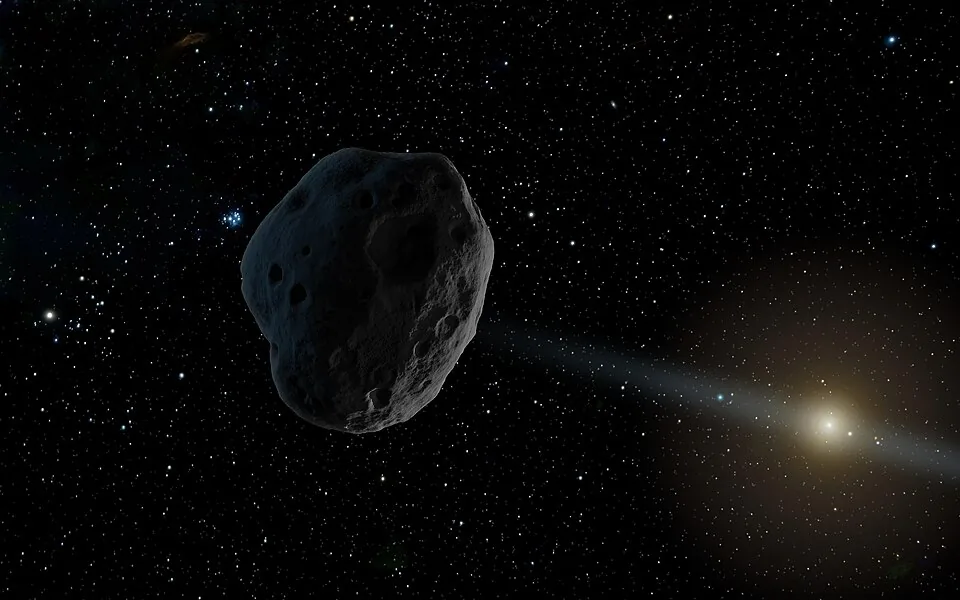
Two asteroids more than 2 kilometres wide are completing a full rotation every 5 minutes, a speed that should have shredded them into gravel eons ago. They did not get shredded. Scientists analysing the first data from the brand new Vera C. Rubin Observatory are now stuck explaining why space rocks are refusing to follow the rules.
The Telescope Has Been Open for Business for Five Minutes
The Vera C. Rubin Observatory in Chile only began its 10-year survey of the sky in June 2026. That's it. That's the whole timeline. And already it has handed astronomers a puzzle that makes a decades-old textbook look like a rough draft, as New Scientist reported.
Dmitrii Vavilov at the University of Washington in Seattle and his colleagues dug into some of the earliest data the observatory collected. From a sample of more than 9000 asteroids, they were able to measure the rotation of 260 of them. They did it by tracking changes in brightness, which happen because asteroids are lumpy and their shapes reflect different amounts of light as they spin.
So the new telescope turned on, looked up, and immediately found something that shouldn't exist. Most of us can't get a new printer to work on the first day.
Sixty-Six Rocks Break the Speed Limit
Of the 260 asteroids with measured spins, 66 were classified as super-fast rotators. These are rocks that finish a full rotation in under 2.2 hours. That number matters because 2.2 hours is roughly the limit past which an asteroid can no longer hold itself together under its own gravity.
The logic is simple. Spin something fast enough and the stuff on the outside wants to fly off. If gravity is the only thing gluing a space rock together, there's a speed where gravity loses. These 66 objects blew past that line and apparently didn't get the memo.
Other fast spinners have been spotted before, so this alone wouldn't be a shock. The shock is what showed up next.
Two Giants Doing a Full Spin Every 5 Minutes
Two asteroids in the main belt between Mars and Jupiter were the real freaks of the sample. Each is larger than 2 kilometres wide. Each completes a full spin once every 5 minutes. Nothing that big has ever been seen rotating that fast.
Think about that for a second. A chunk of rock wider than a lot of city downtowns is whipping around faster than you can microwave leftovers twice. And it's staying in one piece.
Standing on the surface, a person would be moving at more than 100 kilometres per hour, or over 60 miles per hour. That's actually much slower than Earth's equatorial rotation of 1670 km/h. But because these asteroids are so small, Vavilov says it would feel like a rollercoaster, and clinging to the surface would be difficult. So no, you can't just chill up there and enjoy the view.
Not Rubble, Not Even Close
Here's why this is a big deal. The standard picture says that over billions of years, asteroids this size smash into each other and clump back together. That produces rubble piles, which are loose conglomerations of material held together mostly by gravity and wishful thinking.
Rubble piles can't survive a spin like this. They'd fly apart. So the fact that these two are still intact means they're something else entirely. Vavilov says the speeds suggest they're monolithic objects, solid single bodies, at least 30 times stronger than clay.
"On the scale of billions of years, asteroids of this size should hit each other and reaccumulate," Vavilov said. If these two didn't, then somebody's model of the solar system's 4.6-billion-year history of cosmic fender benders is wrong.
Maybe They're Leftovers From the Very Beginning
Vavilov says the implication is that our models of how asteroids smashed together over the history of the solar system aren't correct. One possibility is that these are pristine objects from the early solar system, survivors that dodged the demolition derby that wrecked everything else.
That would make them extraordinarily valuable. A rock that has been sitting there intact since the solar system was young is basically a time capsule, and scientists love a time capsule more than most people love a free lunch.
There's still a loose thread, though. The asteroids might have been spun up by the sun heating their surfaces and giving them torque, a phenomenon known as the YORP effect. But that's uncertain, because these things are very far from the sun. "That's another mystery," Vavilov said. He hopes to study them in more detail in future.
The Dingo Take
Imagine a bridge engineer announced that a span rated to fail in a light breeze had been holding up rush hour traffic for four billion years. Nobody would say, "Well, the old math was probably fine." They'd tear up the math and start over. That's the energy the asteroid people should be bringing right now.
And honestly, that's the part worth savouring. The Rubin Observatory has barely cleared its throat, and it's already telling us that the solar system's history is messier and weirder than the tidy story we've been sold. Science works best when reality walks into the room and flips the table, and this is a pretty spectacular table flip. Two giant rocks, a spin every five minutes, and a shrug from physics.
It's also a reminder that the universe is under no obligation to be as predictable as our models. We spent decades assuming big asteroids are piles of loose junk. Turns out some of them might be pristine relics that have been spinning like cosmic dreidels since before the Earth had oceans. Ten years of this survey are still ahead of us. Buckle up.




Comments