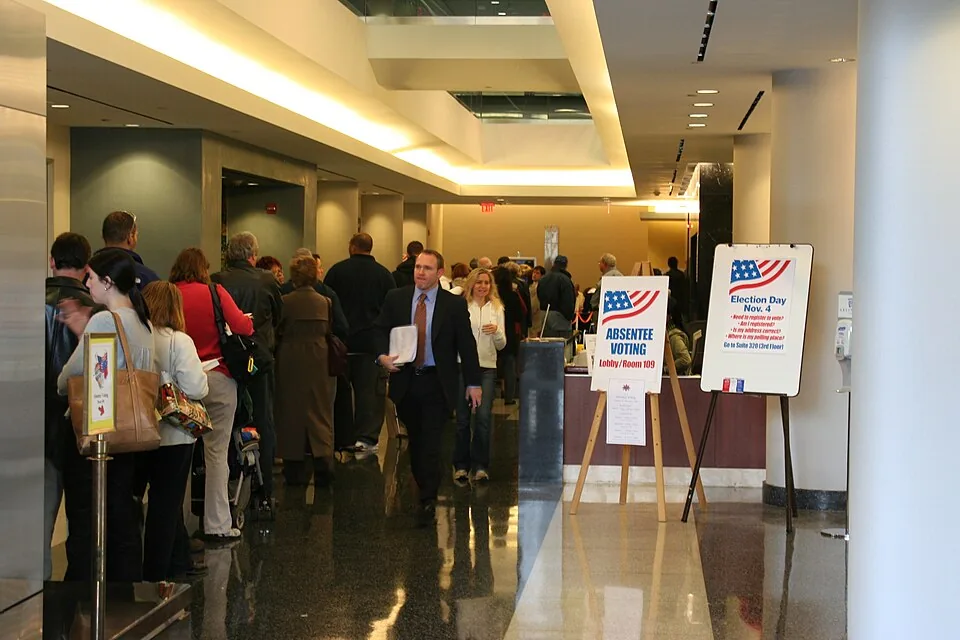
House Republicans are sending "dozens and dozens" of congressional staffers into close-race districts on Nov. 3, and the committee chairman running the show is cheerfully explaining that the point is to build a paper trail for lawsuits. He calls it "election integrity." He also calls it "the most robust program the House has ever done."
The Plan, In Steil's Own Words
Rep. Bryan Steil, the Wisconsin Republican who chairs the Committee on House Administration, laid the whole thing out for Fox News Digital. The committee runs an election watcher program, and this year it is going bigger than ever. Staffers fan out to districts expected to be tight, watch the voting, and in some places watch the counting too.
Steil's pitch is that "a large number of House races are likely to be close" and that "the balance of power in the United States House of Representatives is at stake." Fair enough. Both parties want the majority. Nobody is pretending otherwise.
But notice the logistics he describes. Observers report in real time "directly" to Steil and the committee on Election Day, so "we're in a position to deploy additional resources, if necessary, to make any court challenges if that was required." That is not a neutral observation post. That is a legal strike team with a hotline.
Evidence Gathering Dressed Up as Oversight
The reporting itself is refreshingly blunt about the purpose. The program is aimed at adding oversight in tight districts and, in the outlet's words, "in some cases, paving the way for legal challenges if improprieties are found." It is described as "part of a process to build a case in the event the results need to be re-examined."
Steil says observers are "the first step in identifying if there is a problem, and then they notify our team and we get to work immediately." Read that again. The workflow is: observer spots something, committee lawyers mobilize, court filing follows. All of it staffed by federal employees on the House payroll.
Someone watching a polling place for 12 hours is not inherently sinister. Observers are a normal feature of elections, and the law protects their access. The question is what happens when the observer's job is explicitly to document problems for litigation rather than to confirm that things went fine.
California Is Apparently the Villain Again
Steil singled out California for "poor election policies," because the state lets ballots arrive after polls close and counts them for days. He told the outlet that Florida, which "runs their elections well," will have observer shifts ending early in the evening, while California shifts "go on for days on end until the counting is done."
Here's the thing. Counting every valid ballot is not a malfunction. Slow is not the same as crooked. Allowing mail ballots that were cast on time to arrive afterward is a policy choice that many states make, and a long count is what you get when millions of people actually vote.
Steil described visiting Los Angeles County, about 10 million people counting ballots at one location, and watching ballots arrive "days after the election." He presented this as self-evidently alarming. It reads more like a county doing arithmetic at scale.
The Milwaukee Anecdote Doing a Lot of Work
To justify the program, Steil recalled an incident in Milwaukee where a tabulation issue arose and "ultimately thousands of ballots would have to be recounted." That's the whole anecdote. A problem surfaced, and the ballots were recounted.
Sit with that for a second. By his own telling, the system found an issue and fixed it. That is the process working. It is an odd choice of cautionary tale for a program built on the premise that someone needs to be standing there to catch problems that might otherwise go unaddressed.
None of this means observers are useless. Transparency has real value, and plenty of election officials welcome scrutiny. But an observer program is only as credible as its willingness to report that everything went smoothly when everything went smoothly.
Democrats Can Play Too, Technically
The program operates under the Confirmation of Congressional Observer Access Act, enacted by Congress in 2024, which federally protects observers' access. Any House staffer except interns can participate. Democrats are free to run their own version under the law, but according to the reporting, they do not coordinate with Republicans on it.
So the playing field is formally level. In practice, one side has built a large, organized, centrally directed operation with a litigation pipeline attached, and the other is welcome to show up if it feels like it. Whether Democrats run a comparable effort is a fair question, and one the source material doesn't answer.
The same Fox News package is surrounded by headlines about a Biden-appointed judge blocking voter-fraud probes in battleground states and a DOJ illegal voting crackdown across 17 states. Put the pieces together and you can see the shape of the fall campaign for the courts.
The Dingo Take
"Dozens and dozens." That is how many federal House staffers Republicans are sending out on Nov. 3, according to their own chairman, and every one of them is reporting to a committee that has told us it is ready to file court challenges. Not ready to certify. Ready to sue.
We are not against observers. Sunlight is good. Anyone who wants to watch a count should be able to, and the law says they can. But there is a difference between an observer who tells you whether the process worked and a litigation scout whose success is measured by whether he finds something to fight about. When the program's stated function is to "build a case," you have already decided what a good day looks like, and it isn't a boring one.
So here is what to watch. If a close race breaks the GOP's way, will these staffers write up how smoothly it went? If it breaks the other way, will the lawsuits be ready by Wednesday morning? Steil says the program is about making sure the rules are followed. We will find out soon enough whether that applies to the rules about conceding.


Comments