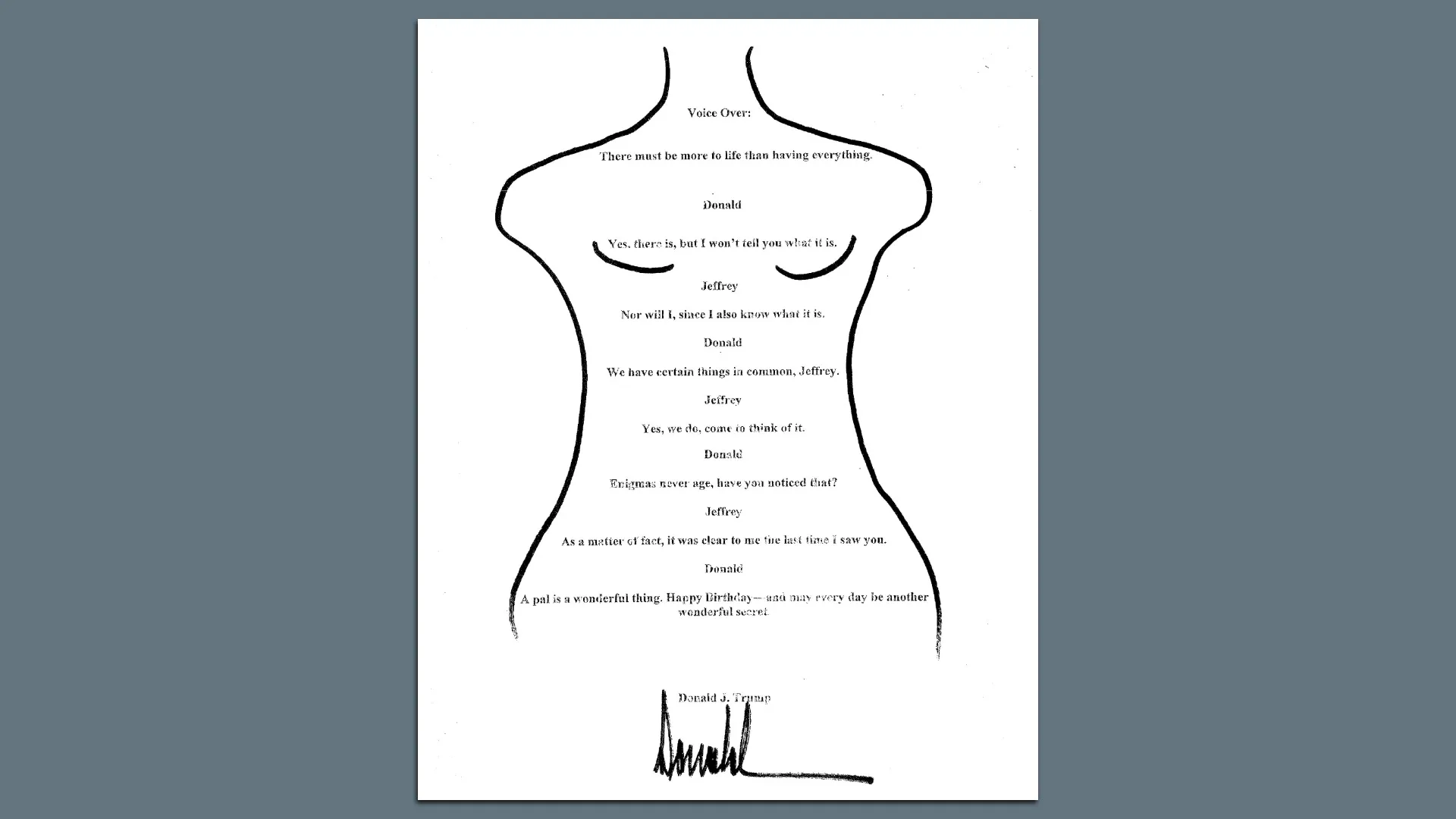
A federal judge in Florida has thrown out, for the second and final time, Donald Trump's $10 billion defamation lawsuit against The Wall Street Journal over its story about a bawdy birthday card allegedly sent to Jeffrey Epstein. The dismissal is with prejudice, which is the legal system's way of saying: stop. The suit has been tossed twice, and the card, meanwhile, is still very much a thing that exists.
Second Swing, Same Whiff
U.S. District Judge Darrin Gayles ruled that Trump's amended complaint suffered from the same fatal flaw as the original, according to NBC News. It failed to clear the brutally high legal bar of "actual malice," the standard public figures must meet to win a defamation case. In plain English, Trump had to plausibly argue that the Journal knew its story was false or recklessly didn't care whether it was.
He couldn't. "As President Trump has not plausibly alleged that each Defendant made defamatory statements with actual malice, the Amended Complaint must be dismissed," Gayles wrote.
Then came the part that stings. "Because this is President Trump's second attempt to allege his claims, the Court finds that dismissal with prejudice is appropriate." No third draft. No reboot. The franchise is cancelled.
The Card At The Center Of This Mess
Quick refresher on what we are all talking about. Last July, the Journal published a story about a birthday book that Ghislaine Maxwell assembled for Epstein's 50th birthday in 2003. Among the entries was what appeared to be a card from Trump, who was friends with Epstein back then.
The card allegedly featured a hand-drawn outline of a naked woman, with what appeared to be Trump's first name signed in the pubic area. It also carried a typewritten note depicting an imaginary conversation with Epstein, who would later be charged with sex trafficking.
This is the document Trump decided was worth a $10 billion lawsuit. Not a financial scandal. Not a policy disaster. A birthday card. Picking this particular hill to litigate on is a choice, and it is a choice that guaranteed the card would be described in loving detail in every news story about the case, including this one.
The Estate Released The Card Anyway
Here's the thing that made the whole lawsuit wobble from the jump. Trump's complaint accused the paper of making the story up and claimed that no such note existed. It criticized the Journal for not publishing an image of the card in the original piece, arguing that this showed "no authentic letter or drawing exists."
Then Epstein's estate released a copy of a card matching the Journal's description. The House Oversight Committee publicly released it after getting it from the estate. So the argument that no card exists ran headfirst into a card that exists.
Trump and the White House maintain the document is a fake. That is their position, and they are entitled to hold it. But a court does not decide defamation cases on whether the president says something is fake. It asks whether the reporters had reason to think they were publishing a falsehood, and the answer from Judge Gayles, twice now, was that Trump did not plausibly allege they did.
Why The Journal's Reporting Held Up
Trump's suit argued the paper should have known the story was bogus because he said it was. That is not how any of this works. A denial from the subject of a story does not turn the story into knowing fabrication. Every reporter on earth gets denials. If a denial were a legal force field, nobody would ever publish anything about anybody.
The suit also dinged the Journal for failing to interview Maxwell, who is serving 20 years in prison on sex trafficking charges. But the story said Journal reporters wrote her a letter asking for an interview, and it included a comment from her attorney. They tried. That is called reporting.
The paper's lawyers made the obvious point in their motion to dismiss: the article itself showed the Journal investigated, and it told readers that Trump called the letter a fake and denied writing it. Trump's side of the story was in the story. That is the opposite of actual malice. Their lawyers also argued that alleging someone sent another person a birthday card is not inherently defamatory.
A Pattern With Price Tags Attached
Ten billion dollars is a number chosen to make headlines, not to survive a motion to dismiss. It is the legal equivalent of a toddler announcing he will have a thousand ice creams. The figure was never a damages calculation. It was a threat, and a loud one aimed at every newsroom watching.
The legal bar for a public figure suing over press coverage is high on purpose. The Supreme Court set it that way in 1964 so powerful people could not use lawsuits to bury unflattering stories. That protection exists precisely for cases like this one, where a president with a very large legal budget takes aim at a newspaper over a story he does not like.
And it worked as designed. The paper's lawyers did not even need a trial. They needed a motion and a judge who read the complaint twice.
The Dingo Take
A president sued a newspaper for $10 billion over a birthday card, lost, rewrote the complaint, and lost again. That is the whole story. Everything else is commentary.
But the commentary matters, because the lawsuit was never really about winning. A suit like this is meant to scare editors, make lawyers bill hours, and signal to every other reporter that touching the subject will cost you. It did not scare the Journal, and it did not work. The paper stood behind its story, the Epstein estate handed over the card, and a federal judge told Trump no, then told him no with prejudice.
The card is still out there. The denial is still on the record. And the president who wanted $10 billion walked away with a legal defeat and a permanent news hook that guarantees the words "birthday card" and "Epstein" will keep appearing together. If the goal was making this story go away, that is not what winning looks like.


Comments