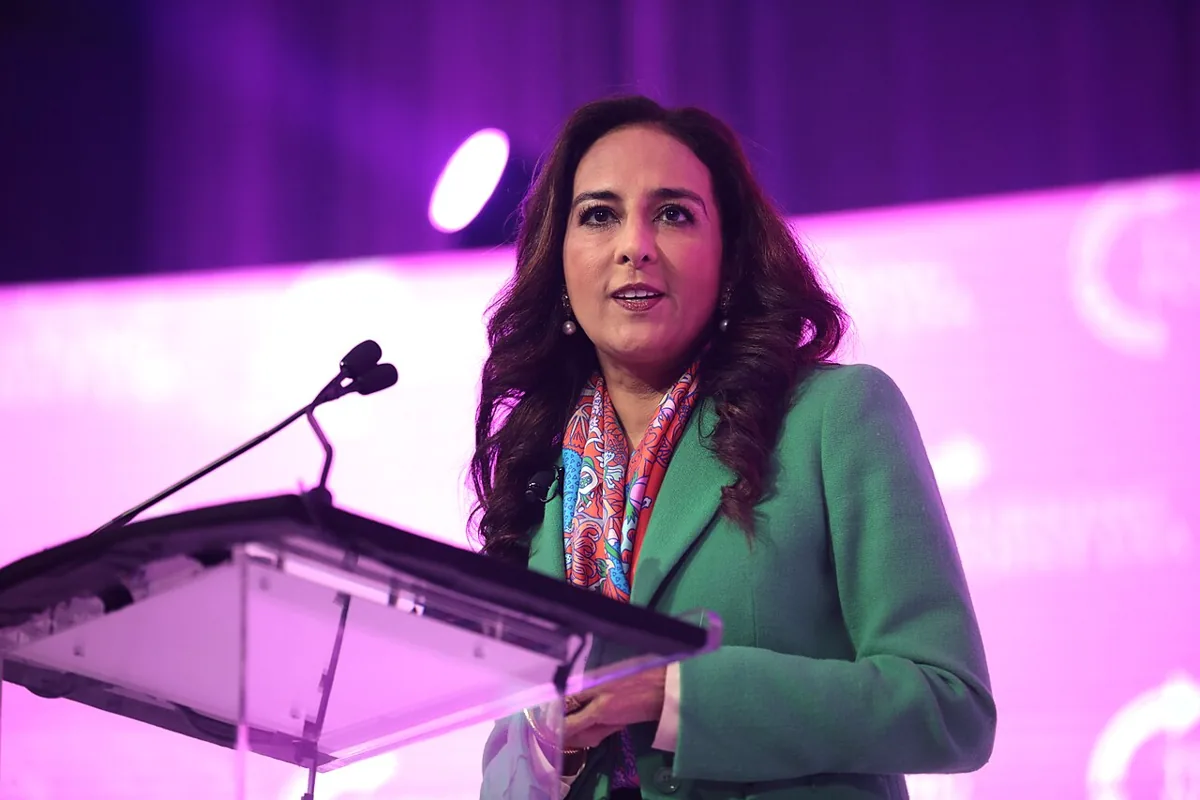
Harmeet Dhillon, the woman who handed out challenge coins stamped "FAFO" while dismantling the Justice Department's Civil Rights Division, resigned Thursday. She did it two days after Democrats took Congress and, in her telling, purely by coincidence. Her boss called her a defender of "the civil liberties of every American," which is a bold thing to say about someone who spent 19 months making sure the civil rights division did less civil rights.
The Timing Is Pure Coincidence, Allegedly
Attorney General Todd Blanche announced the resignation Thursday on X, as reported by Axios, praising Dhillon for enforcing the law "without fear or favor." She is the first senior Justice Department official to leave since Democrats swept the midterms and took control of Congress. That Congress is now expected to start asking aggressive questions about what exactly happened at the department over the past two years.
Dhillon says none of it is connected. She told Fox News Digital that she informed White House chief of staff Susie Wiles three weeks before Election Day that she wanted out, and that Wiles asked her to hold off until after the votes were counted. "I wasn't asked to resign," she said. "My decision, my choice. It's time."
So the official story is that the White House asked its civil rights chief to quietly stay put until the election was over. Make of that what you will. She also said she hasn't discussed a pardon with Trump, has "done nothing" that would require one, and would "take legal counsel" if Congress comes calling with a subpoena. Normal stuff for someone just leaving to pursue private practice.
Congratulations, You Gutted the Place
Here is what Dhillon accomplished in her own words: "We changed it, and that's what we came here to do. And it's done." That much is true.
More than 75 percent of the division's lawyers left on her watch. Fox News puts the departures at roughly 300 attorneys during Trump's second term, and Dhillon says she hired more than 130 replacements. The division that used to be called the crown jewel of the Justice Department spent a year and a half being reorganized around a different set of priorities: gun owners' rights, attacking DEI at universities, transgender participation in women's sports, and opposing civil rights protections for trans people.
Meanwhile, the traditional work fell off a cliff. The department closed many cases involving discrimination against Black Americans and dismissed more than 50 decades-old school desegregation consent decrees, many in the Deep South. She also killed pending consent decrees with the Minneapolis and Louisville police departments, the ones that came out of the killings of George Floyd and Breonna Taylor, and rescinded misconduct findings against six other police departments.
Thirty-One Lawsuits, Twenty-Seven Losses
If there is one stat that defines the Dhillon era, it is this one. The Civil Rights Division sued 31 jurisdictions, mostly blue states and the District of Columbia, demanding unredacted voter rolls. The Justice Department has lost 27 of those cases so far. According to the Guardian, it lost every one of the first two dozen, and several of the judges who ruled against the department were appointed by Trump himself.
The stated reason was making sure states keep clean voter lists. Then division lawyers admitted in court that the real plan was to hand the data to the Department of Homeland Security for criminal and immigration enforcement. That is a fairly significant detail to leave out of the original pitch.
On Election Day, the division fielded more than 1,000 monitors to polling sites, a record. It got there by recruiting volunteers from the Bureau of Prisons and the Bureau of Alcohol, Tobacco, Firearms and Explosives. Because nothing says "protecting the right to vote" like a deputized corrections officer at your polling place.
Two Dead Americans and No Criminal Charges
Earlier this year, immigration agents shot and killed two American citizens, Renee Good and Alex Pretti, in Minneapolis while they were protesting the administration's immigration crackdown. Longstanding practice says the Civil Rights Division opens a criminal civil rights investigation into a high-profile shooting by federal officers. Under Dhillon, it did not.
The division only got involved in the Pretti case after the Justice Department took heavy criticism over why Homeland Security Investigations, the investigative arm of the agency whose people did the shooting, was leading the probe into itself. Nobody has been charged in either death. State officials are separately investigating Pretti's killing.
This is the division whose job is to hold government power accountable when it kills people. Under Dhillon, it sat out the first round.
Investigations by Tweet and Findings in Advance
Dhillon ran the division like a verified account. She posted her own videos, announced investigations on X (a break from the department's longstanding practice of not discussing them), and admitted in interviews that she sometimes pulled ideas for civil rights investigations from posts she saw on social media. Career lawyers were reportedly startled. A whistleblower has said that the university investigations were run with a predetermined outcome and that lawyers were told to find a reason to file a lawsuit.
She has also publicly used a slur for people with disabilities, whose civil rights her division is charged with protecting, and called conservative influencers "hoes." Her personal brand, in her own words to the Dartmouth alumni magazine, is that her "superpower is not really caring what people think about me."
Stacey Young, a former division lawyer who now leads the group Justice Connection, called Dhillon "the most destructive, lawless and hateful head of the civil rights division in DoJ history." Dhillon's response to critics, apparently, was a challenge coin that says FAFO.
What Comes Next for the Wreckage
Dhillon is heading back to private practice, having moved to Washington after the deaths of her husband and her father, as she told Fox News Digital. She came from a law firm in San Francisco, a stint as vice-chair of the California GOP, and post-2020 lawsuits contesting the election results. She was nominated in December 2024 and confirmed in April 2025.
What she leaves behind is a division with a fraction of its former staff, a mission turned inside out, and a stack of court losses. And a new Congress with subpoena power and a long reading list. Whoever inherits the job also inherits the question of whether there is anything left to rebuild.
The Dingo Take
She broke it and left. That's the whole review.
The Civil Rights Division spent nearly 70 years enforcing laws that Americans demanded. Dhillon spent 19 months proving how fast a motivated ideologue with an X account can undo that. She lost 27 of 31 voter-roll cases, admitted in court that the real goal was feeding data to immigration enforcement, sat out the investigations into two dead American citizens, and scrapped decrees meant to stop cops from killing people like George Floyd. Then she said "it's done" like she was announcing a kitchen remodel.
She wants you to believe the timing is a coincidence, that she quit three weeks before Election Day and the White House just asked her to hold the announcement. Fine. Maybe so. But the new Congress is going to ask her anyway, under oath, with documents. "I'd take legal counsel" is the kind of thing people say right before they take legal counsel. If you were looking for the first person to find out what FAFO really means, here she is.
Comments