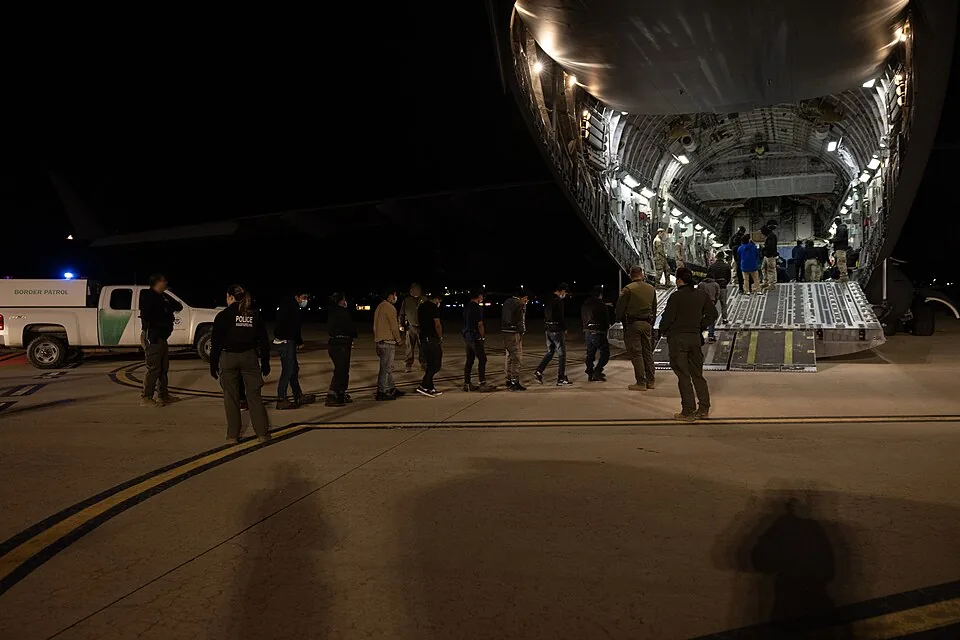
A government lawyer told a federal judge in a sealed hearing that the United States is planning to remove people to Iran, a country the U.S. is currently at war with, according to a transcript made public by Public Citizen. Asked whether that meant sending people back to "at a minimum a serious threat of certain death," the lawyer answered, "Yes, Your Honor," and added that the government is "executing lawful orders of removal."
What the Government Told the Judge
The exchange comes from an October 15 hearing in Iranian American Legal Defense Fund v. Rubio, a case before Judge Ana C. Reyes in the U.S. District Court for the District of Columbia. Part of that hearing was held as a sealed ex parte session, meaning the plaintiffs' lawyers were not present. Public Citizen, the group representing the plaintiff, posted the unsealed transcript on November 5.
Government lawyer Dimitar Georgiev told the judge that she had earlier asked whether any removals to Iran were planned. "The answer in August was no," he said. "Today that answer has changed and it is yes." He said the government was "not authorized to provide details about specific plans" because of "operational security" and "implications to foreign policy and national security."
Reyes put the question plainly: "We are going to remove people in our custody to a country with which we are at war?" Georgiev answered, "That is my understanding, Your Honor."
Through a Third Country, but Still Iran
Georgiev said nothing has been finalized and there is no specific date, but "DHS is working on a plan for that." His understanding, he said, is that the removal would be similar to what happened before, routed through a third country. "It's not a third-country removal, it is still a removal to Iran," he said.
He described the mechanics this way: "the United States will facilitate the travel to the third country, and the government of Iran will facilitate the travel from the third country into Iran." In other words, Washington handles one leg and Tehran helps with the last.
He did not spell out what "previously" meant. Earlier deportation flights to Iran, which emails obtained by the National Iranian American Council showed were arranged with input from the Iranian Embassy, were chartered through Doha, Qatar.
The people in question, Georgiev said, are individuals with final orders of removal. Asked whether they had applied for asylum in the United States, he said he did not know: "I don't have the list of people who would be removed."
"They're Going to Get Killed"
The judge pressed the point. If these are people who applied for asylum here and described how they would be treated back home, she said, "they're going to get killed." Georgiev replied that he understood the concern, but that people subject to final removal orders can be removed, and that DHS is "working on a plan to enforce the law in that setting."
Reyes then laid out her view of the situation. "We are at war with a country, where the president of the United States has said as recently as two or three days ago, if not yesterday, that it is essentially lawless," she said. She noted that the U.S. had killed that country's first and second levels of leadership and that, according to the president, it "murdered tens of thousands of protesters." Then she said what Georgiev was telling her was that the United States "is going to send individuals back to that region facing what you and I and everyone who would ever look at this would know would be at a minimum a serious threat of certain death."
Georgiev's answer: "Yes, Your Honor. It is -- the government is executing lawful orders of removal." Public Citizen reads that "Yes" as an acknowledgment that the people face potential death. In the pages made public, Georgiev does not dispute the judge's description, and his answer turns straight to the legality of the orders.
The Asylum Files Behind the Case
The underlying lawsuit, filed July 7, challenges what the plaintiffs say is a policy dating to March 2025 of giving the Iranian government confidential information from the immigration files of Iranians seeking asylum. Public Citizen says those files belong to people such as pro-democracy protesters, religious minorities, and LGBTQ people. The suit names Secretary of State Marco Rubio, the Department of Homeland Security, and Immigration and Customs Enforcement, and asks the court to stop the sharing and to require notice to the affected asylum seekers. We covered the filing in July.
In the open part of the hearing, plaintiffs' attorney Michael Kirkpatrick said they had filed seven new detainee declarations from four facilities, covering November 2025 through June 2026. In one, a detainee was held by ICE on June 12, and on June 19, Kirkpatrick said, two people from the Iranian Interest Section, including a senior official, came to California, interrogated him, and told him they had his asylum-related information. Reyes asked whether that was while the U.S. was at war with Iran. "That's right," Kirkpatrick said. He added that the senior official later declined to testify, saying he would stand on diplomatic immunity. Those are the plaintiffs' allegations, drawn from declarations they filed with the court.
A Notice Order and a Contempt Warning
Reyes did not wait for a final plan. "I can't just say let me know if there's a final plan," she said, and ordered the government to notify her within 24 hours of a final plan, and at least five days before anyone is put on a plane. "That is an order." If either requirement is violated, she warned, "I will hold every single person associated with violating it -- I will start contempt proceedings."
"We are talking about sending individuals in our care and custody to a country that we have bombed and we may continue bombing, and is a declared enemy of this country," she said. "It is like saying we have individuals in 1942 in this country that we are going to send back to Nazi Germany."
The government's other lawyer, Dhruman Sampat, objected that the court has no jurisdiction here: the people to be removed are not parties to the lawsuit, and a federal immigration provision, section 1252(g), limits court review of how removal orders are carried out. Reyes called the point fair and said she was not sure what her jurisdiction was, since the case concerns a policy on releasing information. She kept the notice requirement anyway, saying she was not going to sit there and "say go on your merry way," and told the government it could ask her to reconsider. The order itself was to be issued ex parte and under seal.
Why It Was Sealed, and What Comes Next
Georgiev said the secrecy was about operational security: if a date or time became known, it "raises the risk to the flights, to the individuals." Reyes agreed that a date should not get out, but pushed on the broader point. She asked what "the national security implication" is "of just being honest with the American public about the fact that this country is going to send individuals back to another country with which we are at war." She later said, "I'm not sure that I see the national security risk, but obviously, I'm not a national security expert anymore than I'm a golf expert," and that "the word national security is not like a get out of jail free card." She also said she would not be shocked if someone moved to unseal the transcript.
Sampat told the court no dates were set yet and that the government wanted to be "absolutely candid." The judge replied, "You know there aren't dates until there are." Back in open court, the government objected that questions about planned removals were irrelevant, because the lawsuit is about whether an information-sharing policy exists.
Kirkpatrick, in Public Citizen's release, called it "shocking that the U.S. is planning removals to Iran while engaged in a war against the country," and said the government's lawyers "have made clear that the Trump administration is knowingly putting people in mortal peril." Public Citizen is the plaintiffs' counsel, so that is their reading of the exchange.
The Dingo Take
The most striking thing in this transcript is not the judge's Nazi Germany comparison. It is how little anyone on the government side argues about the danger.
Judge Reyes put it to the government's lawyer straight: sending these people back means, at a minimum, a serious threat of certain death. The lawyer said "Yes, Your Honor," and then talked about lawful orders. Maybe that "yes" was just confirmation that he had understood the question. Public Citizen reads it as an acknowledgment. Either way, in the pages made public, nobody on the government side says the danger is overstated. The defense is that the paperwork is in order and that the court can't do much about it.
That may even be legally right, since the judge herself called the government's jurisdiction argument fair, including its point that a federal statute limits court review of how removal orders are carried out. But "lawful" and "safe" are different words, and this case began with allegations that the same administration handed asylum files to the government those applicants fled. Put the two together and the question is not complicated: who is on that flight, and does anyone in the chain know what is waiting for them? Whether any of them applied for asylum is something the government's own lawyer, by his own account, could not say.
Until a plan is final, the main thing standing in the way is one judge's notice order, a contempt warning, and a government that promised to be "absolutely candid."





Comments