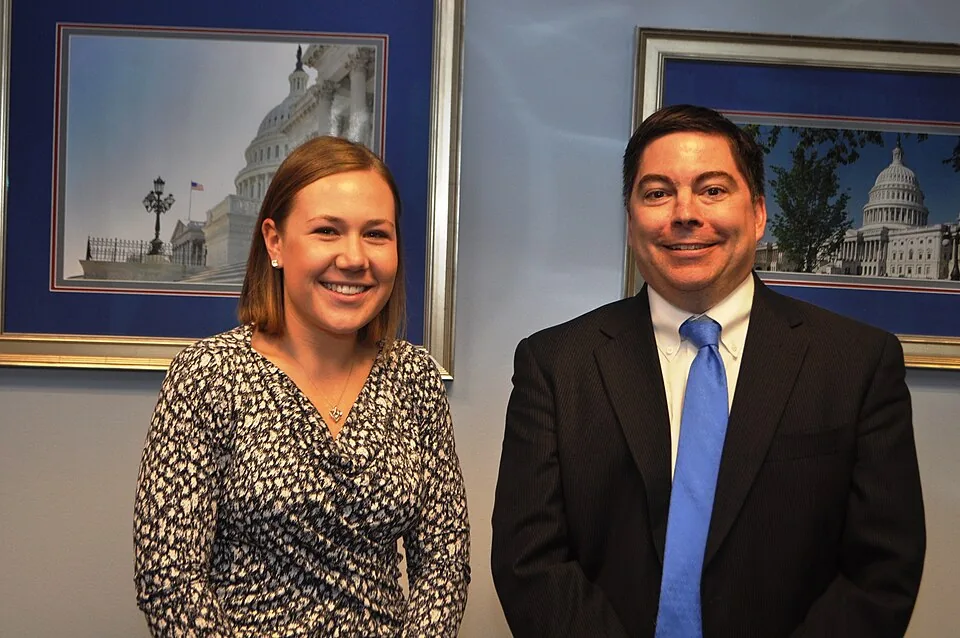
Danielle Thumann is Brendan Carr's senior counsel at the FCC. She told the Senate she has not worked with him on any media-related issues and is not familiar with the details of the agency's fight with ABC. That is a bold claim from someone who works down the hall from the man running the fight.
The Witness Who Saw Nothing
At a contentious Tuesday hearing on Trump's nomination of her to serve as an FCC commissioner, Thumann got asked the question that was always going to define her day. Senator Ben Ray Luján wanted to know if she supports Chairman Carr's campaign to remove Jimmy Kimmel from the nation's airwaves.
Her answer, in full: "I have not worked with the chairman on any media-related issues, and I'm not familiar with all of the details regarding the investigation of ABC or the early license renewal of their licenses." She added that she hasn't been "involved in any of those conversations regarding any of their practices or regarding Jimmy Kimmel."
Pause on that. She is the chairman's senior counsel. She works for the man. And she wants the Senate to believe the biggest, loudest, most litigated fight at her own agency somehow never crossed her desk, her inbox, or a single hallway conversation.
What Exactly She Was Dodging
Here is the background she was so unfamiliar with. In late April, the Carr-led FCC issued a nearly unprecedented order forcing ABC to apply early to renew its local station licenses. The order came right after the president and Melania Trump criticized one of the network's biggest stars, late-night host Jimmy Kimmel.
That timing is the whole story. A president complains about a comedian. Within days, the federal regulator that controls the network's licenses starts squeezing the network. You do not need a law degree to see the shape of it.
And it wasn't the first act. Carr was also accused of pressuring ABC affiliates to drop Kimmel's show the previous fall. So this is a pattern, not a one-off, and the nominee wants credit for having missed all of it.
Markey Does Not Let Her Hide
Senator Ed Markey went straight at the constitutional core of it. "Does the FCC have the authority to punish a broadcaster because the president disagrees with its news coverage?" he asked. When Thumann gave him a non-answer, he pushed back, calling it a "straightforward constitutional limitation."
The FCC cannot punish a broadcaster because the president doesn't like the coverage. Markey noted that her boss, Chairman Carr, "has threatened to do exactly that." Then he accused her of choosing to "evade" his questions and said that anyone seeking an FCC seat "must be willing to stand up to such threats and to defend the first amendment, and you are not willing to do so here in your confirmation hearing."
That is not a hard question. It is the question. If a nominee to the speech regulator can't say out loud that the government shouldn't punish speech, what exactly is she being nominated to do?
The One Thing She Would Admit
To be fair, Thumann did say something sensible when Senator Tammy Duckworth cornered her. She acknowledged that "editorial decision-making is protected by the first amendment for broadcasters." She also said: "I don't think that a decision [about a station's license] should be based purely on someone's discontent with the content that's being aired."
Good. Correct. Now apply it. Luján asked her to name a single issue where she has disagreed with Carr. She demurred. He asked whether it was appropriate for the FCC to call up Disney's broadcast license for early renewal. No straight answer there either.
A principle you will state in the abstract but refuse to apply to the one live example sitting in front of you is not a principle. It is a hall pass.
A Commission With Its Thumb on the Scale
Several Democrats also argued the hearing itself was inappropriate. Their point was that if Republicans are going to nominate another Republican, they should follow past precedent and pair the pick with a Democrat. The FCC currently has one commissioner nominated by a Democratic president, Anna M Gomez, and her term has already technically expired.
So the math is simple. Republicans control the Senate and the House, and Thumann is expected to be approved. The commission gets one more loyalist, and the lone Democrat is working on borrowed time.
That is how you build an agency that never has to hear the word no from the inside.
Luján Puts Carr on the Calendar
Luján closed the hearing by talking directly to Carr. "Mr Carr, if you're listening now, know you're going to be in this body once a month, if not more, and in the House of Representatives as well, answering questions, and you don't have the protection of the gavel any longer."
He was referring to January, when Democrats take charge of the chamber. He also invoked the subpoena authorities that come with the gavel, saying they would be used "so we can get to the bottom of the nonsense and the cover-ups that have been taking place."
That is a promise with a date on it. Whether Democrats follow through is a different matter, and given their record of strongly worded letters, it's fair to wait and see.
The Dingo Take
You are being asked to believe that the senior counsel to the FCC chair has no idea what the FCC chair has been doing to ABC for the better part of a year. Say it slowly. Her job is to advise him, and she wants you to think she missed the biggest media fight in the building.
That is not ignorance. That is a rehearsed answer from someone who knows the truth would cost her the job. Thumann can recite the First Amendment when it costs nothing. The moment someone asked her to apply it to the real, specific, documented case of a president grumbling about a comedian and a regulator suddenly reaching for the license renewal paperwork, she developed amnesia. Convenient. Very convenient.
Here is the part worth holding onto. She will almost certainly be confirmed, and the agency will keep doing what it has been doing. The only real check left is the one Luján described, a Democratic gavel in January and a chairman who has to show up and answer questions under oath-adjacent pressure. Until then, a nominee has just told the country that the speech regulator's own lawyer cannot bring herself to say the speech regulator shouldn't punish speech.


Comments