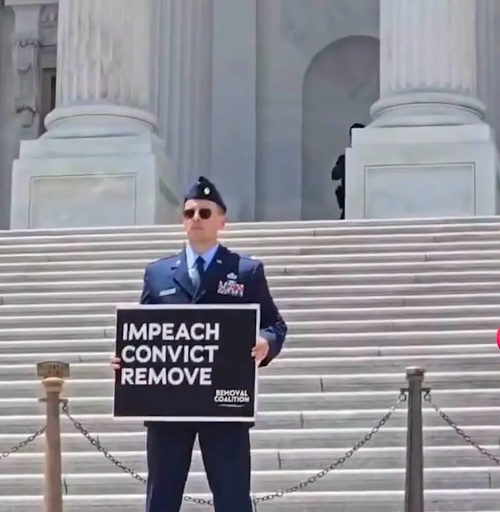
An Air Force major stood on the steps of the U.S. Capitol with a sign that said "Impeach. Convict. Remove." and has now spent months in solitary confinement for it. The Air Force is prosecuting him under a law that bans officers from using "contemptuous words" against the president, a statute so dusty it practically comes with cobwebs.
One Sign, One Arrest, One Very Long Detention
Here are the facts, as laid out by Military.com. Maj. Jason Watson was arrested July 1 on the steps of the Capitol, where he demonstrated in uniform holding that sign after speaking at a news conference calling for President Trump's removal.
Then came the CNN interview. On Aug. 17, Watson repeated his criticism on air. The very next day, Aug. 18, the Air Force ordered him into pretrial confinement. He has been held at a county facility in Maryland on a military hold ever since.
Read that timeline again. Interview on Monday, jail on Tuesday. The Air Force said it was acting on "probable cause to support allegations of continued misconduct." The continued misconduct, as far as anyone can tell, was talking.
Twenty-Four Hours of Alone
Watson's attorney, Christopher Mutimer, told CNN that his client is "still in solitary confinement 24 hours a day." Mutimer added that "even if he gets an hour to eat or to exercise, he's alone."
The Air Force tells a more bureaucratic version. A spokesperson said that under an agreement with the Calvert County Detention Center, Watson, as a pretrial confinee, must be housed separately from post-trial inmates. He also has access to exercise, the library, and personal hygiene items.
Notice what that statement does and doesn't say. Being housed separately from convicted inmates is a rule about who he can't be near. It is not a denial that he's alone all day. The service has not publicly addressed Mutimer's description of the conditions, which is a very loud way of not addressing them.
Article 88, the Law Nobody Remembers Until Now
Prosecutors charged Watson under three articles of the Uniform Code of Military Justice. One of them is Article 88, a rarely used provision that bars officers from using "contemptuous words" against the president.
The Air Force confirmed that the charges have been referred to a general court-martial, the military's most serious level of trial and the rough equivalent of a civilian felony proceeding. One specification, Charge 2, Specification 4, was dismissed. The rest are moving forward.
In September, a hearing officer recommended that most charges proceed to that forum while urging that several others be dismissed. So even the process's own reviewer looked at the pile and said some of it had to go. The pile that remains is still enough to put a major in front of the heaviest tribunal the military has.
The Rule Against Punishing Someone Before Trial
Military law draws a hard line here, at least on paper. Article 13 of the UCMJ prohibits punishing a service member who is awaiting trial. It says confinement may not be "any more rigorous than the circumstances require."
The Air Force insists all requirements of Rule for Court-Martial 305 were met. A neutral and detached pretrial confinement review officer determined that Watson would remain confined pending trial. Watson can ask the military judge to review whether continued confinement is proper.
Courts-martial can award credit against an eventual sentence when a judge finds pretrial confinement crossed into punishment. That's the system's built-in admission that this kind of thing happens. The question is whether a man in solitary for a protest sign is the kind of case the rule was written for. Check the rule's own language and then check the sign.
The Scheller Comparison
Watson's defense wants the case handled at a special court-martial, a less severe forum, and has pointed to Marine Lt. Col. Stuart Scheller. Scheller was court-martialed after publicly criticizing military leaders over the Afghanistan withdrawal, and he pleaded guilty to lesser charges.
There's a meaningful difference worth stating plainly. Scheller went after his own chain of command. Watson went after the commander in chief, and the statute the Air Force reached for exists specifically to protect the president from officers with opinions.
No trial date has been set. Watson sits in pretrial confinement, and the clock runs on him, not on the people who put him there.
What Watson Says It Cost
Watson has framed this as conscience, not partisanship. In a CNN interview recorded before his arrest, he said, "Nothing that is worth doing is something that you can do for free. Everything that is worthwhile is going to cost something."
He added, "So, all that I could do was ask myself, what's the highest price that I'm willing to pay?"
His attorney lays out the bill. Watson is looking at removal from the military, loss of his benefits, and potentially significant time in jail. He knew the price going in. That doesn't make it a fair one.
The Dingo Take
A decorated officer held a cardboard sign, said some mean words about the president on television, and got a cell with nobody in it. The government has called this good order and discipline. Everyone else can call it what it looks like.
Look, military officers don't get to freelance on politics in uniform. That's a real rule with a real purpose, and a protest in full dress on the Capitol steps is the kind of thing a commander can fairly punish. But there is a canyon between discipline and months of solitary confinement before a trial, and the Air Force is standing at the bottom of it insisting the view is great. A law that criminalizes "contemptuous words" about the president should embarrass anyone who has ever claimed to love the First Amendment, the military, or both.
Here's the part that should keep you up. Article 88 spent decades gathering dust because every administration understood that using it looks like exactly what it is. This one dusted it off. When the people in charge reach for a statute that only exists to protect one man's feelings, they are telling you what they're protecting. It isn't the Constitution.

Comments