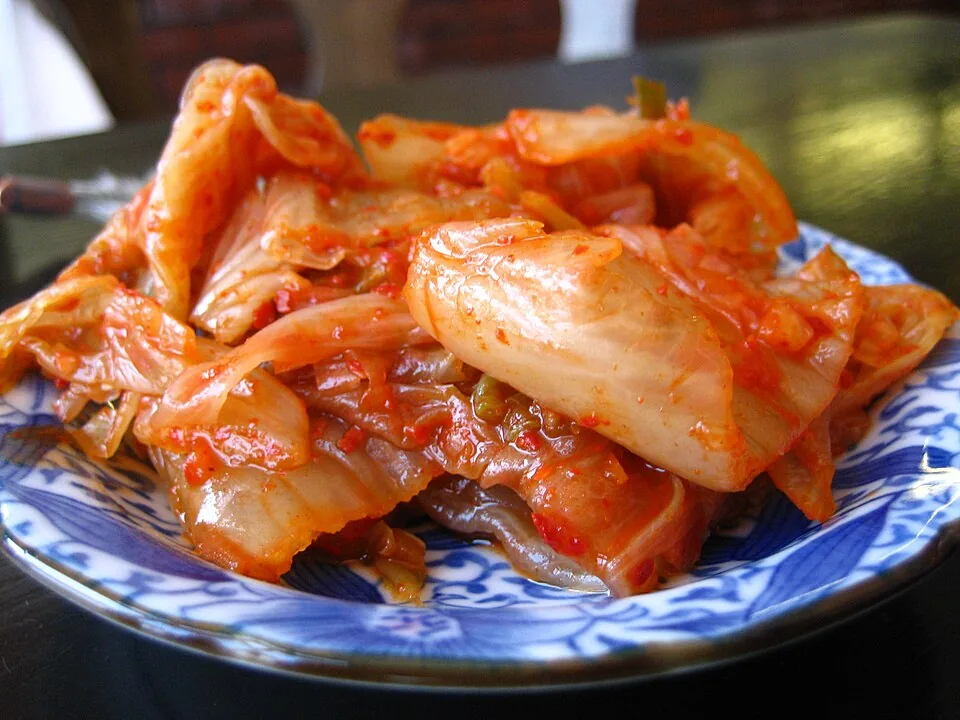
We have filled the oceans, the clouds, and apparently our own intestines with plastic, and the possible fix is a bacterium from kimchi. Scientists in South Korea found a microbe that trapped 87 percent of nanoplastics in water and made germ-free mice poop out more of the stuff. It's a genuinely cool result, and it's also not a reason to start eating kimchi by the bucket.
Explain Like I'm 5 · 44-second video

Narrated and captioned. Made by The Dingo Daily from this article.
The Bug With A Very Long Name
The microbe is called Leuconostoc mesenteroides CBA3656, and its day job is fermenting sugars into lactic acid. Researchers at the World Institute of Kimchi, a government-funded institute in South Korea devoted entirely to the health benefits of salted and fermented vegetables, ran it against tiny polystyrene particles. The findings were reported by ScienceAlert and published earlier this year in the journal Bioresource Technology.
Yes, the World Institute of Kimchi is a real place. Yes, it has a research budget. Somewhere in a lab, a microbiologist is doing important work on cabbage, and frankly, good for them.
The Numbers, Without The Hype
Mixed into plain water with nanoplastics, the bacterium trapped 87 percent of the particles. In a fluid built to mimic the human intestine, it still bound 57 percent. That's the part that makes headline writers sit up straight.
Then the researchers fed the microbe to germ-free mice, and the animals' droppings contained more nanoplastics. The working theory from microbiologists Se Hee Lee and Tae Woong Whon is that nanoplastics stick to the surface of some gut bacteria and ride them out of the body. Hitch a ride on a microbe, exit through the usual door, never get absorbed. It's the world's worst bus tour, and for once that's a good thing.
Why You Shouldn't Cancel Your Grocery Order Yet
Here's the thing. Those mice were germ-free, meaning they were bred to lack certain microbes. Real guts, yours and mine, are crowded, chaotic ecosystems with trillions of residents who may or may not cooperate with a plastic-grabbing newcomer. Nobody knows how those other microbes would change the result.
The lab-dish numbers also do not demonstrate success in a living human gut. The authors say as much themselves, calling for further field-scale and microbiota-integrated studies before anyone gets excited about the human gut. So this is a promising first step. It is not a prescription.
Kimchi Is Not Even The First Fermented Food To Try This
Other fermented foods have been in this race. A 2025 study found two bacterial strains that increased microplastic excretion in mice by 35 percent and cut the plastic left in their intestines by 67 percent. Another study this year found a yogurt bacterium, Lactobacillus delbrueckii subsp. bulgaricus, that did something similar. Mice fed that microbe excreted 12 times as many microplastics and showed fewer signs of intestinal damage.
So the pattern is consistent, which is encouraging. It's also all mice, and mice have been cured of a great many things that stubbornly refuse to be cured in people.
We Don't Even Know If The Plastic Is The Problem
This is the part that gets lost. Microplastics and nanoplastics have been linked to all sorts of health concerns, but there is no reliable evidence that they cause damage or disease in humans. It's not even clear how long they stick around in the body. Most seem to pass right through us.
That means we are developing microbial plastic-flushing tools for a problem whose size we haven't measured. Even if a bacterium boosts plastic excretion, there's no guarantee it improves gut health. Science is working on the cleanup before the crime scene has been fully mapped, which is admittedly better than the alternative of doing nothing.
The Dingo Take
"A new biological approach to address this emerging challenge." That's how Se Hee Lee framed it, and the phrase deserves a second look, because the challenge is that humanity manufactured so much plastic that it now lives inside us and we're asking cabbage microbes to evict it. We built the problem. The kimchi gets the cleanup job.
The science here is legitimately interesting, and the researchers were refreshingly honest about its limits. But watch what happens next. Within a month some wellness influencer will be selling "nano-plastic detox kimchi shots" at forty dollars a bottle, citing a mouse study that involved germ-free rodents and a petri dish. Don't fall for it. A result in water and in mice is a lead, not a cure.
The real fix is boring and obvious: make less plastic, stop dumping it everywhere, and regulate the industries that profit from both. Eat the kimchi because it's delicious. Just don't pretend a fermented cabbage can mop up what we refuse to stop spilling.



Comments