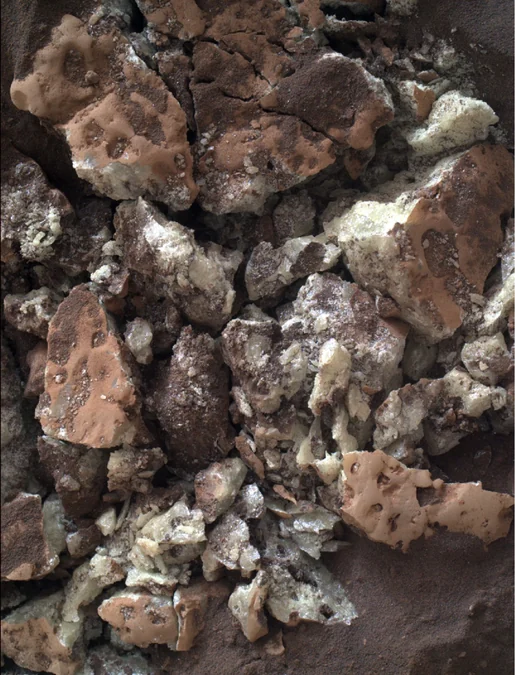
A NASA rover drove over a boring rock on Mars, the rock exploded, and out came crystals of pure elemental sulfur. Brimstone. On the red planet. The kind of thing that, in a less scientific era, would have been taken as a very bad sign.
Now, per ScienceAlert's write-up of two new studies, scientists think they finally have a couple of explanations for how a field of the stuff got there, and neither one involves the devil.
Explain Like I'm 5 · 44-second video

Narrated and captioned. Made by The Dingo Daily from this article.
The Rover Did It By Accident
Here is how one of the stranger Mars discoveries in years happened. In 2024, Curiosity was rolling along through the Gediz Vallis Channel in Gale Crater, minding its own business, when its 899-kilogram body went over a rock that looked like every other rock. The rock gave up and burst open.
Inside was a pale yellow shine that stumped NASA scientists. It looked like crystals of startlingly pure elemental sulfur. Not sulfate, the salty stuff Mars is famous for. Actual brimstone, the first time it had ever been spotted on the planet in that form.
And it wasn't one freak rock. The surrounding ground was littered with more of the same. Curiosity project scientist Ashwin Vasavada of NASA's Jet Propulsion Laboratory put it this way at the time: "Finding a field of stones made of pure sulfur is like finding an oasis in the desert." We would also have accepted "Mars is messing with us."
Why Pure Sulfur Is Weird on Mars
Sulfates are not news. They're salts containing sulfur and oxygen, left behind when mineral-laden water evaporates, and they've been telling scientists about Mars's watery past for a long time.
Pure sulfur is a different animal. On Earth, big deposits usually point to volcanic or hydrothermal activity, meaning serious heat. But there was no evidence of high-temperature conditions at Gediz Vallis that could have cooked up a deposit like this.
So scientists had a field of yellow rocks and no good story for how it got there. There are, to be fair, plenty of things we don't know about Mars's geological history. But scads of pure sulfur just hanging out on the surface suggested something important was missing from the picture.
2,100 Square Meters of Fragile Brimstone
In a paper published in Science in June 2026, a team led by planetary scientist Scott VanBommel of Washington University in St. Louis went back through Curiosity's images and chemical analyses. The initial impression held up. The sulfur lay scattered across roughly 2,100 square meters, and it was remarkably pure, a stark contrast to the usual Martian sulfate minerals.
Then there's the physics. Curiosity weighs far less on Mars thanks to the lower gravity, about what a 341-kilogram object weighs on Earth. The rock popped open under only part of that weight, which means these things are fragile. Brittle rocks don't survive being tumbled around, so the team's most plausible conclusion is that they formed right where they were found.
That also means they sat there, barely altered, for an absurdly long time. The researchers put the formation between 3.1 and 2.8 billion years ago. Geochemist Jeff Berger of NASA's Johnson Space Center, who co-led the study, said it's "hard to wrap your head around how long those rocks had been sitting there with little to no chemical alteration happening to them."
Theory One: Volcanic Gas in Ice Cages
So how do you make fragile sulfur crystals in a place with no heat to speak of? VanBommel's team suggests the sulfur began as gases released by ancient volcanic activity. As those gases cooled, they got trapped beneath the Martian surface, possibly inside cage-like ice structures called clathrates.
Over time, erosion carved out Gediz Vallis and released the pressure on the buried gases, letting them escape. Chemical reactions among the sulfur-bearing gases could then have produced pure sulfur deposits without high temperatures at the site.
In other words, the planet exhaled, and the sulfur is what was left on the carpet.
Theory Two: A Room-Temperature Chemistry Experiment
A separate study in Geophysical Research Letters, published in July 2026, came at it from the lab. Atmospheric scientist Jiawei Wang of Cornell University led a team that mixed dissolved sulfide with chlorate, a chlorine-and-oxygen compound that may have been around on ancient Mars, in acidic water at room temperature.
It worked. The reaction produced tiny yellow crystals of elemental sulfur, no high heat and no living organisms required. The chlorate dose mattered a lot: lower concentrations favored pure sulfur, while higher concentrations produced more sulfate.
To be clear, the lab crystals were microscopic, not the chunks Curiosity ran over. But the team suggests similar reactions running over much longer periods could build larger deposits. They also noted the hydrogen sulfide needed could have come from the same underground gas reservoirs VanBommel's group proposed, so the two ideas aren't rivals so much as possible chapters of one story.
Why Anyone Should Care About Yellow Rocks
Fair question. Sulfur is an essential element for all life. Many organisms take it up as sulfates, using it to build two of the amino acids needed to make proteins.
But we've known about sulfates on Mars for a while, so this find doesn't change anything on that front. And while microbes can make elemental sulfur here on Earth, Wang's experiment shows you can get it with plain chemistry, no biology needed. So nobody is announcing Martian germs.
What the discovery does is expose a gap in how well we understand the planet's ancient chemistry, and give researchers two testable ideas for filling it.
The Dingo Take
A robot weighing about as much as a grand piano drove over a rock, the rock broke, and our understanding of a planet got a little bigger. That is the entire plot. No one planned it, no one budgeted for it, and no one saw it coming.
That's the part worth sitting with. We spend billions on instruments designed to answer specific questions, and sometimes the best answer is a rover's wheel. Curiosity was not looking for brimstone. It found 2,100 square meters of it anyway, and now two research teams have spent months turning one fragile rock into real science.
Meanwhile, back on the planet with the lawn chairs, we keep treating this kind of work as a line item to trim. A rock cracked open on Mars in 2024 and we're still learning from it in 2026. Nobody gets a quarterly earnings bump out of that. It's just the best thing humans do, and it keeps happening by accident.




Comments