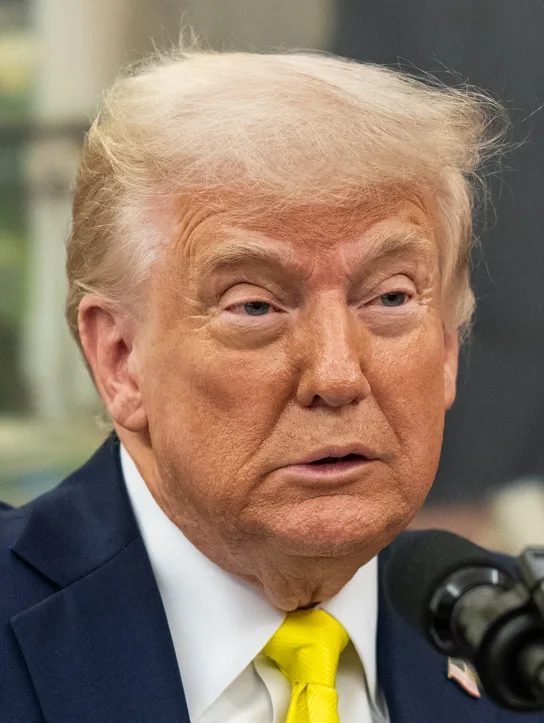
President Trump flew to Shenzhen to sit down with Xi Jinping while the biggest chip-smuggling scandal in years burns behind him, and his takeaway on the suspected Chinese spy at the center of it was this: "any woman coming to the country, that's a beautiful woman that comes from China, they say she's a spy." Meanwhile, two Americans are rotting in Chinese detention, his Treasury and Commerce secretaries are openly feuding, and Xi is about to ask him what he plans to do about Taiwan.
It is a lot. And somehow the spy comment is not even the main event.
Explain Like I'm 5 · 42-second video

Narrated and captioned. Made by The Dingo Daily from this article.
The Spy Who Allegedly Loved Nvidia
Let's start with the part that sounds like a bad airport thriller. Alice Huang is a former executive at Megaspeed, a Singapore-based company the Justice Department has been investigating for diverting advanced semiconductor chips to China. She is also, per CBS News, a suspected Chinese intelligence asset who had an affair with former Nvidia CEO Jensen Huang.
Asked whether he would raise her with Xi, Trump said he might, then immediately threw doubt on the whole spy thing. "I don't know that she is a spy," he said. "Usually, what happens with that is that any woman coming to the country, that's a beautiful woman that comes from China, they say she's a spy. I don't know that she was a spy at all. I mean, I really don't."
The president of the United States, on his way to meet the leader of a country the Justice Department says is siphoning off American chips, reviewed the evidence on a suspected intelligence asset and concluded that the real problem is that people are mean to beautiful women. Sure. Cool. Great.
The Scandal Is Bigger Than the Affair
Here's the thing. The affair is the tabloid hook, and it is also the least important part of this story. Chris McGuire, a senior fellow at the Council on Foreign Relations, said so plainly on a briefing call with reporters Wednesday.
The scandal, he said, has "unfolded into a much bigger, longer-term scandal that involves the question of how many chips did China get, how porous were export controls, and how did the Commerce Department enforce them." He called that a far more important strategic question than anything about Jensen Huang's personal life.
The answer to "how porous" appears to be: very. McGuire pointed to a recent digital forensic study showing that every single advanced Chinese AI model was trained on the most advanced American chips. Chips that are, officially, banned from going to China. So the export controls are a bit like a screen door on a submarine. They probably had some impact, McGuire said, "but not that much."
Bessent Versus Lutnick, Round One
The scandal cracked open a very public fight inside the Cabinet. Treasury Secretary Scott Bessent went on CNBC and accused Commerce Secretary Howard Lutnick of slow-walking restrictions on Megaspeed. Bessent said Trump had made clear that China should not have access to the chips, and suggested Lutnick was the one resisting.
Trump, asked to referee, declined to pick a winner. He said the two men have "two different views," where "one wants to be friendly with China, and one wants to have a blowup with China." He described one side as "you don't want to insult China" and the other as "go, you know, down and dirty and do what you have to do." Then he added that "both can say either is wrong or right."
That is not a policy. That is a man watching two dogs fight over a sandwich and saying he can see both sides. The fact that the Commerce Department is the agency actually responsible for enforcing export controls makes its secretary's alleged reluctance a bigger deal than a personality clash.
The New Rule Nobody at Commerce Wrote
Shortly before Trump left for Asia, the administration announced interim trade rules that restrict Chinese AI companies from remotely accessing advanced U.S. chips. This closes a loophole where Chinese firms rent computing power from data centers abroad rather than buying banned hardware directly.
Look at who wrote it. The Treasury Department and the National Security Council drafted the rule, not Commerce. Commerce issued it, which is a bit like the mailman delivering a letter about his own performance review. McGuire called it "a very significant action that really cuts off a lot of the avenues that China is using to get AI computing power," and said it could "materially widen the lead" between the U.S. and China on AI.
So the rule is real, and it matters. It also arrived only after a scandal and a public Cabinet brawl, which is a hell of a way to run national security policy.
Two Americans, Still Locked Up
Buried under the chip drama is the part that should keep people up at night. Two American scholars are detained in China, and the families say Trump intends to press Xi for their release.
Youlin Chen has been held since November 2024 and faces espionage charges tied to U.S. government-funded research on detecting North Korean nuclear tests. His family says the work relied on publicly available data and was done with Chinese scientists. Min Zin, a naturalized American who fled Myanmar's 1980s democracy movement, was detained June 3 after traveling to Kunming for an academic conference at a Chinese professor's invitation. The State Department formally designated him as wrongfully detained in August.
His wife, Sylvia Zin, says he is in solitary confinement at an undisclosed location with no lawyer, was hospitalized last month for severe dehydration after a stomach illness, and is held in a facility with no heat. He is under a system called Residential Surveillance at a Designated Location, which human rights groups describe as secret detention. His family has not been allowed to see or speak to him. This will be the third time Trump has raised Chen's case and the second for Zin, and neither man is home. In October, the State Department put a "D" wrongful-detention risk indicator back on China's travel advisory, joining Russia, North Korea, Iran and Afghanistan.
Taiwan, Putin, and a $14 Billion Question
Then there's Taiwan. Trump said Xi will raise it: "I won't have to raise it." David Sacks of the Council on Foreign Relations (not the former White House AI czar of the same name) said that tracks, noting that Xi does a check-in on Taiwan every time he sees Trump. A $14 billion arms package for Taiwan is still sitting on the president's desk.
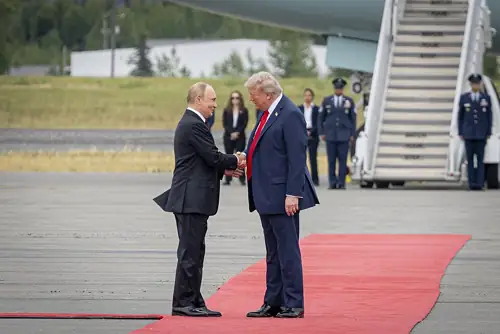
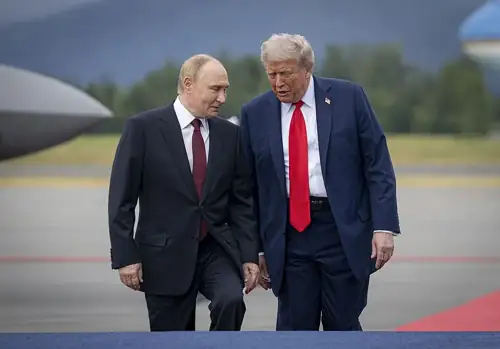
The schedule is also worth a look. This is the third face-to-face between Trump and Xi this year, after the May Beijing trip and the September White House summit. The Shenzhen meeting, on the sidelines of APEC, will be followed by a three-way sit-down with Vladimir Putin. The next stop is the G20 at Trump National Doral in Miami in December, where Xi is expected to attend, though Beijing hasn't confirmed. That means the president is hosting a major rival at his own golf resort while the families of detained Americans hope for a holiday miracle.
The Dingo Take
In 1962, the U.S. and the Soviets managed a hotline because everyone finally understood that miscommunication could end the world. Now Washington and Beijing have agreed to set up a channel to share information when AI "goes off the rails," which is a bit like agreeing to call each other after the building burns down. Alvin Wang Graylin of the Asia Society Policy Institute said it plainly: talking about wayward AI incidents after the fact isn't nearly enough.
That is the whole administration's China strategy in one image. React late, split the Cabinet down the middle, and let the president shrug that both sides "can say either is wrong or right." Chips flowed to China for months. Every top Chinese AI model runs on American silicon that was supposedly banned. The agency in charge of enforcement is accused of dragging its feet, and the fix came from Treasury and the National Security Council after the story blew up.
And through all of it, two Americans sit in cells while the president makes jokes about beautiful women and spies. Min Zin is in a facility with no heat. Youlin Chen has been locked up for a year. Their families are being told Trump will raise it. He has raised it before. They are still there. If the best leverage the United States has is a good relationship and a golf resort in Doral, it is not leverage. It is hope, and hope does not get anyone out of Chinese custody.

Comments