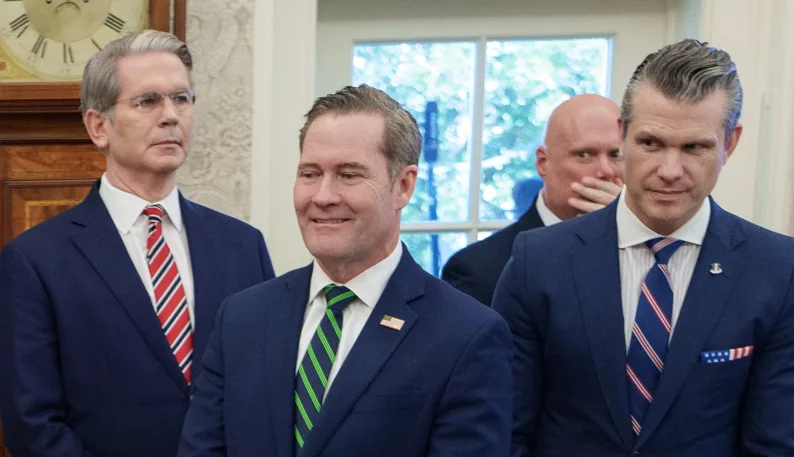
Treasury Secretary Scott Bessent went on national television and told Americans that last week's bank tech failures, which sent customers scrambling to pull out cash, are basically like a flu shot. Your arm may hurt, he said, but you'll be stronger later. Meanwhile, the president of Microsoft sat in another chair on the same show and explained that the world's digital infrastructure is being rebuilt at a speed nobody can safely test, and that we should brace for more.
Explain Like I'm 5 · 41-second video

Narrated and captioned. Made by The Dingo Daily from this article.
The Treasury Secretary Prescribes a Little Pain
According to CBS News' "Face the Nation" transcripts from Nov. 22, host Margaret Brennan asked Bessent whether Americans should worry about their banks after thousands of customers hit tech outages and some started withdrawing cash. His answer was no. Banks, he said, are "by far the most resilient companies in the U.S. economy," and the glitch came from patching their security systems. J.P. Morgan went in to patch, he said, and something hiccuped.
Then came the metaphor. "The American people should think of it as a vaccine," Bessent said. "Your arm may hurt, you may feel a little bad the next day, but it increases your long-term immunity and resiliency."
Look, I get the instinct. Nobody wants a run on the banks, and the Treasury Secretary's job is to say calming things. But comparing a failure that left customers unable to access their accounts to a sore deltoid is a choice. Nobody gets to opt out of this vaccine, and nobody signed a consent form.
Microsoft Admits the Whole Thing Is a Race Nobody Can Afford to Lose
Brad Smith, Microsoft's president and vice chair, was considerably more candid than the man in charge of the nation's money. He apologized for the 24-hour global outage that hobbled corporations and newsrooms around Nov. 12, and said it was not an AI failure and not a cyberattack. It was, in his words, "a perfect storm" of software updated four months earlier that collided with a new update and a shift in network traffic.
But then he got to the part that should keep you up at night. Earlier this year, Smith said, AI made it far easier to find vulnerabilities in code. That set off a global race. Defenders are using these tools to find and patch holes before bad actors can exploit them, and they're doing it at a pace "we have never seen before."
The problem is speed. When you patch that fast on older infrastructure, you can't test the changes as thoroughly, and "you do increase the risk of something going wrong." Smith called the recent outages, at least in substantial part, "AI ripple effects." His forecast: "The whole information infrastructure of the world is in effect being upgraded right now," and we should be "prepared, frankly, for the coming months."
Two Interviews, One Very Different Level of Alarm
Put the two interviews side by side and the contrast is almost funny. Bessent says banks are fine and the pain is a feature. Smith says the pain is coming, it's structural, and the fix is going to take far longer than a couple of weeks.
Smith's advice to ordinary people was refreshingly boring: apply the updates on your phone and laptop. For organizations, he said IT teams have to change how they work together and upgrade legacy systems. He also pointed to a "huge opportunity" for government and the tech sector to work together, naming Jay Clayton as someone focused on advancing that inside the administration, and called for better sharing of threat intelligence.
Notice what that adds up to. The company at the center of one of the biggest outages of the year is asking for more cooperation and more resources, while the Treasury Secretary is telling you the system is the most resilient it has ever been. Both of those things cannot be fully true at once.
Trump Wants to Tax Data Centers Abroad, and Nobody Knows How
During a roughly 90-minute press conference on Friday, President Trump said the U.S. is "not allowing data centers to go into other countries because China will take all of them," and promised "tremendous penalties" on companies that try. Brennan put that to both Bessent and Smith, and the answers were revealing.
Bessent admitted he hadn't talked to the president about it. He was in the room for the press conference, he said, but didn't get a chance to speak to Trump afterward. So the Treasury Secretary, the person who would presumably help design a tax like this, learned about it the same way the rest of us did.
Smith offered the nuance the policy lacks. Microsoft has more than 600 data centers in 34 countries, and most of them don't train frontier AI models. They stream your video, run your video game, and power your business software, and they have to sit near customers. "You can't support Helsinki from New Jersey," he said, "any more than you can keep the lights on in Helsinki from an electricity power plant in New Jersey." Bessent clarified that the target is American companies, and that the administration isn't reversing its push for data centers in Gulf allies like the UAE.
Bessent Blames Democrats for the Market Selloff
Asked why stocks sank this past week, Bessent offered a theory with a convenient villain. The selloff, he said, started as Democrats moved ahead in the polls and accelerated after Election Day, because the Democratic position on the AI buildout "has spooked a lot of investors." He also cited hawkish remarks from the Federal Reserve and a substantial tightening of financial conditions over recent months.
It's a neat story. It's also the Treasury Secretary assigning market jitters to an election his own party just lost, on a week when the market was simultaneously digesting a global tech outage and a president promising to penalize data center construction. Bessent also waved off concerns about Nvidia's circular financing, noting the CFO is now in charge and demand is "near unlimited." Brennan noted that multiple congressional committees and federal prosecutors are probing Nvidia's role in sending advanced chips to China.
Jeffries Lays Out the Democratic Agenda for January
House Minority Leader Hakeem Jeffries, whom Brennan introduced as the incoming Speaker, said Democrats will move early on affordability and accountability. His list: end what he called a "reckless and costly war of choice in Iran" that has driven up gas, food and diesel prices, reverse the Medicaid cuts, restore SNAP benefits, deal with the Trump tariffs, and extend the Affordable Care Act tax credits.
Brennan pressed him on whether any of that can get a Republican president's signature, since much of it undoes his signature tax and spending bill. Jeffries said it "remains to be seen" and pointed to affordability, health care and immigration as three areas where they might work with Trump. He also floated lowering the Medicare eligibility age and expanding coverage to vision, hearing and dental.
On accountability, Brennan cited exit polls showing 89 percent of voters called cost of living a crucial or major factor and 90 percent said the same about corruption. Jeffries said House Democrats will move early to ban members of Congress from trading stock, and that cleaning up Washington means "the Congress, the Supreme Court, and also the administration." Asked about Rahm Emanuel's proposals, including a ban on stock trading in prediction markets and mandatory blind trusts for those worth over $1 million, he said "yes" to an appetite for that kind of reform.
The Dingo Take
Since when did "it's a vaccine" become an acceptable answer for a system failure that scared people into pulling cash out of banks? Bessent's metaphor is cute right up until you remember that a vaccine is tested, scheduled, and administered with your informed consent. Nobody told the customers locked out of their accounts that they'd be getting a booster shot that week.
The man who should be coordinating the response to this didn't know about the president's data center tax until he heard it at a press conference. That's the real story across all three interviews. Microsoft's Smith is describing a fragile, rushed global rebuild and begging for government partnership, while the Treasury Secretary is busy telling you your arm will stop hurting soon. One of these people is describing the problem. The other is describing a vibe.
And then there's Jeffries, who now has about six weeks to decide whether "accountability" means a stock trading ban that hits his own caucus or something that sounds good on a Sunday morning. Voters told pollsters in plain numbers that corruption mattered nearly as much as groceries. They'll notice if the first thing Democrats clean up is somebody else's house.


Comments