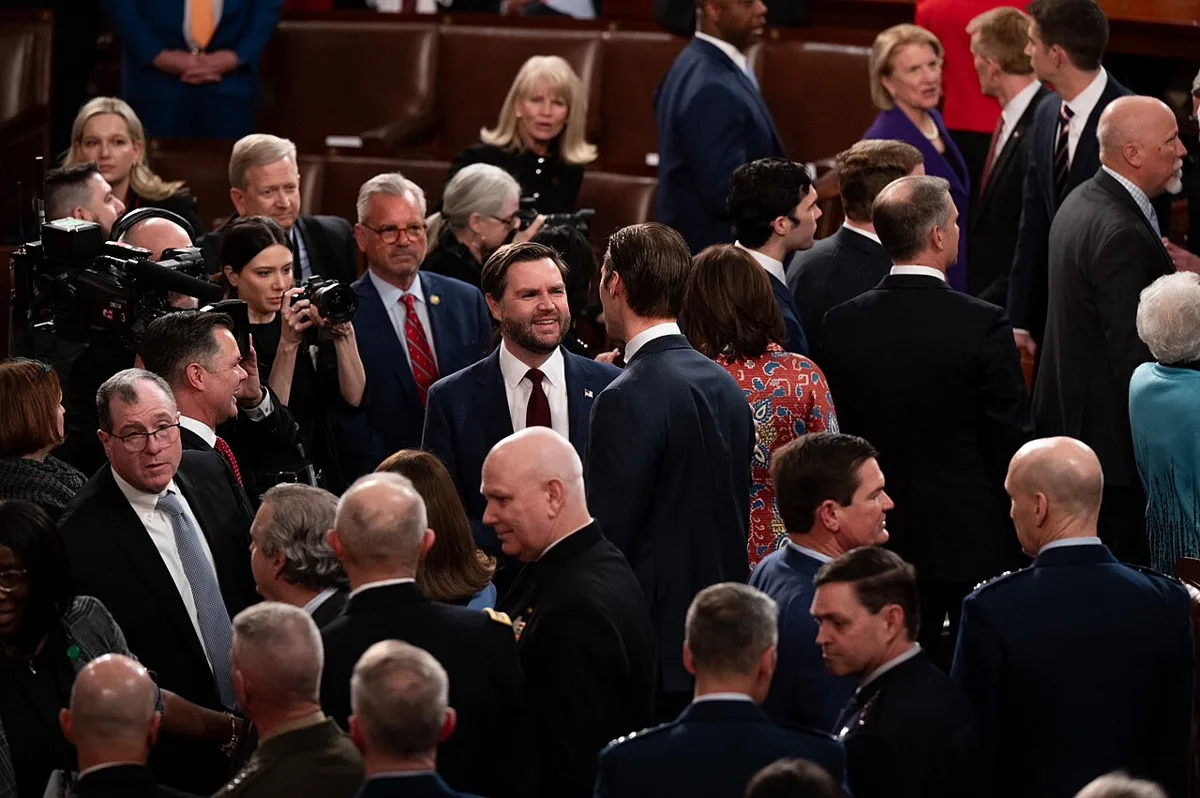
Vice President JD Vance stood in front of reporters at Wright-Patterson Air Force Base after serving Thanksgiving dinner and insisted that Nvidia CEO Jensen Huang does not need a pardon. Nobody had charged Huang with anything. The fact that the question even came up tells you how deep this mess goes: the president pressured a company board to rehire its ousted CEO while holding millions of dollars of that company's stock.
Explain Like I'm 5 · 45-second video

Narrated and captioned. Made by The Dingo Daily from this article.
The Pardon Nobody Asked For, Discussed Anyway
Let's start with the basic absurdity. Vance told reporters Wednesday that he doesn't think Huang needs a presidential pardon because the Justice Department and national security officials assured him Huang isn't under investigation. As CBS News covered it, the vice president was responding to questions about his role in getting Huang reinstated at Nvidia.
Think about that. A pardon is what you discuss when someone has done something. Here we have a sitting vice president volunteering that a tech billionaire doesn't need forgiveness for a crime no one has alleged in public, which of course makes everyone wonder why anyone was discussing forgiveness at all.
President Trump didn't exactly clear things up. In an interview with the New York Post, he said a pardon is "always an option, I guess, but I don't think it'll be necessary." Always an option, I guess. That's the same energy as a guy at a restaurant saying he probably won't need the fire extinguisher.
Who Exactly Told Vance Everything Was Fine?
Here's where it gets slippery. Asked who gave him these assurances, Vance said he spoke with "multiple people in the United States government," including Attorney General Todd Blanche. He didn't name the national security officials. He just said they existed and they were reassuring.
"We were told that he was under no investigation," Vance said, adding that the accusations against Huang were "based on anonymous reporting, not on actual evidence." He also invoked the principle that "we don't try people in the court of public opinion."
That's a lovely sentiment, and one that this administration has applied with the consistency of a weather vane. The same crowd that has spent years trying people in the court of public opinion, on Truth Social, at rallies, and from the Oval Office, suddenly discovered due process when a chip-making CEO needed a hand.
The Board Made the Call, Except Trump Says He Did
Vance insisted that "ultimately, it was the board's decision to bring Jensen Huang back." Technically true. Nvidia's board did vote to reinstate Huang. But the sequence of events matters here.
Trump urged the board to bring him back. Then Trump said, in his own words, that he "convinced" the board to reinstate the ousted CEO. CBS News also reported that Trump and Vance spoke repeatedly with Huang, Nvidia board members and their legal counsel.
So the vice president is out here saying it was the board's decision, while the president is out here taking credit for the board's decision. One of them is wrong, or both are choosing whichever version sounds better in the moment. Either way, a corporate governance matter at a publicly traded company turned into a White House phone tree.
The Stock Thing, Which Is a Whole Thing
Now the part that should make everyone put down the pumpkin pie. Trump owned millions of dollars of Nvidia stock while he pushed for Huang's reinstatement amid tanking stock prices.
Read that sentence again. The president held a financial stake in a company, watched its stock price fall during a leadership crisis, and then personally leaned on the board to restore the CEO. If you wanted to design a conflict of interest in a lab, you would struggle to improve on it.
Maybe the stock wasn't the motivation. Maybe Trump just really believes in Jensen Huang. But we are asked to take that on faith from an administration that has never once given the public a reason to extend any.
Meanwhile, the 2028 Hopefuls Are Eating the Fallout
Axios points out the political stakes extend well beyond one CEO. Vance and Marco Rubio are the Republicans most likely to run to succeed Trump, and the past few weeks have shown how saddled each would be by decisions Trump made against their advice. Trump's unpopularity already cost Republicans their congressional majorities.
The Iran war and now the Huang imbroglio cut to the core of each man's political identity. Vance has cast himself as a new-generation Republican, and being dragged into explaining a pardon nobody needs for a CEO the boss insisted on rehiring is not exactly a brand-building exercise.
That's the trap of running as the heir to a man who won't take advice. Every decision he makes over your objections becomes your problem the moment you try to run on your own terms. You can't distance yourself from the guy who made you vice president, and you can't defend him either without sounding like a hostage reading a statement.
The Dingo Take
"We don't try people in the court of public opinion." That's what Vance said, and he said it with a straight face about a guy whose boss has litigated half of Washington on social media before breakfast. Fine. Let's apply that standard evenly. Let's apply it to every person this administration has publicly smeared, investigated for sport, or threatened to prosecute over a bad news cycle. Something tells me the principle has a very short shelf life.
The real story here isn't Jensen Huang. It's a president who owned millions in a company's stock, leaned on its board to rehire its CEO, and then took a victory lap while his vice president went on a military base to explain that everything was above board because unnamed officials said so. Trust us, we were told. That's the whole defense.
And if you're JD Vance, that's the nightmare. You want to be the future of the party, but the present keeps handing you someone else's mess to explain. Good luck in 2028, champ. You're going to need a lot more Thanksgiving dinners to scrub this one off.

Comments