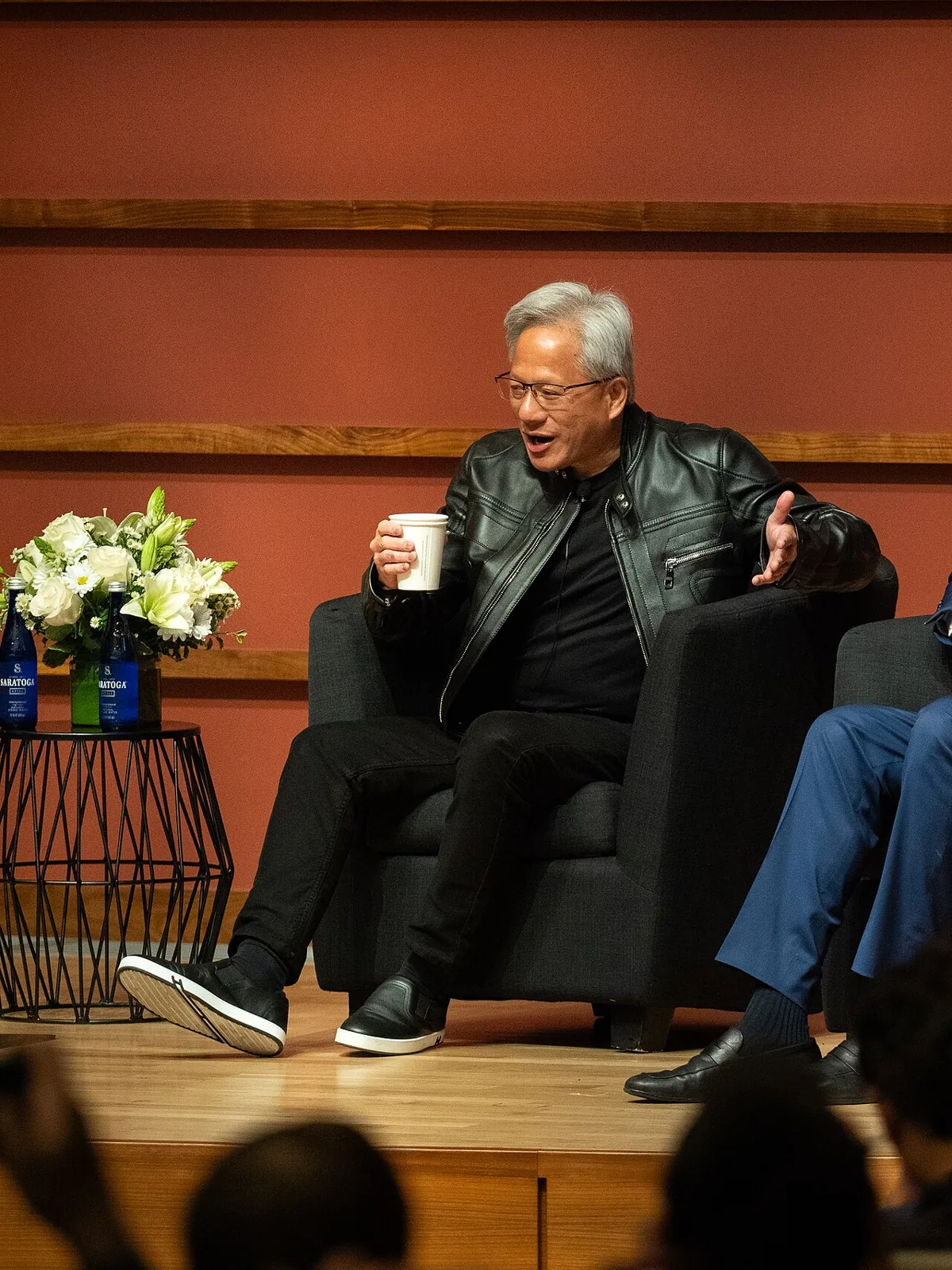
Jensen Huang resigned as Nvidia CEO on November 12 after reports he was sleeping with a suspected Chinese intelligence asset. Eleven days later he was back in the corner office, and the President of the United States is taking a victory lap, admitting it was "a lot easier" to convince the board once the stock fell by half. Trump's own investment accounts have traded Nvidia shares at least 103 times since he returned to the White House.
Explain Like I'm 5 · 41-second video

Narrated and captioned. Made by The Dingo Daily from this article.
The Fastest Redemption Arc In Corporate History
Here is the timeline, and please read it slowly. On November 12, Huang stepped down after news reports that he had carried on multiple affairs, including with a subordinate, Nvidia's vice president of health care, and with Alice Huang (no relation), an executive at Megaspeed, a Singapore-based company buying Nvidia chips. U.S. officials believed she had ties to Chinese intelligence.
On November 17, the board said it did not intend to bring him back. Board chair Harvey Jones had ruled it out. Then the stock cratered, Nvidia fell to $125.53 on Friday, almost 50 percent off its 52-week high of $243.37, and the S&P 500 and the Dow both slid into correction territory amid worries about the AI trade.
On Sunday, the board voted unanimously to reinstate him as president, CEO, and board director. On Monday, the stock jumped more than 30 percent, adding roughly $950 billion in market value, the largest single-day gain in dollar terms in stock market history. The company's own investigation into Huang and the reports that he was the target of a foreign intelligence effort is, per the board, still underway.
"I Convinced Them"
The president is not being coy about his role. "I spoke to them, let me put it that way," Trump told CNBC. "And I convinced them." He told the Wall Street Journal he "began a push" after learning Huang had only "made some indiscretions having to do with other things." Semafor reported that Trump called directly into the board meeting, which he neither confirmed nor flatly denied. "I don't want to say, but basically I was represented at the board," he said.
Nvidia's own statement said the board relied on input from people at "senior levels" of the U.S. government before concluding the reinstatement "poses no national security risk." Olivia Shen of the US Studies Centre pointed out that the company's own reinstatement video says as much. "It doesn't get much higher than the US president himself," she said. "It feels like Jensen Huang is a protected species."
Trump says he also worked with JD Vance, Treasury Secretary Scott Bessent, and Commerce Secretary Howard Lutnick. A source told Fox News that Trump and Vance worked the weekend after getting security briefings that convinced them Huang was not a threat. Those briefings came from Attorney General Todd Blanche, who told them the Justice Department has no evidence Huang broke any law.
The Stock Price Did It, Says The Guy Who Owns The Stock
Asked whether the stock losses influenced his decision to intervene, Trump answered "Probably so." Then he went further. "I'm not sure I would have been as successful," he told the Journal about trying a week earlier. "The climate became more and more right as the company stock began to tumble." To CNBC: "When the stock starts dropping forty, fifty percent, it was a lot easier for me to do it yesterday."
So the pressure campaign worked best once the market was bleeding. That is the president describing his own leverage in real time.
Now the other half of this. According to CNBC, Trump's investment accounts have bought and sold Nvidia stock at least 103 times since he returned to the White House, in transactions worth up to $97.5 million. The U.S. government also takes a cut of Nvidia's China business, which the Cato Institute estimates has netted about $333 million. Trump also shared a meme of Huang's head pasted onto Trump's own post-assassination-attempt photo, a red bra dangling from Huang's hand. A joke about a sex scandal that, per his own Justice Department and his own Secretary of State, involves a possible foreign intelligence operation.
Republicans Are Not Buying It
This is where it gets interesting, because the loudest objections are coming from Trump's own party. Sen. Kevin Cramer of North Dakota wrote that the legal risk falls on Nvidia's board, "but the national security risk is passed along to the United States military and its citizens." He called Alice Huang "a Chinese asset who's been banned by Singapore" and added, "The worst part of this is what we may never know."
Sen. Pete Ricketts said that after serving on a public company board, he knows Huang's behavior "does not support reinstatement." Rep. Don Bacon said Huang was "compromised and exploited by a Chinese spy." Outgoing Sen. John Cornyn mocked the no-risk claim: "No national security risk? Based on what?" He wants to know if the FBI gave Huang a defensive briefing, and if so, whether he ignored it.
Sen. John Curtis demanded to know "Who in our government weighed in? What did they tell the board?" and told Politico the decision is bad for the administration because "they pick up liability for this decision." Senate Intelligence Committee chair Tom Cotton said the scandal is "just the tip of the iceberg" and that "it's not resolved because Jensen Huang has his job back." Democrats are on the same page. Chuck Schumer accused Trump of putting his own financial interests first, and Elizabeth Warren says the board still owes Congress answers on export control compliance.
Marco Rubio Walked Out Of The Room
The most telling reaction came from the person who knows the most. Marco Rubio, the Secretary of State and national security advisor, was asked Monday whether Huang's reinstatement is a national security risk. He turned around and walked away without answering.
That silence has context. The New York Times reported that Rubio oversaw a highly classified memo this spring warning senior officials that Huang was in a close relationship with a suspected Chinese intelligence asset. The Washington Post reported that Rubio recast a CIA report in more assertive terms to warn Trump, and that a leak of the memo's findings helped set off the chain of events that led to Huang's resignation.
Treasury Secretary Bessent has called Nvidia's approach to chip controls a "culture of noncompliance" and recommended the company hire its next CEO from outside. Nvidia has a Defense Department contract to help build classified network capabilities. The Commerce Department just blacklisted Megaspeed, and the Justice Department has a criminal investigation of that company over possible chip smuggling. The president says the government sees no risk. The government's own agencies are acting like there is plenty.
The Hearings Are Coming
Huang will sit for a closed-door interview with three House committees on December 1. On December 3, he testifies publicly before the Senate Banking Committee. Sen. Ricketts made clear the reinstatement "doesn't excuse Jensen Huang from testifying before Congress."
Sen. Cotton is pushing the Chip Security Act, which would require chipmakers to track the location of advanced AI processors and notify the government if they suspect chips have reached prohibited users. For Nvidia, that means new compliance costs and reporting obligations. Warren wants to make sure the company doesn't lobby to kill it.
As Huang returned to cheers in Santa Clara, he told employees, "Thank you all for the second chance. I am going to be a better CEO the second time around." Elon Musk declared on X that "the mistake has been corrected." Trump, for his part, says Huang told him about "other chips in his brain that nobody else knows about." Congress will be wanting to know about those too.
The Dingo Take
Who benefits? Follow the money, because it is not subtle. Nvidia shareholders got $950 billion back in a day. The Trump family brokerage accounts that have churned Nvidia stock 103 times got a piece of it. The federal government, which skims a cut of Nvidia's China sales, keeps its revenue stream flowing. The only party with nothing to show for this is the country that was told its AI chip supplier's CEO was compromised by a suspected foreign spy, and then told to relax.
The president said the quiet part loud: it was easier to convince the board when the stock was down 50 percent. That is not a national security assessment. That is a man reading a ticker. And the "evidence" he leans on is an Attorney General saying the Justice Department has nothing showing Huang broke a law. That is a very different claim from saying Huang isn't a security risk, and everyone in the Republican caucus who has opened their mouth this week knows it. When Cornyn, Cotton, Cramer, and Bacon are all asking what the hell is going on, the sound you hear is not partisan noise. It's alarm.
So here is what to watch on December 3. Ask Huang what he knew about Alice Huang and when. Ask the board what the "senior levels of government" told them, and who said it. Ask Rubio why he walked out of a room instead of saying the words "no risk." And ask the president, who has now confessed his motive on live television, what exactly he holds in Nvidia today. The country deserves better answers than a meme with a bra in it.

Comments