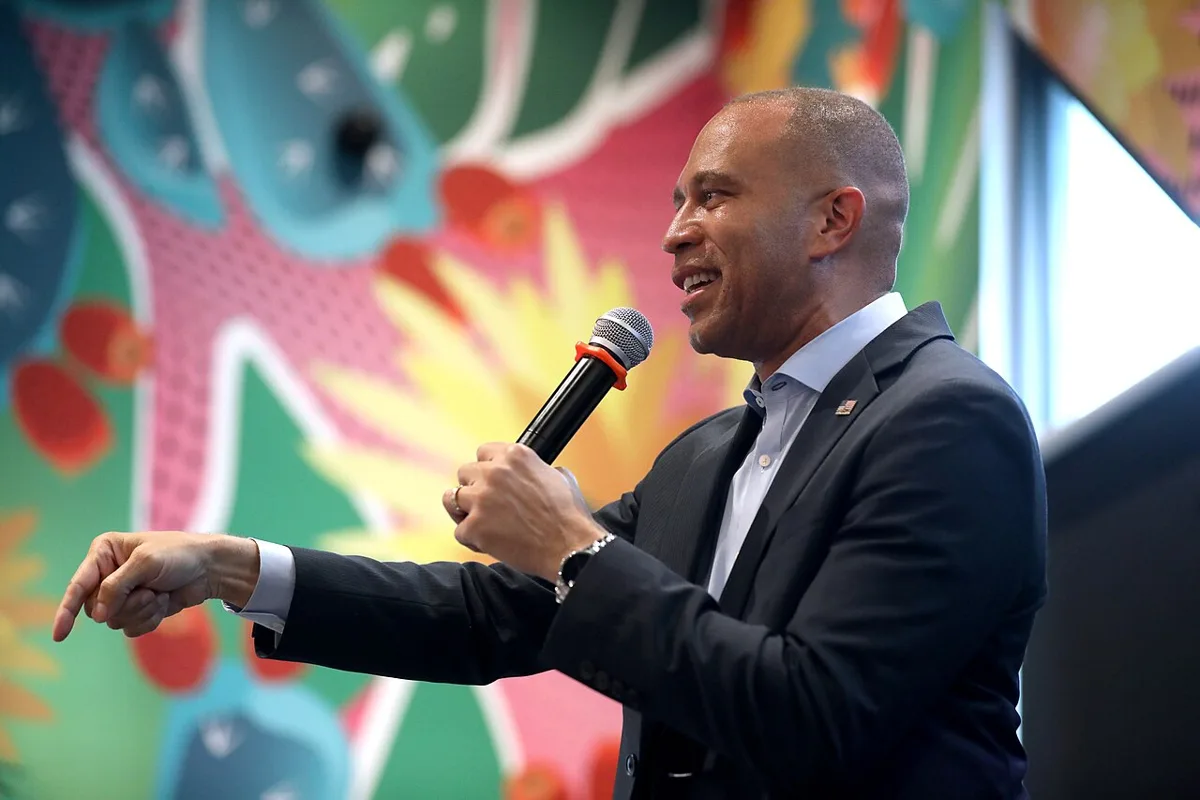
Hakeem Jeffries, the man whose entire job right now is holding the Democratic Party together with scotch tape and vibes, stood in front of reporters this week and said, with a straight face, that he and democratic socialist Zohran Mamdani are basically on the same page. The New York congressional primaries are apparently no big deal. Nothing to see here. Please stop asking questions.
The Art of Saying Nothing While Everything Burns
According to Axios, Jeffries told reporters Tuesday that the ideological direction of the Democratic Party will not be decided by a handful of House seats in New York. This is the political equivalent of a football coach saying the score doesn't matter, it's how you play the game. Except the score is the whole point. The score is always the point.
When pressed specifically on his relationship with New York City Mayor Zohran Mamdani, Jeffries offered this gem: "I don't think we're on opposite pages. You can ask him whether he thinks we're on opposite pages. He doesn't believe we're on opposite pages." Read that again. Jeffries did not say they agree. He said neither of them thinks they disagree. That is a different thing. That is a man who has been in Washington long enough to turn 'I have no comment' into a three-sentence non-answer.
What Is Actually Happening Here
Let's be clear about the situation Jeffries is in, because it is genuinely uncomfortable and the political press has been underplaying it. Axios reports that he is actively trying to prevent a democratic socialist takeover of key House seats while simultaneously avoiding open conflict with Mamdani, who just became the mayor of the largest city in the country and currently has more political momentum than basically anyone in the Democratic Party.
That is a needle that does not want to be threaded. On one side, you have the institutional Democratic establishment, the donors, the consultants, the people who think the word 'socialist' is a general election death sentence. On the other side, you have a grassroots left that just watched Mamdani run circles around the party apparatus in New York City and is not in the mood to be managed by someone telling them to simmer down. Jeffries is standing directly between these two forces and smiling pleasantly.
The New York congressional primaries are the immediate battleground. Mamdani's political energy is already flowing downstream into these races. Candidates aligned with his brand of politics are running. Candidates aligned with the Jeffries wing are running against them. Jeffries publicly calling this a minor skirmish does not make it a minor skirmish.
The Mamdani Problem Isn't Going Away
Here is what makes this particularly awkward for Jeffries. Zohran Mamdani did not win New York City by squeaking through a crowded primary on a technicality. He won decisively, running explicitly as a democratic socialist, making the cost of living the centerpiece of his campaign, and generating the kind of genuine enthusiasm that Democratic consultants have been promising is just around the corner for about fifteen years now.
That is not a fluke you can quietly sideline. That is a proof of concept. And the people drawing lessons from it are not sitting around waiting for Hakeem Jeffries to give them permission to run left-wing candidates in New York congressional districts. The question of whether the party's ideological future gets decided by "a few House seats" is somewhat beside the point. Movements do not announce themselves in advance. They show up in the results.
The Minority Leader's Impossible Position
To be fair to Jeffries, and we are contractually obligated to try, the position he is in has no clean exits. If he openly endorses candidates against the Mamdani-aligned slate, he picks a fight with the most energized faction of his own coalition right before a midterm election cycle where Democrats desperately need turnout. If he endorses the progressive candidates, he loses the centrist donors and the moderate members who are already nervous about the party's direction.
So instead he is doing what politicians do when they have no good options. He is talking without saying anything. He is describing a conflict as a non-conflict and hoping the party faithful are too busy to look closely. It might even work for a little while. Political ambiguity has a longer shelf life than it deserves.
But the New York primaries will produce actual winners and actual losers. The results will be specific. And at that point, no amount of "we're not on opposite pages" is going to paper over which page the Democratic Party actually turned to.
The Dingo Take
The Democratic Party has been having this exact argument, in one form or another, since at least 2016. The establishment says: electability first, ideology second, trust the professionals. The left says: the professionals have been losing to a reality television host, so maybe reconsider. Neither side has fully won the argument because neither side has fully won enough elections to close it out.
Jeffries is a smart politician and a genuine tactician. He did not get to House Minority Leader by being sloppy. But smart tactics and a coherent vision are two different things, and right now the party is asking for the second one and getting very polished versions of the first. Telling reporters that a few House seats won't decide the party's direction is not a vision. It's a delay.
Mamdani, whatever you think of his politics, is telling people exactly what he believes and what he wants to do. Voters in New York City found that refreshing enough to elect him by a comfortable margin. The lesson Jeffries seems to be drawing from that is: stay vague, avoid conflict, manage the optics. The lesson a lot of New York Democrats appear to be drawing is something else entirely. We are going to find out which lesson was right when the primary votes are counted, regardless of how many times Jeffries insists the test doesn't matter.


Comments