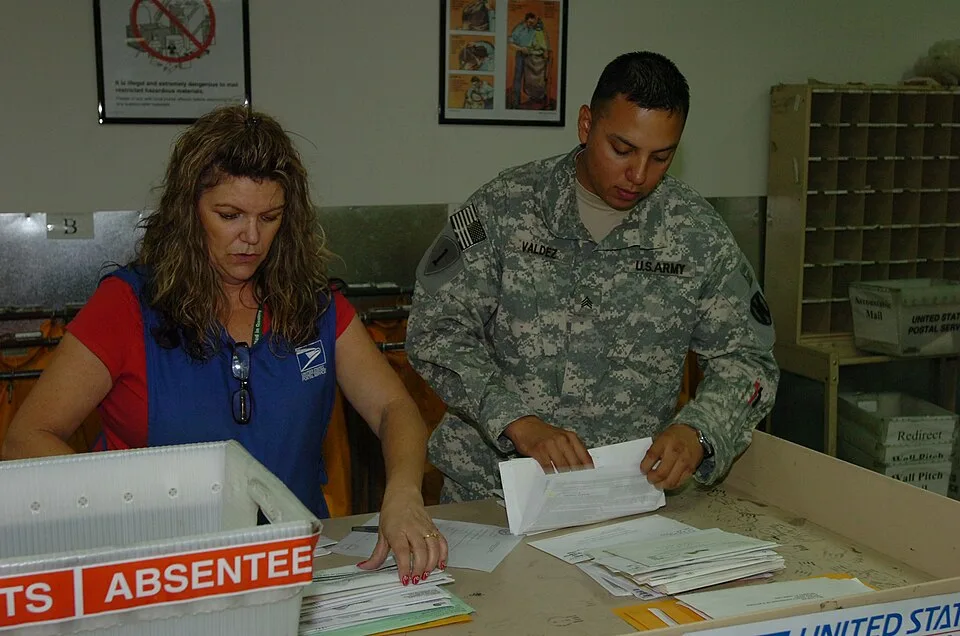
A Republican political consultant published an op-ed in the New York Post this week arguing that the US Postal Service should require states to hand over voter information before mailing ballots, and had the audacity to end it with the phrase 'that's not voter suppression, that's good government.' His name is Matthew Klink, he runs a Los Angeles-based Republican campaign firm called Klink Campaigns, Inc., and he wants you to know he's just asking questions. The reasonable kind. The not-at-all-political kind.
Let's Start With Who Is Actually Writing This
The New York Post ran this piece as an opinion column without much fanfare about its author's background. Matthew Klink is not a voting rights scholar. He is not a constitutional law professor. He is the owner and president of a Republican public affairs and political consulting firm based in Los Angeles. His professional life is built on winning elections for conservative clients.
That's fine. People with skin in the game can have opinions. But it matters when someone frames a nakedly partisan policy position as a nonpartisan appeal to common sense. It matters a lot, actually. The 'I'm just a reasonable person asking reasonable questions' framing only works if we ignore the guy behind the curtain charging hourly rates to help Republicans win.
What the USPS Proposal Actually Does
Here's the policy at the center of this. The US Postal Service, under the current administration, proposed requiring states to share voter roll data before mailing out ballots. The stated justification is accuracy and verification. Critics, mostly Democrats, called it what it looks like: a federal mechanism to inject bureaucratic friction into a voting process that millions of Americans rely on.
A federal judge has already blocked the proposal while legal challenges play out, as the New York Post piece itself acknowledges. That detail gets one sentence near the bottom of the column. The courts apparently also have questions, and they're not the 'just asking' variety.
The Airport Security Argument Is Doing a Lot of Heavy Lifting Here
Klink's core rhetorical move is the verification-is-normal argument. Banks verify identities. Airports have security. We check IDs to buy guns. Therefore, requiring states to submit voter data to a federal postal agency before sending out ballots is just... the same thing, obviously.
This analogy falls apart the moment you push on it. Airport security is a federal system designed to catch threats to aviation safety. Voter rolls are administered by states and localities, and the constitutional framework for running elections explicitly gives states primary authority over how they conduct them. Comparing TSA to the USPS demanding voter databases is not an analogy. It's a rhetorical card trick.
Also, and this is worth saying plainly: we already verify voters. People register. They sign ballot envelopes. States maintain and regularly update voter rolls. The USPS proposal doesn't add a new layer of verification to a verification-free system. It adds federal control to a system that states have run for decades. That's a different thing.
The 'Where's the Evidence' Dodge
Klink addresses the obvious counterargument, the one about evidence of widespread fraud, and dismisses it immediately. 'Election integrity isn't just about catching fraud after it happens,' he writes. 'It's about building systems that earn public confidence before a single ballot is cast.'
This is a genuinely clever piece of misdirection. He's right that good systems don't wait for disasters. But the question of what specific problem this specific proposal solves never gets an answer, because there isn't one. Decades of research and hundreds of court cases have consistently failed to surface evidence that mail-in ballots are a significant vector for fraud. The Heritage Foundation, which tracks election fraud cases with evangelical enthusiasm, has documented a few hundred cases over twenty years across billions of cast ballots.
So the 'we build systems before problems occur' logic only holds if there's a plausible threat model. Here, the threat model is vibes and eroded public confidence, much of which was deliberately manufactured by Republican politicians after 2020. You don't get to spend four years telling people elections are stolen and then cite their resulting distrust as a justification for restricting the process.
California Gets Singled Out, Shocker
The piece spends considerable time on California specifically. Klink notes that California automatically sends mail ballots to all active registered voters, allows online registration, and counts ballots postmarked by Election Day and received up to a week later. He describes this as a system 'built largely on trust' that may need more 'verification.'
California also has one of the largest and most scrutinized election systems in the country, and its results are certified without meaningful controversy every single cycle. But Klink is a Republican consultant in Los Angeles writing about California's elections, which is a context that explains a lot about which state wound up in the crosshairs of a piece ostensibly about national election policy.
The Dingo Take
Here is the tell that gives the whole game away. Klink writes that 'expanding access and strengthening verification are not mutually exclusive goals' and that the stronger principle is 'trust is earned through transparency, accountability and verification.' Hard to argue with in the abstract. But every single concrete policy position in the piece points one direction only: toward more federal control over a state-run process, more friction in the mail ballot system, and more ammunition for the argument that the current system is untrustworthy. When someone tells you they just want balance and their every specific recommendation lands on one side of the scale, the balance argument is not the real argument.
The New York Post ran this without noting anywhere in the piece that Klink runs a Republican campaign operation, which is a choice. Readers get 'Matthew Klink is the owner and president of Klink Campaigns, Inc., a Los Angeles-based public affairs firm.' Public affairs firm. Sure. That's one way to describe it. A federal judge has blocked the policy he's cheerleading for, the legal challenges are live, and the constitutional questions are genuinely complicated. None of that makes it into the piece as anything other than a footnote.
What we have here is a campaign professional laundering a partisan policy preference through the language of civic reasonableness, published in a Murdoch paper that has been running election skepticism content since before the ballots were even counted in 2020. It ends with 'that's not voter suppression, that's good government.' Right. And this isn't a partisan op-ed. It's just a reasonable person asking questions.


Comments