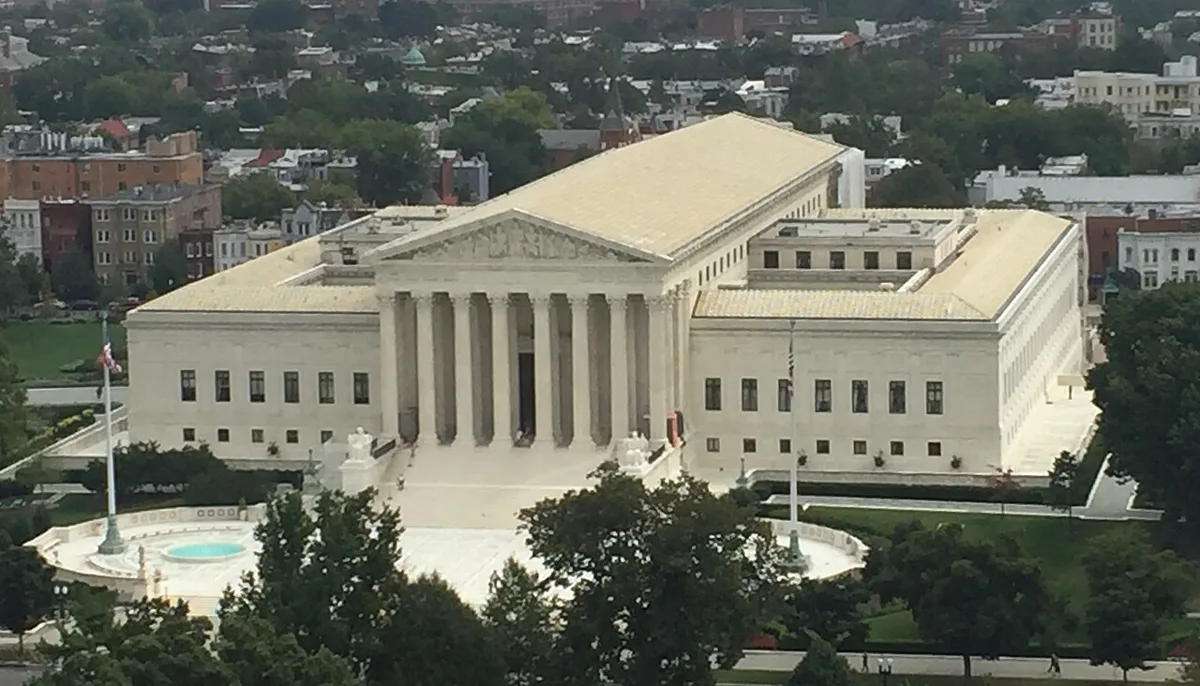
The Supreme Court just told tens of thousands of cancer patients that the federal government's pesticide label is more important than their tumors. In a 7-2 ruling handed down Wednesday, the Court sided with Monsanto, now owned by German pharmaceutical giant Bayer, shielding the company from state liability claims over Roundup, its blockbuster weed killer whose key ingredient, glyphosate, plaintiffs say gave them cancer. Brett Kavanaugh wrote the majority opinion, because of course he did.
What the Court Actually Decided
The case centered on James Durnell, a Missouri resident who sued Monsanto arguing the company failed to warn him that glyphosate, the active ingredient in Roundup, could cause cancer. His claim was a state tort lawsuit, the kind of thing American courts have handled for over a century when companies hurt people and don't tell them about it.
Monsanto's defense, written in legalese but translatable to plain English, was essentially: the EPA approved our label, so you can't touch us. The Federal Insecticide, Fungicide, and Rodenticide Act, a law most people have never heard of, gives the EPA authority to set pesticide labels. Monsanto argued that federal authority wipes out any state-level attempt to hold them accountable for what isn't on that label.
Kavanaugh bought it. Seven justices bought it. According to NPR, Kavanaugh wrote in the majority opinion that because Durnell's state tort claim would impose a labeling requirement "in addition to or different from" what the EPA requires, federal law expressly preempts his case. Translation: if the EPA didn't require a cancer warning, no state jury gets to say Monsanto should have included one anyway. Case dismissed. Durnell loses.
The Dissent That Tells You Everything
Justice Ketanji Brown Jackson filed a dissenting opinion, and she did not mince words. Justice Neil Gorsuch joined her, which is the kind of ideological crossover that only happens when the majority opinion is genuinely hard to defend on the law.
Jackson wrote, as NPR reports, that the majority "misunderstands FIFRA's requirements, misinterprets the scope of FIFRA's preemption, and ultimately leaves Durnell without a remedy for the significant harms he has suffered." Her core argument was straightforward: adding a cancer warning to Roundup's label does not conflict with anything the EPA requires. There is no contradiction. The majority manufactured a preemption conflict where one didn't have to exist, and they used it to hand Monsanto a liability shield Congress never actually voted to give them.
That last part matters a lot. Durnell's lawyer, Ashley Keller, told the justices during oral argument in April that Congress has been debating whether to give Monsanto exactly this kind of protection as part of the farm bill. They haven't done it yet. So the Supreme Court just gave Bayer what Congress has so far declined to legislate. The Court didn't interpret the law. It made a policy choice and dressed it up in statutory language.
What This Means for the Tens of Thousands Still Waiting
This ruling does not just affect James Durnell. According to NPR, experts said a decision for Monsanto could significantly narrow its liability in tens of thousands of cases currently crawling through the courts. Bayer has been sitting on a massive legal liability since it acquired Monsanto in 2018, and this ruling is the closest thing to a get-out-of-jail-free card the company could have hoped for short of an act of Congress.
Bayer has already paid out billions settling some of these cases. The company has repeatedly tried to get courts to shut the litigation down and failed. Now the Supreme Court has done what years of settlement negotiations and lower court battles couldn't: effectively closed the courthouse door on future failure-to-warn claims. If the EPA's label doesn't mention cancer, no jury in Missouri or anywhere else gets to say it should have. That is the rule now.
For the people who spent years gardening, farming, or maintaining golf courses while soaking themselves in Roundup without any warning about cancer risk, the Court's message is brutally clear. The federal government approved the label. Take it up with them. Good luck.
The MAHA Wrinkle Nobody Saw Coming
Here is where this story gets genuinely weird. NPR reports that scores of protesters showed up at the Supreme Court in late April in solidarity with Roundup cancer victims, and many of them came flying the Make America Healthy Again banner. MAHA, Robert F. Kennedy Jr.'s health movement that became a strange satellite of the Trump political universe, has been loudly critical of glyphosate for years.
But President Trump, whose administration's Solicitor General John Sauer filed a brief siding with Monsanto, also signed an executive order to boost domestic production of glyphosate. The chemical the MAHA movement hates. Boosted by executive order. By the president MAHA supporters helped elect. NPR describes this as having contributed to "a rupture between the White House and some MAHA supporters," which is the journalistic equivalent of calling the Titanic a maritime inconvenience.
So to recap: Trump's Justice Department backed Monsanto. Trump's Supreme Court picks formed the core of the majority that ruled for Monsanto. And Trump signed an order to make more glyphosate. The MAHA voters who thought they were getting a health-focused administration are watching the EPA's rubber-stamped label become the legal ceiling for corporate accountability. How's that working out.
Paul Clement Walks Away Happy
It is worth spending exactly one paragraph on the man Bayer hired to argue this case: Paul Clement, former Solicitor General under George W. Bush and one of the most successful Supreme Court advocates alive. His argument during April oral arguments, as quoted by NPR, was that "you shouldn't let a single Missouri jury second-guess" the EPA's label judgment.
That framing is worth sitting with. The man being protected isn't a jury. It's a corporation with a $60 billion acquisition to justify. The "judgment" being deferred to is from an EPA that operates under political pressure and has repeatedly declined to add a cancer warning to Roundup's label despite the International Agency for Research on Cancer classifying glyphosate as a probable human carcinogen back in 2015. Clement's argument, dressed up as a defense of federal regulatory coherence, was really an argument that Bayer shouldn't have to pay sick people. The Supreme Court agreed, 7-2.
The Dingo Take
Let's be honest about what happened here. A corporation that knowingly sold a product without a cancer warning now cannot be held accountable by any state jury in America, because the federal government also declined to require a cancer warning. The circularity of this is staggering. Monsanto's argument, accepted by seven of nine Supreme Court justices, is essentially that its failure to warn is protected by the government's parallel failure to require a warning. Two wrongs don't make a right, but apparently two failures to warn make a preemption defense.
The Trump administration's fingerprints are all over this outcome, and not just because two of those seven justices wear the Trump brand. The current Solicitor General filed on Monsanto's side. The president signed an order promoting glyphosate production. The EPA under this administration was never going to revisit the label. Every lever of federal power pointed the same direction: toward Bayer, away from James Durnell. The MAHA crowd wanted to fight corporate poison in America's food and water supply. They backed people who handed the poisoners a legal fortress.
The only real question now is whether Congress will do what the Court has refused to: actually make this decision through democratic process instead of statutory interpretation gymnastics. The farm bill negotiations that Durnell's own lawyer mentioned are ongoing. Don't hold your breath. The same industry that just won at the Supreme Court writes significant checks to the same members of Congress who write the farm bill. The courthouse door is closed. The legislative door has a bouncer. James Durnell has cancer.


Comments