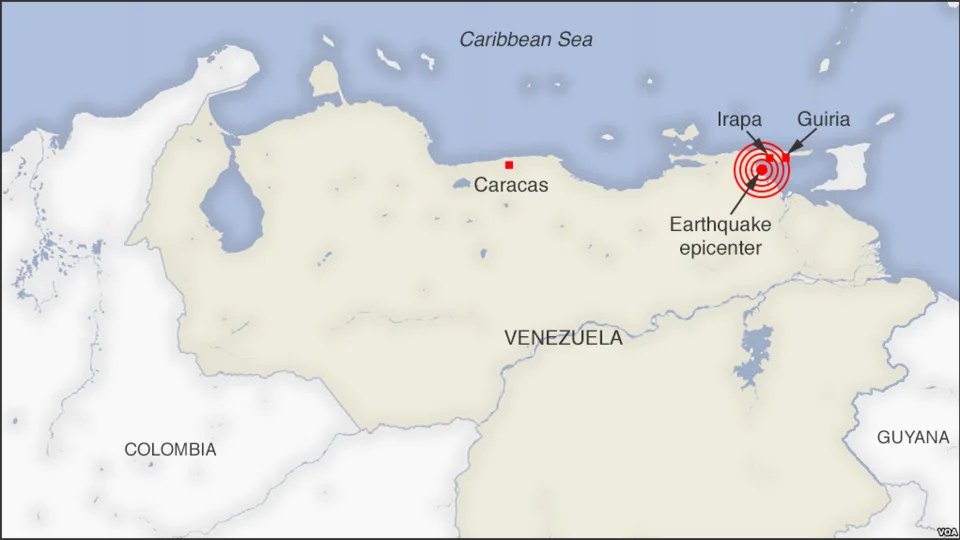
For three days, a professional soccer player clawed through the ruins of a collapsed building in Venezuela, looking for his wife and two kids. He found them. They were dead. This is what a 7.5 magnitude earthquake does to a country that was already on its knees.
The Building Was Just Gone
Lucas Trejo, 38, plays for Club Sport Maritimo La Guaira, a second-division Venezuelan club. He was at a team training camp in Caracas on Wednesday evening when two earthquakes, magnitude 7.2 and 7.5, tore through the country within hours of each other. He got back to La Guaira as fast as he could.
What he found, according to his brother-in-law Ricardo Ardiles, speaking to CNN Espanol, was that there was nothing left. "He found absolutely nothing of what the building itself had been," Ardiles said. His wife Yanina and their children Aaron and Ainhoa were somewhere inside that nothing.
Trejo spent three days searching the rubble himself before rescue workers recovered their bodies. Three days. Let that sit for a second.
La Guaira Got Hit Worst
La Guaira, the coastal state where Trejo's family lived, was the hardest-hit region in the entire disaster, CBS News reports. It is not a wealthy area. The buildings were not built to survive what hit them on Wednesday night.
Club Sport Maritimo La Guaira released a statement on Instagram mourning "the irreparable loss of our player's wife and children." On X, the club wrote, "Peace to their souls and comfort for Lucas and all his loved ones." It's the kind of statement no organization ever wants to have to write. There is no good version of it.
The Numbers Are Staggering and Probably Getting Worse
Venezuelan authorities confirmed Monday that more than 1,700 people have died. But the number that should make your stomach drop is this one: approximately 51,000 people remain missing, according to online tracking databases. The government of Caracas said that as of Saturday, roughly 200 people had been rescued from the rubble.
Two hundred out of fifty-one thousand missing. That is not a rescue operation. That is a lottery.
Acting President Delcy Rodriguez says the Venezuelan government is mounting a full response. Venezuelans on the ground are reporting something different. CBS News spoke to residents of the hardest-hit areas who said they have seen almost no state rescue teams arrive. A woman named Diana Sandrano told CBS News she had been searching for her missing brother herself, by hand, for an entire day. "He deserves to live and have a future," she said.
Americans Pulled a Mother and Baby Out of the Rubble
Over the weekend, a U.S. search and rescue team got to one of the collapsed buildings in time. Virginia Urban Search and Rescue Task Force 1 pulled a woman from the wreckage, and the team shared video of it. Neighbors watching cheered when she came out.
The U.S. State Department shared a separate video showing a 9-month-old baby being lifted from the rubble wrapped in blue fabric. The baby's face was blurred, but you could hear it crying. That sound, according to CBS News, was the sound of the whole operation: something salvaged from the collapse, barely, against all odds.
Those are the good moments. They are outnumbered badly right now.
The Dingo Take
Here is what is true: Venezuela was already a humanitarian catastrophe before Wednesday. Years of economic collapse, political repression, and infrastructure rot had hollowed out the country long before the ground started shaking. When a disaster this size hits a nation this broken, the people with the least power absorb almost all of it. Fifty-one thousand missing is not a statistic. It is a city's worth of families doing exactly what Lucas Trejo did, digging through concrete with their hands, hoping.
The story of a famous soccer player losing his family is the one that cuts through, and that's fine, that is how human attention works. But behind it is a number that doesn't fit in a headline: tens of thousands of people nobody has found yet, in a country whose government can apparently confirm 200 rescues while 51,000 people remain unaccounted for. Those two numbers should not be able to coexist in the same official statement without someone being forced to explain themselves loudly and in public.
What happens next in Venezuela will depend almost entirely on whether the international community decides to pay attention past the first week, which historically it does not. The cameras will move on. The rubble will still be there. And a lot of families are going to spend their own three days searching before they find out what Lucas Trejo found out.


Comments