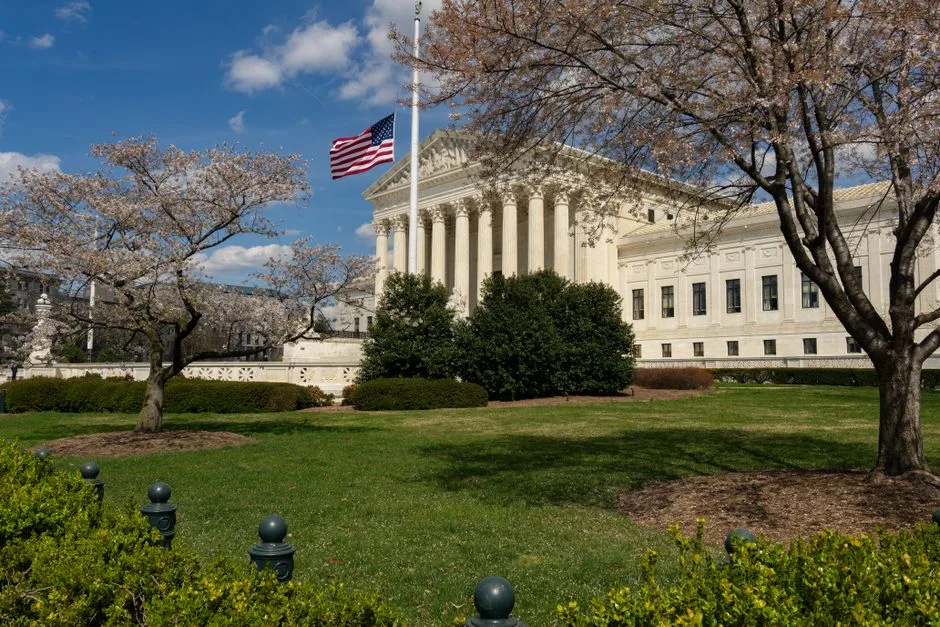
The Supreme Court ruled Thursday that the Trump administration can end Temporary Protected Status for more than 1.3 million immigrants, potentially deporting them to countries the United States government itself has officially declared too dangerous to visit. This is not a metaphor or a slippery slope. It is the current, documented, legal reality of America in 2026. The court's conservative majority made it happen 6-3.
What TPS Actually Is, Since Nobody Explains It
Temporary Protected Status was signed into law in 1990 under George H.W. Bush. It exists because asylum law has a narrow legal definition, covering people with a well-founded fear of persecution based on race, religion, nationality, or political opinion. That definition leaves out people fleeing active war zones, environmental disasters, and pandemics. They can't get asylum, but the U.S. also cannot legally send them home to die. That principle has a name: non-refoulement. It is a bedrock of international law.
So TPS fills the gap. It offers deportation protection and work authorization, but critically, as the Guardian notes, no pathway to permanent residency. It gets renewed every six to eighteen months by the administration in power. Haiti's designation has been renewed for fifteen consecutive years, since the 2010 earthquake. El Salvador's has been active for twenty-five years. Somalia's for more than thirty-five. People built entire lives, raised American children, and ran businesses here, because each renewal was a promise that the ground beneath them was stable enough to stand on.
Kristi Noem Wanted to Kill It. The Courts Said No. Then the Supreme Court Said Sure, Whatever.
Trump's former Homeland Security Secretary Kristi Noem moved to terminate TPS for thirteen countries. Lower courts repeatedly blocked her, ruling that the terminations lacked legal basis. In February, federal judge Ana Reyes delivered an 85-page smackdown finding that while the executive branch has discretion over TPS renewals, that discretion is not, in her word, "unbounded." The government, she argued, still had to follow a process to ensure it wasn't shipping people to their deaths.
Reyes included in her ruling a screenshot of Noem's own social media post, in which Noem urged Trump to impose a travel ban on "every damn country that's been flooding our nation with killers, leeches, and entitlement junkies." She also pointed out the staggering contradiction at the heart of the government's position: officials were arguing in court that Haiti was safe for deportees, while the State Department simultaneously maintained a Level 4: Do Not Travel advisory for Haiti, its highest warning level, citing crime, terrorism, kidnapping, civil unrest, and collapsing healthcare infrastructure.
The Supreme Court looked at all of that and, by a 6-3 margin, said the executive can do what it wants and courts cannot stop it.
What Samuel Alito Actually Wrote, and Why You Should Be Furious
Let's be precise here, because precision is what makes this so enraging. Justice Samuel Alito, writing for the majority, addressed Trump's well-documented history of dehumanizing statements about Haitian immigrants, including the debunked claim that Haitians in Springfield, Ohio were eating people's pets, and his repeated assertion that immigrants are "poisoning the blood" of the nation.
Alito's conclusion, per the Guardian's reporting, was that these statements are not "overtly racial" but rather "expressed policy views that could rest on race-neutral justifications." Read that again slowly. The man who spread a fabricated story about immigrants eating cats and dogs, and who has described immigrants as bloodborne contaminants, was given a clean bill of racial neutrality by the highest court in the country. Alito did not find a loophole. He wrote the loophole. He named it. He published it in a binding legal opinion.
The Scale of What Just Happened
The case before the court specifically concerned 350,000 Haitian TPS holders and 6,000 Syrian ones. But the Guardian reports the ruling creates a framework that could expose more than 1.3 million total TPS holders to deportation. These are people who, according to the same reporting, contribute over $29 billion to the U.S. economy and pay nearly $8 billion in taxes annually, while being legally barred from accessing most public assistance programs. They pay in. They cannot take out. That is the deal they live under.
And Thursday's TPS ruling did not happen in isolation. On the same day, the court issued a second 6-3 decision allowing the Trump administration to block migrants from applying for asylum at the southern border while their cases are pending. The Guardian describes courts simultaneously ordering asylum seekers removed without hearings, sending them to third countries to have claims processed there, and new policies requiring people to physically return to their home countries to apply for green cards, which for many people in TPS-designated nations would trigger a travel ban trapping them outside the country permanently. By some estimates cited in the reporting, these combined policies could produce a 30 to 55 percent reduction in legal migration.
The 'Come Here Legally' Crowd Has Some Explaining to Do
For years, the go-to rhetorical deflection from immigration restrictionists has been a simple question: why don't people just come here legally? TPS holders did exactly that. They followed the rules. They renewed their status. They filed paperwork, paid taxes, obeyed the terms of their protection, and built their lives on the assumption that the law meant what it said.
What the Supreme Court just confirmed is that "legal" was never a stable category. It is a political designation that can be revoked at will, by whoever holds power, for whatever reason they care to invent, with the courts now explicitly standing aside. As the Guardian piece argues, what is deemed legal or illegal in immigration is a reflection of whose lives those in power consider worth protecting. The court just made that abstract argument into binding federal law.
The Dingo Take
Here is what is genuinely hard to sit with: the United States government is arguing in deportation proceedings that Haiti is safe while its own State Department tells American citizens not to go there under any circumstances. That is not a tension or a contradiction. It is a deliberate lie being told in two directions simultaneously, and the Supreme Court has now ruled that this is fine, actually, and none of the lower courts' business.
Alito's opinion on Trump's "eat the dogs" rhetoric being race-neutral will age about as well as every other moment in this court's recent legacy. The reasoning requires you to believe that a man who has spent a decade calling immigrants disease, vermin, and bloodborne pollution is making purely policy-based assessments. It requires you to believe that with your eyes open. Six justices managed it.
The only real check left is Congress, which currently has the attention span of a golden retriever at a tennis ball factory and the political courage to match. TPS was created legislatively. It can be protected legislatively with a pathway to permanent residency that doesn't evaporate the moment a cruel administration decides the paperwork is inconvenient. Whether Congress will do that before 1.3 million people are put on planes to countries we tell tourists to avoid is the only question that matters right now.





Comments