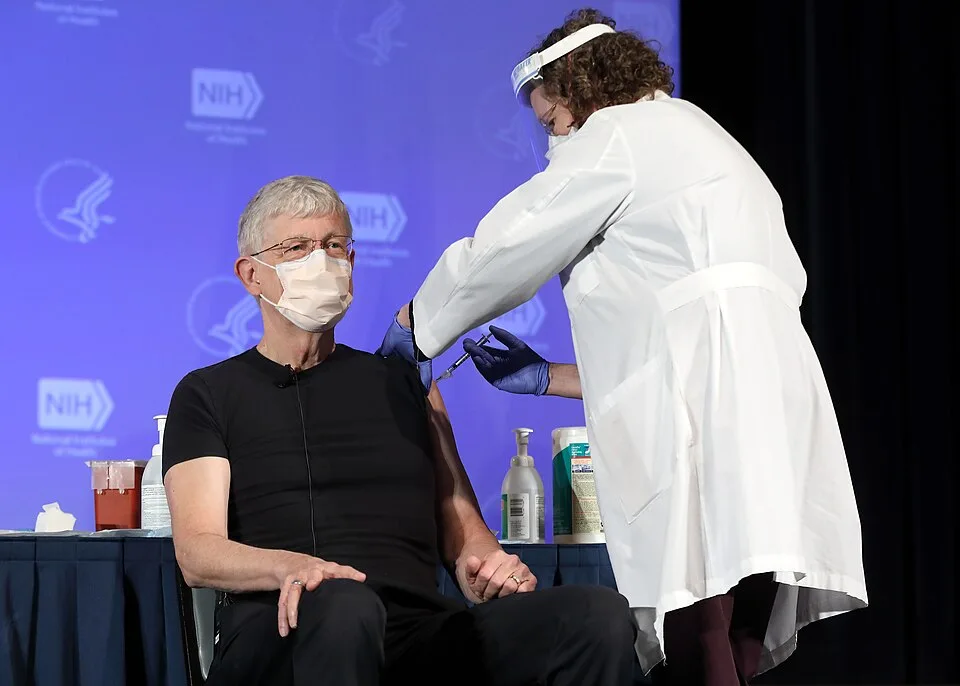
The director of the National Institutes of Health went on national television Sunday and told parents to vaccinate their kids against measles. This should not be news. It is news because the man's direct superior, Robert F. Kennedy Jr., has spent thirty years telling people vaccines cause autism, and the White House is currently drafting an executive order about exactly that.
What Bhattacharya Actually Said
Dr. Jay Bhattacharya, appearing on Face the Nation with Margaret Brennan, did not hedge. "I trust the science," he said, adding that "for most kids, especially for the measles vaccines, the DTP, all the standard childhood vaccines, it's very important that parents vaccinate their kids." He said he vaccinated his own children. He said the best way to protect your kid from measles is to get the measles vaccine. All of this is true, uncontroversial, and would have been completely unremarkable in any administration prior to this one.
Bhattacharya has also been serving as acting CDC director in recent months, which means he is running two of the country's most important public health agencies simultaneously. He pointed to specific outbreak victories: Texas, addressed. Arizona and Utah, addressed. South Carolina, addressed. He noted that one of his first acts as acting CDC director back in February was to go on camera and recommend vaccination to end the South Carolina outbreak, and that the outbreak did, in fact, end. The man clearly knows what he is talking about.
The Measles Numbers Are Not Fine
Here is why any of this matters right now. CBS News reports that measles cases have risen to their highest levels in 35 years. Thirty-five years. We essentially eliminated measles in this country in 2000, and we are now watching it come back in real time, with outbreaks churning through Texas, Arizona, Utah, Virginia, Pennsylvania, and counting.
According to CDC data, only 10 states maintained measles vaccination coverage above 95% among kindergarteners during the 2024-2025 school year. That 95% threshold is the floor required for herd immunity. We are not meeting it nationally. We are not close. And school starts soon, which means you are about to put millions of kids in rooms together, some of them unvaccinated, in a country experiencing a multi-state measles surge. Bhattacharya at least acknowledged this reality directly, which is more than his colleagues have done.
The Boss in the Room Nobody Wants to Mention
When Brennan asked Bhattacharya whether the administration should launch a national push amplifying RFK Jr.'s recent CNN message that parents should vaccinate against measles, Bhattacharya said "I've done my best to try to do that." Which is a careful answer. A very careful answer.
Because Kennedy is not just some cabinet official with a quirky hobby. According to CBS News, he is a longtime critic of vaccines who has actively promoted the debunked connection between vaccines and autism for decades. He is the Secretary of Health and Human Services. He is Bhattacharya's boss. And the White House is right now drafting an executive order specifically tied to childhood vaccines and the autism question Kennedy has been loudly wrong about for thirty years. Bhattacharya said he could not speak to the details because the order is not finished yet. That is either admirably honest or deeply alarming, depending on how generous you are feeling.
The Autism Question and How It Paralyzes Everything
Bhattacharya did something interesting when asked about autism. He did not lie. He said, plainly, that he does not know why autism rates have risen, that the question is scientifically complicated, and that the vaccine-autism link debate has created a chilling effect where scientists are afraid to work on the topic for fear of being destroyed if they reach the "wrong" answer politically.
"The way you build public trust," he said, "is allow people to talk and think without that kind of political overlay." That is a reasonable thing to say. It is also a notable contrast to his secretary, who has not exactly been modeling open scientific inquiry. Kennedy did not get famous for saying "I'm not sure, let's study it." He got famous for saying vaccines cause autism, a claim that has been investigated extensively and has not held up. Bhattacharya knows this. He said the connection "gets so tied up" with the vaccines question. He is describing the problem his own department is creating.
The School Reopening Angle Nobody Asked For
Bhattacharya also wanted to make a separate point about schools, which is that parents should not be afraid to send their kids to school even if some classmates are unvaccinated. He framed fearmongering about unvaccinated kids at school as a "tremendous mistake" that erodes public trust, comparing it to COVID-era school closure decisions he clearly views as having been wrong.
This is where things get slippery. Vaccinating your kid and then not worrying about unvaccinated classmates is reasonable if vaccination rates are high enough for herd immunity. They are not. That is the entire problem. Telling parents not to worry about the unvaccinated kids in the room is a different message than telling them the room is safe because everyone is vaccinated. Bhattacharya clearly wants to encourage vaccination, but threading the needle between "get vaccinated" and "don't be scared of the unvaccinated kids" while measles cases hit a 35-year high requires a precision he did not quite achieve on Sunday morning television.
The Dingo Take
You are supposed to feel reassured that the NIH director said vaccines are good, actually. And on one level, sure. After months of the federal government treating childhood vaccination schedules like a matter of personal taste, hearing the person running NIH say "I vaccinated my kids, you should too" is a low bar that somehow still feels like news. But let's be precise about what Bhattacharya accomplished Sunday: he stated medical consensus on cable news while carefully avoiding any direct confrontation with the man who signs off on his department's budget and has spent three decades undermining that same consensus. That is not courage. That is damage control.
The executive order hanging over all of this is the real story. The White House is drafting something that connects childhood vaccines and autism, and the acting CDC director went on national television and said he does not know what is in it yet. Think about that. The person responsible for the country's disease prevention apparatus cannot tell you what the president is about to order him to do about vaccines. In the middle of a measles outbreak. That's not a communications problem. That is a governance catastrophe in slow motion.
Measles was gone. We beat it. It took decades of unglamorous public health work and one of the most effective vaccines ever developed, and we actually got there. Now it's back, crawling through state after state, and the federal response is the NIH director politely suggesting on a Sunday show that vaccines are probably good while an executive order gets drafted behind closed doors by an administration whose health secretary believes the opposite. History is going to have a field day with this.



Comments