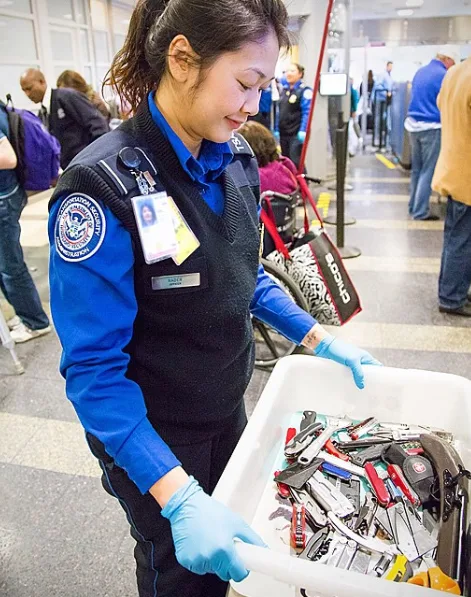
The people checking your ID and scanning your bags at Kansas City International Airport are not federal employees. They work for a private company called VMD Corp., based in McLean, Virginia, and most passengers have no idea. Now the Trump administration wants to roll that model out to dozens more airports, and it has given the program a name that sounds like a credit card upgrade: TSA Gold+.
The Secret Most Travelers Walk Right Past
Here is a thing that is apparently happening at American airports: private security contractors are wearing U.S. flag patches, standing at checkpoints, and screening passengers, while those passengers assume they are interacting with federal officers. NPR reports that travelers at Kansas City International were genuinely surprised to learn this. "It's news to me," said one passenger. Another said she taught her kids not to question anything at security.
That is both an extremely relatable parenting strategy and a pretty revealing window into how little scrutiny this arrangement has received over the years. The Screening Partnership Program, or SPP, has existed since the TSA was created after September 11, 2001. Federal law gave airports a choice: use federal officers, or opt out and hire private firms that the TSA then oversees. Most airports went federal. A small number did not.
Currently, according to NPR, there are 20 privatized airports operating under the SPP, compared to 440 federalized ones. The biggest holdouts using private security are Kansas City and San Francisco International. For a quarter century, this has been a quiet backwater of aviation policy that almost nobody thought about.
Then Came the Government Shutdown, and Suddenly Everyone Noticed
The recent partial government shutdown changed the calculus considerably. NPR reports that federally run airports saw long lines when the shutdown hit, while private facilities ran more smoothly. That contrast put the SPP program on the radar of travelers who had never heard of it. And it handed privatization advocates exactly the talking point they needed.
The Trump administration has wasted no time. It launched TSA Gold+, a new expanded version of the SPP, last month. The administration is promising to announce the first airports joining the program later this year, and says privatizing security would save tens of millions of dollars. The American Federation of Government Employees union is pushing back hard, warning the plan would gut federal workers while undermining security standards.
How much money are we actually talking about? The administration has not been specific. "Tens of millions of dollars" is doing a lot of work in that sentence, covering an enormous range between "marginal savings" and "genuinely significant." Nobody seems to be rushing to nail that number down.
Who Is Actually Watching the Watchers
Here is the part that deserves more attention than it is getting. At Kansas City, VMD Corp. program manager Gabe Murphy told NPR that the TSA maintains its own security team at the airport whose job is to audit the private contractor and make sure they follow TSA procedures. "Their SOP is our SOP," he said. Fine. That works at one airport.
But Tina Won Sherman, director of the GAO's Homeland Security and Justice team, told NPR that scaling this up raises serious questions the government has not answered yet. If dozens of small and medium airports join Gold+, the TSA suddenly has to handle oversight of private contractors at a vastly larger scale than it ever has before, covering everything from technology standards to screener performance. Sherman called maintaining security standards "absolutely critical" but acknowledged the details of how Gold+ would actually work are still emerging.
In other words: the administration is already rolling out the program, and the oversight framework is still being figured out. Classic.
The Wage Problem Nobody Wants to Talk About
Federal law requires that private contractors pay their employees at least as well as equivalent TSA federal workers. That sounds like a protection. Here is the catch: TSA officers have historically been paid some of the lowest wages in the entire federal workforce. NPR notes that pay improved significantly after a 2023 omnibus spending bill, and workers also benefited from a collective bargaining agreement the TSA reached with the AFGE union in 2024.
The Trump administration is currently trying to revoke that union contract. So the floor that private contractor pay is benchmarked against is a floor the administration is actively trying to lower. That is not a coincidence. That is a policy.
If the collective bargaining agreement goes away and federal TSA officer pay stagnates or falls, the "at least as well as federal workers" standard for private contractors becomes a much weaker protection than it looks on paper. The union understands this. The administration understands this. The question is whether anyone else is paying attention.
Atlanta Is Watching. So Is Everyone Else.
Hartsfield-Jackson Atlanta International Airport is reportedly considering going private, according to NPR. Atlanta is not some regional hub. It is one of the busiest airports on the planet. If Atlanta joins Gold+, that is not a marginal policy shift, that is a signal to every major airport in the country that the door is open.
Sherman told NPR the SPP had essentially plateaued at 20 airports for years. The Trump administration is betting it can break that plateau wide open. Whether the TSA has the capacity to oversee a dramatically larger private contractor network while simultaneously being reshaped by DOGE cuts and union contract fights is a question that deserves a much more direct answer than anyone in the administration is currently providing.
The Dingo Take
Look, the case for private airport security is not insane on its face. Kansas City seems to function fine. San Francisco has been doing it for years. Private contractors can theoretically be more flexible, and if genuine cost savings exist without sacrificing security, that is worth examining honestly. Nobody is arguing for inefficiency as a principle.
But this is not a good-faith policy experiment being rolled out with careful oversight and transparent benchmarks. This is an administration that is trying to break a union contract for federal security workers, gut the agencies that would oversee private contractors, and simultaneously expand private involvement in one of the most security-critical systems in the country. The GAO is flagging unanswered questions. The details are still "emerging." The program is already launching. That sequence should bother you.
The thing about airport security is that when it works, nobody notices. The badge looks federal. The process feels official. Passengers teach their kids to keep their mouths shut and move through the line. That is precisely the kind of invisible infrastructure that is easiest to quietly degrade, because nobody raises an alarm until something goes very, very wrong. The Trump administration is counting on that. They are betting that if the shirts look the same, nobody will ask what changed underneath them.

Comments