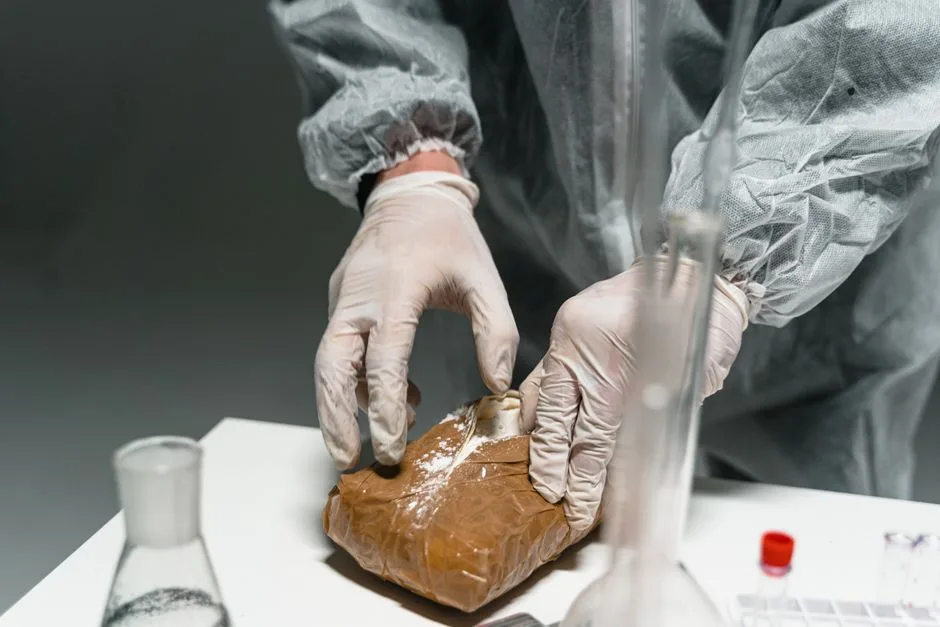
A DEA special agent turned whistleblower says federal drug agents sat and watched a deal involving 74,000 fentanyl pills go down in an Albuquerque mobile home park in June 2023 without making a single seizure. They did this, he says, to chase a bigger bust. New Mexico, which already leads the nation in overdose deaths, got the bill.
'We 100% Got People Killed'
The Associated Press published the kind of story that should make your hands shake a little. Based on whistleblower testimony and documents reviewed by the outlet, the reporting describes DEA agents who had precise intelligence about fentanyl shipments into Albuquerque, knew the pill counts, tracked the deliveries in real time, and then deliberately let the drugs walk.
"We poisoned our community to make cases," DEA special agent David Howell told the AP. "Through our own willful blindness, we get to say, 'We don't really know what happened to the drugs.' But we 100% got people killed."
Howell filed a complaint about this in 2023 with the Justice Department's Office of Professional Responsibility. He was then relegated to desk duty and docked in his performance evaluations. Internal records show prosecutors eventually barred him from testifying in federal court, citing his pattern of refusing to let drug shipments through without seizure. So they punished the guy who didn't want to flood his city with fentanyl. Good system.
The Numbers That Should Not Be Acceptable to Anyone
Let's put some scale on this. One kilogram of fentanyl has the potential to kill 500,000 people, by the DEA's own reckoning. The AP's reporting describes agents surveilling a single transaction of 74,000 fentanyl pills at a mobile home park. Days before that deal, another shipment had also gone uninterrupted.
"We did nothing but sit back and watch," Howell said.
Albuquerque is not some abstract policy theater. New Mexico overdose deaths increased 23% over the past year, making it the second straight year the state led the nation in overdose mortality. During the first half of 2025, three counties in the state's northeast saw drug-related emergency room visits spike by as much as 204%, according to the New Mexico Department of Health. While overdose deaths nationally fell by about 24% between 2023 and 2024, that trend did not reach New Mexico. The state is in crisis, and federal agents, per a whistleblower with documents to back him up, were watching drug shipments roll in.
The DEA's Defense, Which Is Not Particularly Comforting
The DEA pushed back on the AP's story with a statement that told the Guardian the reporting "fundamentally mischaracterizes the facts." The agency says the investigations in question were "complex, court-authorized Title III investigations" involving real-time surveillance and coordination with US attorneys' offices. They describe the operational decisions as "lawful, reasonable under the circumstances, and consistent with department guidance."
And look, the practice of letting some drugs through to catch bigger fish is real, it has legal grounding, and prosecutors do authorize it. Alex Uballez, who served as US attorney in New Mexico from 2022 through 2025, confirmed to the AP that shipments were allowed to pass as part of building cases against major trafficking organizations. The strategy is called a controlled delivery, and it is a recognized law enforcement tool.
Here is the problem: when the drug in question is fentanyl, and when your city is already drowning, the math on "let it go now to catch the bigger operation later" gets genuinely horrifying. And the DEA, whatever its legal justifications, has also asked the Justice Department's inspector general to investigate Howell's complaint. You do not call in the watchdog because you are completely confident everything was fine.
New Mexico Is Now Demanding Answers
New Mexico Attorney General Raúl Torrez announced Friday that he is opening a formal investigation into the allegations. His letter to Governor Michelle Lujan Grisham did not mince words. "If those allegations are accurate, the consequences for New Mexicans were not abstract. They were fatal," Torrez wrote, per the Guardian's coverage.
"New Mexico already ranks among the states hardest hit by fentanyl overdose deaths, and the families who have lost children, siblings, and parents to this crisis deserve a full accounting of what the federal government knew, what it did, and what it failed to do."
Torrez did add a notable caveat: federal agents have substantial constitutional protections under the Supremacy Clause when acting within the scope of their authority. So even if everything Howell says is accurate, accountability is not guaranteed. Welcome to the part where the law makes it very hard to do much about the thing everyone agrees is bad.
How Howell Got Exposed, and What It Cost Him
Howell's identity as the whistleblower became known in a somewhat remarkable way. Reporters noticed that the redactions on his complaint had missed the last letter of his name. They then contacted former DEA agents in the Albuquerque area via LinkedIn and pieced together who he was.
What followed his complaint was a professional beating. Desk duty. Negative performance reviews. Ultimately, prosecutors cut him out of federal court testimony entirely. The message from the institution was clear: this is not the kind of problem we solve by talking about it.
The AP's investigation is the reason any of this is public. The Guardian picked up the story and solicited the DEA's response. The New Mexico attorney general is now involved. But the core question, whether federal agents made a calculated decision that got people killed in one of the most overdose-ravaged states in the country, is sitting right there in the middle of all of it, waiting for someone with actual power to answer it.
The Dingo Take
The DEA's position is that it followed proper legal procedure, coordinated with prosecutors, and made reasonable operational judgments in pursuit of larger trafficking networks. That might even be true, in a technical sense. But there is a version of following every rule correctly that still ends with you watching 74,000 fentanyl pills disappear into a city that is posting the worst overdose numbers in America, and calling it sound policy. If that is lawful, the law has some explaining to do.
Howell filed a complaint in 2023. He got punished for it. The story sat until the AP pulled it into the open with documents and sources. Now the DEA is asking the inspector general to investigate the whistleblower's complaint, which is the kind of institutional response that is specifically designed to look like accountability without producing any. Watch that investigation carefully and watch how long it takes.
New Mexico families buried people during this period. The state's overdose rate went up while the rest of the country's came down. And the federal agency tasked with stopping that had, by one of its own agents' sworn account, the precise intelligence to intervene and chose not to. Whatever the legal justifications are, whoever authorized what, someone needs to sit in a chair and answer for it under oath. Not a press statement. Not an inspector general referral. An actual answer. The people of Albuquerque have earned at least that much.

Comments