The Supreme Court handed American democracy another gut punch Tuesday, striking down decades-old limits on how much money political parties can raise and spend on their candidates. By a 6-3 vote along ideological lines, the court ruled that a post-Watergate campaign finance law violates the First Amendment, and in doing so handed parties something no other political entity has ever had: unlimited money plus the legal right to coordinate directly with candidates. Congratulations, we now have Super PACs that can actually talk to the people they're buying.
What the Court Actually Did
NPR reports that the case centered on the Federal Election Campaign Act, a 1974 law passed in the wake of Watergate specifically to limit the corrupting influence of big money in politics. The law capped how much individuals could give to political parties and how much parties could spend on their own candidates. It was one of the last meaningful guardrails standing between wealthy donors and direct, coordinated candidate capture.
Justice Brett Kavanaugh wrote the majority opinion. The ruling overturns a 2001 Supreme Court decision that had explicitly upheld these party spending limits as constitutional. That's right: the court looked at its own 25-year-old precedent, shrugged, and torched it.
The practical result, as NPR spells out clearly, is that political parties now get the best of both worlds. Super PACs can raise unlimited money but legally cannot coordinate with candidates. Political parties could coordinate with candidates but faced spending limits. As of Tuesday, parties can do both. Unlimited money. Full coordination. No meaningful restrictions whatsoever.
Who Brought This Case and Why
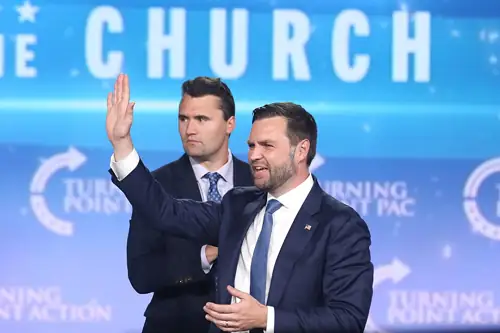
Here is where it gets genuinely surreal. According to The Guardian, the lawsuit was filed in 2022 by JD Vance, then a Senate candidate, Republican former congressman Steve Chabot of Ohio, the National Republican Senatorial Committee, and the National Republican Congressional Committee. The same JD Vance who is now Vice President of the United States.
Vance and the plaintiffs argued that spending limits on political parties are redundant and unconstitutional given that Super PACs already operate without meaningful restrictions. Their legal brief contended the law "severely restricts political party committees from doing what the First Amendment entitles them to do: fully associate with and advocate for their own candidates for federal office." The Trump administration backed this argument entirely, supporting Vance's case before a court that now includes three justices appointed by Trump.
Because the FEC has not had a quorum since April 2025 and cannot initiate enforcement actions, The Guardian notes the court had to appoint outside counsel just to have someone argue the other side. The agency designed to enforce campaign finance law has been functionally paralyzed, which means the administration got to argue for gutting a law while the body meant to defend it sat silent and empty.
The Corruption Argument Nobody Wanted to Hear
Roman Martinez, the outside counsel appointed to defend the law, made the straightforward case that ending these limits effectively legalizes quid pro quo political corruption. Lawyers for the Democratic Party, who intervened in support of the restrictions, put it plainly in a brief cited by NPR: authorizing unlimited coordinated expenditures would "fundamentally reshape the campaign finance regime" and "the potential for actual or apparent corruption is obvious."
The Republicans who brought the case had a response to that, and it is something. According to NPR, their lawyers argued that "it doesn't make any sense to think of a party as 'corrupting' its candidates, because the very aim of a political party is to influence its candidate's stance." Which is technically true in the same way it's technically true that a protection racket is just a business arrangement. The party wants to influence the candidate. The wealthy donor wants to influence the party. Everyone gets what they want except the voter.
Martinez also raised a procedural wrinkle: Vance's standing to bring the case in the first place. The Guardian notes he argued the claim is moot because Vance has "repeatedly denied having any concrete plan to run for office in 2028." The court apparently found this unpersuasive, which is fine, but it does add a certain flavor to the whole thing. The sitting Vice President helped gut campaign finance law using a lawsuit he may no longer personally need.
How We Got Here: A Brief History of the Court Eating Campaign Finance Law
Tuesday's ruling did not come out of nowhere. It is the logical endpoint of a two-decade project the court has been executing with remarkable consistency. NPR traces the timeline: Citizens United in 2010 gave corporations unlimited independent spending rights. The following year, the court dismantled Arizona's public election financing system. In 2014, McCutcheon v. FEC struck down aggregate limits on individual donations across all candidates and committees combined. Every one of these decisions broke along ideological lines. Every one of them cited the First Amendment. Every one of them made the next case easier to bring.
The Guardian notes that Citizens United and McCutcheon together fueled the rise of Super PACs, which can raise and spend unlimited sums as long as they don't coordinate with campaigns. That "no coordination" rule was always the theoretical firewall against outright corruption. The court just burned that firewall down for political parties specifically, which happen to be the organizations that run our elections, select our nominees, and, increasingly, receive vast sums from a small number of extraordinarily wealthy donors.
What's left of federal campaign finance law at this point is essentially the individual contribution limits to candidates directly and some disclosure requirements. The architecture that Congress built after Watergate, which was supposed to prevent the precise kind of money-for-access corruption that brought down Nixon, has been systematically demolished, ruling by ruling, over 16 years.
What Happens Now
NPR acknowledges honestly that the practical implications of Tuesday's ruling are unclear in terms of immediate behavior. But the direction is not unclear at all. Wealthy donors who wanted to funnel unlimited money to candidates but found the Super PAC's no-coordination rule inconvenient now have a cleaner vehicle: the party itself. Write a check to the party. The party coordinates directly with the candidate. The candidate knows exactly who wrote the check.
That is not a hypothetical corruption scenario. That is a description of how the system will function. The court's Republican appointees argued, through the Kavanaugh majority, that there's no real evidence these limits prevented corruption anyway. Which is a little like arguing seatbelt laws are unnecessary because people still die in car crashes sometimes.
The Dingo Take
Let's be honest about what just happened. A Vice President who filed a lawsuit to remove campaign finance restrictions watched a court stacked with justices appointed by his own boss rule in his favor, while the regulatory agency that was supposed to fight back sat empty and powerless because that same administration never bothered to fill it. This is not a coincidence. This is a system being operated exactly as intended by the people operating it.
The Republicans who brought this case argued, with straight faces, that parties cannot corrupt their own candidates because corruption implies someone's being influenced against their will, and parties exist to influence candidates. That framing would be almost philosophically interesting if it weren't being used to justify letting billionaires write unlimited checks to political parties that then spend that money in direct coordination with candidates. The word for that used to be bribery. Now it's First Amendment-protected political speech.
The court has now spent 16 years telling us, ruling by ruling, that money is speech, corporations are people, and any attempt to limit the flow of unlimited wealth into elections is an unconstitutional restriction on freedom. What they have never once explained is whose freedom, exactly, gets expanded when a hedge fund manager can now write an unlimited check to a party that will spend it electing a senator who will then vote on that manager's tax rate. Not yours. Not mine. The answer is obvious and the court knows it, and they don't care even a little bit.



Comments