David Streever sent one angry email to an ICE director in January, compared him to a Nazi, and then apparently forgot about it. The federal government did not forget about it. Six months later, Homeland Security Investigations agents were staking out his front porch in Rochester, tracking him to an airport hotel in New York, and leaving ominous legal warning forms with his wife, an Episcopal priest, while she was still wearing her clergy collar and holding their two-year-old.
What Actually Happened Here
Let's be precise about the sequence of events, because the details are important and also completely insane. On January 26, after federal immigration officers fatally shot two people in Minneapolis, Streever, a 45-year-old former journalist now working in tech, sent a single email to Todd Lyons, then the acting director of ICE. According to NPR, which reviewed the email, Streever told Lyons that his own conscience would torment him for his actions and compared him to a Nazi official. That's it. One email. To a government official. At his government email address.
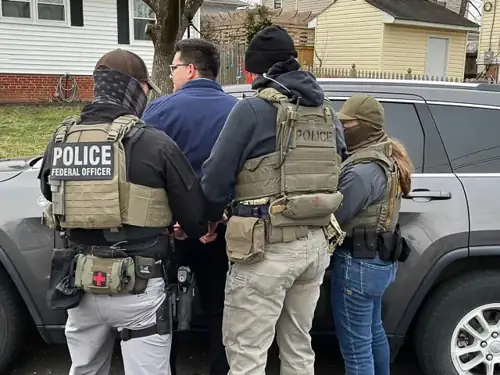
Then nothing. For six months. Until June 23, when two Homeland Security Investigations agents showed up at the Streever home in Rochester while David was in Finland on vacation with his seven-year-old daughter. His wife Hilary, an Episcopal priest, came home with the couple's two-year-old son and found two federal agents waiting on her porch.
The agents told her they were there about an email her husband "may or may not have sent threatening Todd Lyons." They left a form that said, in large letters, "WARNING NOTICE" and "YOU MAY BE IN VIOLATION OF FEDERAL LAW," listing statutes that criminalize threatening federal officials. Then, according to NPR, just hours after David Streever landed at JFK on Thursday evening, a third HSI agent tracked him to the airport hotel where he was staying for the night and left a business card with the front desk.
The Email That Apparently Broke the Federal Government
Streever told NPR he had been watching what he believed was the country sliding toward fascism, specifically after seeing footage of federal officers fatally shooting bystanders Renée Macklin Good and Alex Pretti in Minneapolis, and then watching administration officials try to label both victims domestic terrorists. So he did what an enormous number of Americans do every single day. He sent an angry email to a government official.
"One powerless citizen yelled into the void with a stern email to the former director of this agency six months ago," Streever told NPR. "And now there's agents at his door."
The First Amendment exists precisely to protect this kind of speech. You are allowed to write angry emails to government officials. You are allowed to compare government officials to Nazis. You are allowed to tell a federal bureaucrat that his conscience will haunt him. Adam Steinbaugh, an attorney at the Foundation for Individual Rights and Expression, told NPR the same thing more formally: "The government doesn't have to listen to those, but it doesn't get to dispatch federal agents to your door and stalk you across the state of New York."
This Isn't a One-Off, It's a Pattern
NPR notes this is the most recent in a string of DHS actions against protesters and critics over the past year, and it landed in their reporting on the same day the same two agents presented the identical "WARNING NOTICE" form to a Syracuse poll worker who had allegedly said something critical of ICE on Instagram. Same form. Same agents. Same day. Different critics.
Civil liberties advocates have been sounding alarms about how DHS is using these warning forms, calling them an intimidation tactic designed to silence people who speak out against the agency. When you pair that with the detail that a federal agent apparently tracked Streever's travel itinerary closely enough to find him at a specific airport hotel on the night he landed back in the country, you are not looking at a routine investigation into a credible threat. You are looking at surveillance of a critic.
DHS did not respond to NPR's specific questions about the case, including whether the January email was actually the one that triggered all of this. The department's statement: "ICE investigates all credible threats towards its employees and officers, including threats to the ICE Director. As a matter of policy, we do not comment on any ongoing investigations." So the position is that this was a credible threat investigation. Into a strongly worded email. Sent six months ago. To a government account.
What Three Federal Agents and Six Months of Investigation Actually Achieved
David Streever is not in custody. He has not been charged with anything. He went on vacation to Finland with his kid, came home, and found out the federal government had been treating his January email like an active threat requiring multiple agents, multiple visits, and what looks like airport surveillance.
His wife had to come home to find two agents on her porch while she was carrying their toddler. She had to have a conversation with federal law enforcement about whether her husband sent a threatening email while she was still in her clergy collar. Then she had to call her husband in Finland and tell him the government was looking for him.
"I've never made a threat against anyone. I'm not a violent person," Streever told NPR. Which, if you've read the email he actually sent, is entirely credible. Calling a government official's conscience into account and comparing him to a historical villain is rhetoric. Rhetoric is what citizens do. Sending three federal agents to track a person across international borders and then across New York state in response to rhetoric is something else entirely.
The Dingo Take
Here is what the federal government's behavior in this case actually communicates: if you send an angry email to an ICE director after federal agents kill someone, we will find you. Maybe not immediately. Maybe we'll let you relax for six months, forget you ever sent it, take a nice vacation to Finland. And then we will show up on your porch, flash warning notices at your wife, and track you to your hotel. The message is not "we investigated and found nothing." The message is "we know where you are."
DHS's statement that it "investigates all credible threats" is doing an enormous amount of work here. The agency reviewed an email, decided it rose to the level of requiring federal investigation, and six months later mobilized at least three agents across two locations to confront a guy who compared a bureaucrat to a Nazi in a private email. If that's the credible threat bar, there are tens of millions of Americans who should be very nervous right now. Approximately all of them who have ever sent an angry message to a government inbox.
The Streevers are not alone in this. The same day this happened, a poll worker in Syracuse got the same form for an Instagram post. NPR has been tracking a broader pattern of DHS going after private citizens for speech, including people who posted about ICE online. What the administration is building here is not a law enforcement operation. It's a chill. A systematic, documented, federally resourced effort to make ordinary people afraid to say things the government doesn't like. And it's working the way these things always work, slowly enough that each individual case sounds like an unfortunate one-off, until you line them all up and realize they rhyme.



Comments