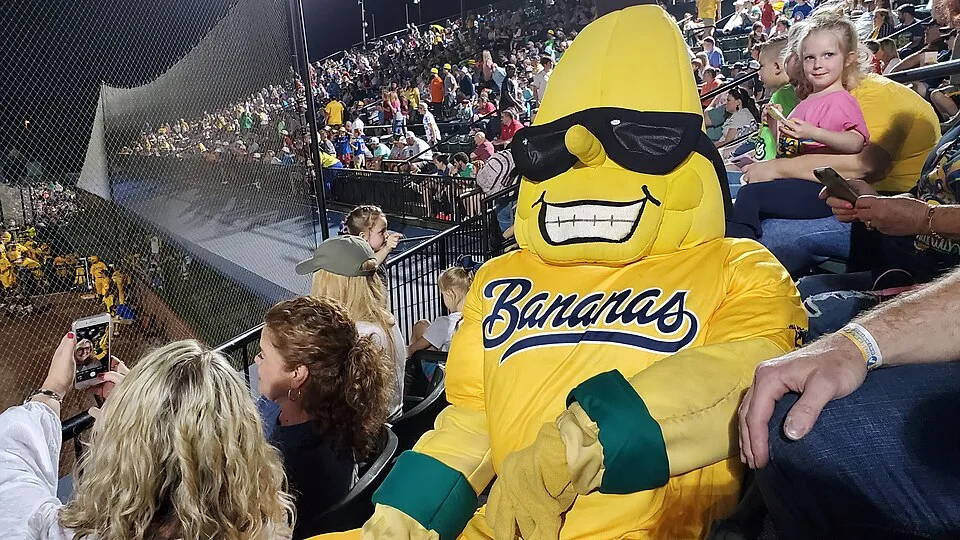
A man in a yellow tuxedo has figured out how to sell out Fenway Park with a game that bans bunting, puts grandmas on the field, and makes a baby dressed as a banana the pregame centerpiece. The Savannah Bananas are not exactly baseball. They are also, somehow, one of the more genuinely heartwarming stories in American sports right now, and that second part is the part you probably didn't see coming.
What the Hell Is Banana Ball, Exactly
Start with this: it looks like baseball. It smells like baseball. There's a mound, a batter's box, an outfield. Then an umpire starts dancing, a batter steps up to the plate on stilts, and a fielder catches a pop-up mid-backflip after tossing his glove aside. According to CBS News, which sent 60 Minutes correspondent Lesley Stahl to document the whole beautiful mess, the game was built by Jesse Cole on a very simple principle: take every slow, boring part of baseball and do the exact opposite.
No mound visits. No walks. No bunting. Two-hour time limit, full stop. If a fan catches a foul ball in the stands, the batter is out. And if the pitcher issues ball four, the batter takes off sprinting and can't be tagged out until every fielder has touched the ball. Cole told 60 Minutes that a walk is 'unathletic' by name and design, and he wasn't wrong. In Banana Ball, a walk becomes, as Cole put it, 'one of the most exciting plays in sports.' Hard to argue with a straight face, but also kind of hard to argue at all.
The game also runs on choreography. Players perform elaborate lip-synched walk-up routines to songs by Kendrick Lamar, Taylor Swift, and the Village People. Before a pitch is thrown, the crowd witnesses the honoring of the 'Banana Baby,' a local infant in a banana costume lifted aloft while 'The Circle of Life' plays and players kneel around it like it's the opening of The Lion King. The dance team is called the Banana Nanas and it is made up entirely of grandmothers. CBS News reports that nearly 50 things happen before the game even starts.
The Guy in the Yellow Tuxedo Has Been at This for a While
Jesse Cole wears a yellow tuxedo every single day. Not as a bit. As a philosophy. His influences, per his own account to 60 Minutes, are P.T. Barnum and Walt Disney, which tells you most of what you need to know about the man's operating theory.
His path here was not a straight line. Cole grew up dreaming of playing for the Red Sox, but a shoulder injury in college ended that chapter before it started. He moved into coaching, landed a job managing a struggling college summer league team in Gastonia, North Carolina called the Grizzlies, and had what CBS News describes as a revelation sitting in the dugout: he was bored out of his mind. If he was bored watching baseball from the dugout, somebody watching from the bleachers with a $14 beer was definitely bored.
He started teaching his players the Thriller dance. His future wife Emily, then working for a minor league team in Augusta, saw him on the field running through the choreography and, according to her own retelling to 60 Minutes, decided immediately that he was the one. They married, and in 2015 they launched the Savannah Bananas as a college summer league team in Georgia. They added all-you-can-eat food, kept escalating the entertainment, won titles, and then hit a wall: fans were still leaving early. That ate at Cole until he realized, as he told Lesley Stahl, that it meant there was 'a fundamental problem with the actual game.' So he started studying crowd behavior on video, clocking exactly when people checked their phones, and built an entirely new ruleset around the answers.
Selling Out MLB Stadiums Without Being MLB
Here is the part that should genuinely impress even the most committed baseball traditionalist: the Savannah Bananas have sold out Major League Baseball stadiums. Not minor league parks. Not fairgrounds. Fenway Park in Boston. Citizens Bank Park in Philadelphia, where CBS News reports they played to a completely sold-out, standing-room-only crowd of 45,000 people last fall.
For context, actual MLB teams with actual playoff contenders sometimes struggle to fill those same seats on a Tuesday in May. This exhibition baseball circus, featuring grandma dance routines and a stilts batter, packed Philadelphia to the rafters. The Bananas play against their main rivals, the Party Animals, who are also owned by Cole, which means the whole competitive structure is essentially a very elaborate performance with real athletic stakes baked in. Longtime baseball writer Tim Kurkjian attended a game and told 60 Minutes, 'This is the stupidest thing I have ever seen. I loved it.' That sentence is probably the most accurate review ever written about anything.
The Foster Care Operation Nobody Expected
Here is where the story takes a turn that genuinely earns its emotion without being cloying about it. Jesse and Emily Cole are licensed foster parents. CBS News reports that the couple, who already had one biological son, received a call to take in a two-year-old girl. A year later, another call, another placement: a newborn baby girl who had tested positive for illegal substances at birth.
Emily Cole told CBS News that the goal was always to walk alongside the children until they could safely reunify with their biological families. That reunification never happened in either case. The Coles have since permanently adopted both girls. The experience changed what they decided to do with their platform.
They created a nonprofit called 'Bananas Foster,' which celebrates and raises awareness about foster families. At every Banana Ball game, a foster family is called onto the field and recognized in front of the crowd. CBS News reports that those families routinely receive standing ovations from tens of thousands of people, many of whom have likely never thought about foster care for more than thirty seconds in their lives. Emily Cole framed it plainly: 'We know about this need in foster care, and fortunately we have this platform now, that we saw an opportunity to be able to use our platform to talk about something that is a topic in society that's not touched on a lot.' That is, frankly, an understatement. Foster care in America is chronically underfunded, undersupported, and invisible in most public conversations.
What This Is Actually About
The Coles are deliberate about the multigenerational angle in a way that goes beyond good marketing. Emily Cole told CBS News that one of the most fulfilling things they hear is from families where the toddlers came, mom and dad came, and they brought the grandparents, and everyone sat together for a few hours and actually connected. She said there are 'so few things in life' that pull multiple generations into the same experience at the same time.
Jesse Cole told 60 Minutes about a man who approached him at a game and said, 'You gave me something that my daughter and I can bond over together. You have no idea how much this means to me.' Cole, who has two daughters, said he understood exactly what the man meant. It is a slightly sentimental thing to include in a story about a baseball gimmick that involves stilts. It also lands, because it is clearly true.
The Bananas run a tight script. Nearly 50 programmed moments before the first pitch. A Circle of Life baby. Dancing grandmas. Lip-sync battles. And buried inside all of it, a real family story about foster kids and a couple who decided their sold-out stadium tour was an opportunity to do something useful with the attention.
The Dingo Take
American professional sports are, in 2026, largely a machine for extracting money from people who were already loyal before the machine arrived. Ticket prices are obscene. Broadcasts are cluttered with ads. The actual games, in baseball's case especially, have spent years in a bureaucratic war with their own watchability. And then this guy in a yellow tuxedo shows up, bans the bunt, recruits some grandmothers, and packs Fenway Park by apparently just asking the question: what if people had fun?
The foster care piece is the thing that separates this from a novelty act. The Coles are not slapping a cause onto their brand for the optics. They are licensed foster parents who adopted two kids through the system and then used the largest stage they could find to make foster families visible for three minutes a night in front of 45,000 people who are already feeling generous because they just watched a backflip catch. That is a genuinely smart use of cultural capital, and it is embarrassingly rare.
There is a version of this story where it is a little too wholesome to write about without rolling your eyes. But the eyes stay straight here, because the evidence is real: people are driving ten hours to see it, MLB stadiums are selling out, and somewhere in Philadelphia last fall, a foster family walked onto a baseball field and 45,000 strangers stood up for them. That is worth two minutes of your attention, even if you have never cared about baseball in your life.




Comments