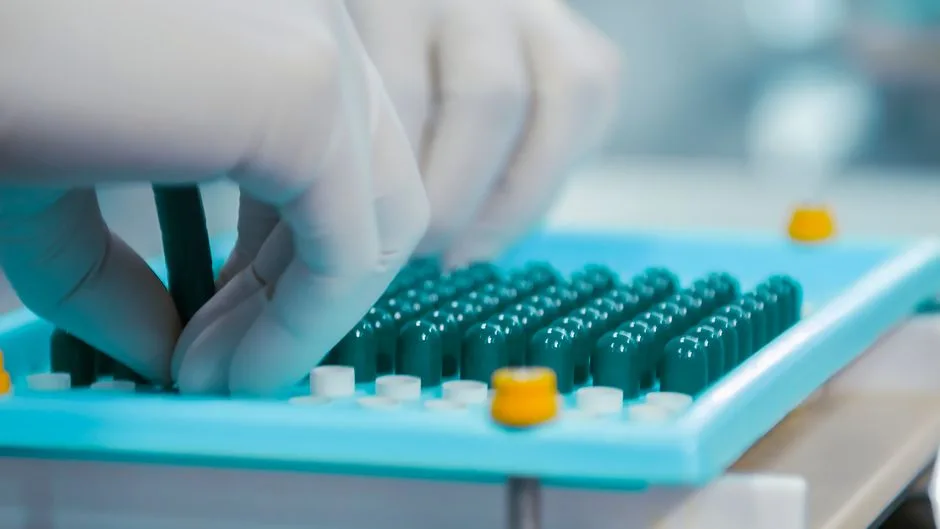
China's pharmaceutical industry just closed $110 billion in cross-border drug deals in the first six months of 2026 alone. That's 80 percent of what the entire previous year produced, and the year is barely half over. Now Beijing is pivoting to AI-designed drug candidates to make sure the next wave is even bigger.
The Numbers That Should Make Washington Choke on Its Coffee
Let's put $110 billion in context. That is not annual revenue. That is not a five-year plan. That is six months of cross-border pharmaceutical deals sealed by Chinese companies, according to South China Morning Post reporting on Chinese state media figures. Eighty-one deals. One hundred and ten billion dollars. January through June.
For comparison, last year's full-year total for the same metric was only about 25 percent higher than what China just did in half the time. The trajectory here is not subtle.
Buyers came from 20 countries and regions, the South China Morning Post reports, with the US, UK, France, and Italy leading the pack. So American and European pharma giants are not ignoring this. They are actively signing checks.
30 Percent of the World's Drug Pipeline. Second Place. Globally.
Here is a number that deserves its own paragraph: China now accounts for roughly 30 percent of all new drugs currently under development worldwide. That figure comes from Lan Gongtao, deputy director general of the Department of Drug Registration at China's National Medical Products Administration, speaking to state media.
Thirty percent. Second globally. And Lan did not stop there, telling state media that China's pharmaceutical industry has risen to the top tier globally in innovation efficiency. That is a government official making a claim that, given the deal flow, is not easy to dismiss as propaganda.
The deals span ten therapeutic areas, per the South China Morning Post: oncology, metabolic diseases, immunology, neurology, and six others. This is not a country quietly specializing in generic knock-offs anymore. This is a full-spectrum pharmaceutical power.
AI Is Now the Engine, Not the Buzzword
The pivot everybody in the industry is watching happened on July 2nd. CSPC Pharmaceutical Group signed a new collaboration with AstraZeneca, one of the biggest Western pharmaceutical companies on earth, according to the South China Morning Post. The deal leverages CSPC's proprietary AI molecular design platform to jointly discover and develop small nucleic acid drug candidates.
This matters because it signals where the next wave of deals is headed. China is not just closing licensing agreements and handing off compounds it developed the old-fashioned way. It is selling access to AI-powered drug discovery infrastructure, the kind of platform that doesn't just find one drug, it potentially finds hundreds.
When AstraZeneca, a company that spends billions annually on its own R&D, decides it needs a Chinese AI platform to hunt for drug candidates, that tells you something has genuinely shifted. This is not flattering imitation. This is China setting the terms.
How Did We Get Here and Why Does No One Seem Alarmed?
The American political conversation about China has spent years focused on semiconductors, TikTok, and steel tariffs. Meanwhile, China has quietly built a pharmaceutical innovation engine that now touches nearly a third of the global drug pipeline.
The conditions that made this possible are not mysterious. China has a massive domestic patient population generating clinical data at scale. It has government investment in biotech infrastructure that makes the US federal science budget look like a rounding error. And it has been importing pharmaceutical talent aggressively for two decades, including a lot of it trained at American universities.
None of this happened overnight. It happened while Washington was busy arguing about drug pricing in ways that, depending on your political alignment, either protected patients or kneecapped domestic R&D investment. Both things can be true. The result is the same either way: China got here while we were distracted.
The Deals Keep Coming
The South China Morning Post notes that momentum has carried into July, with the CSPC-AstraZeneca deal landing just two days into the month. If the first-half pace holds, 2026 full-year totals could push toward $250 billion or beyond.
The therapeutic areas driving the most deal activity include oncology and metabolic diseases, which means we are talking about cancer treatments and drugs for conditions like diabetes and obesity. These are not niche markets. These are the biggest, most lucrative drug categories on earth, and China is planting its flag in all of them.
The Dingo Take
The thing about a story like this is that it does not fit neatly into any of the boxes American politics has built for talking about China. It is not a national security scare story exactly, though there are obvious national security implications when a geopolitical rival controls 30 percent of the global drug pipeline. It is not a trade war story exactly, though $110 billion in cross-border deals in six months will eventually force trade conversations nobody seems ready to have. It is just a story about a country deciding it wanted to be great at something, investing accordingly over decades, and getting there.
The AI angle is where this gets genuinely unsettling. Drug discovery has historically been slow, expensive, and brutally random. A working AI molecular design platform changes the math on all three. If China has built infrastructure that can identify promising drug candidates faster and cheaper than traditional methods, then the $110 billion figure from the first half of 2026 may look quaint in five years.
And before anyone starts drafting the 'but can we trust Chinese drugs' response: AstraZeneca just bet its partnership dollars that yes, actually, they can. You can argue with a lot of things. It is harder to argue with where the money goes.



Comments