The Sudanese army is accused of using Antonov aircraft to drop barrel bombs on civilian neighborhoods in the Jabra area of North Kordofan State, killing and injuring people on the ground. This comes while the United States is separately telling international weapons inspectors that Sudan's military already used chemical weapons on its own population in 2024. Two accusations, one army, zero accountability so far.
What Happened in Jabra
According to local sources cited by teleSURenglish, Sudanese army aircraft dropped barrel bombs on the Jabra area of North Kordofan State, hitting both military positions and civilian neighborhoods. Homes were damaged. Thick clouds of dust and smoke rose over the area. People were killed and injured.
The incident has not been independently verified. The Sudanese army has not claimed responsibility for civilian casualties, and has not clarified what kind of munitions were used. That last part matters quite a bit, as we will get to.
Barrel bombs, for anyone who hasn't had the misfortune of covering a modern conflict lately, are exactly as primitive and horrifying as they sound. Metal containers packed with high explosives and shrapnel, no guidance systems, just shoved out of a plane and allowed to fall wherever gravity takes them. Amnesty International has previously documented the Sudanese Armed Forces using exactly this method in South Kordofan, rolling barrel bombs out of Antonov aircraft flying at high altitude. At that altitude, accuracy isn't just unlikely. It's physically impossible.
A Legal Term Worth Using Carefully, and Often
Amnesty International has been clear about what this technique means under international law. The nature of barrel bombs makes them inherently indiscriminate, and their use in civilian areas may constitute a war crime. That's not hyperbole from a headline writer. That's the legal framing from one of the most rigorous human rights documentation organizations in the world.
The blast waves from these weapons don't just destroy buildings. They send enormous quantities of soil, rubble, ash, and whatever was burning nearby into the air. Health experts warn that the resulting particle clouds can cause breathing difficulties, eye irritation, and respiratory inflammation, and can be particularly dangerous for anyone with asthma or existing lung conditions. People don't have to be in the immediate blast radius to be hurt.
Claims about toxic substances in Jabra specifically are still unverified. TeleSURenglish is careful to note there are currently no independent findings confirming that the dust clouds contained toxic gases or prohibited chemical substances. Human rights organizations are calling for investigative teams to go in, collect munition remnants, and take air and soil samples. Until that happens, the full picture remains incomplete.
But About Those Chemical Weapons Allegations
Here is where this story gets considerably darker. The Jabra bombing isn't happening in a vacuum. It's happening while the United States is actively telling international inspectors that Sudan's military used chemical weapons in 2024.
At the Executive Council of the Organisation for the Prohibition of Chemical Weapons, the U.S. delegation said an independent technical assessment had concluded that the Sudanese Armed Forces used chemical weapons during 2024. Ambassador Nicole Shampaine, leading the U.S. delegation, stated plainly that the prohibition against the use of chemical weapons is absolute and non-negotiable. She called for immediate, unrestricted access for international inspectors and a full Sudanese declaration of relevant facilities, stockpiles, and programs.
Reports cited by teleSURenglish indicate the army used containers or barrels carrying chlorine, dropped from aircraft in remote areas. Chlorine is a yellow-green gas heavier than air. It sinks into low-lying spaces and buildings. When inhaled, it causes severe pain, coughing, suffocation, and lung damage. At high enough concentrations, it kills. Sudan's forces are also, conveniently, the only party to this war with manned aircraft capable of carrying out this kind of attack.
Sudanese authorities deny all of it. They say the United States failed to provide details about when and where the alleged attacks took place, or the test results behind its conclusions. That's a fairly standard response from a government accused of war crimes. Demand specifics you know the accuser can't immediately hand over in a public forum, then claim vindication.
The Militia Problem Nobody Wants to Talk About
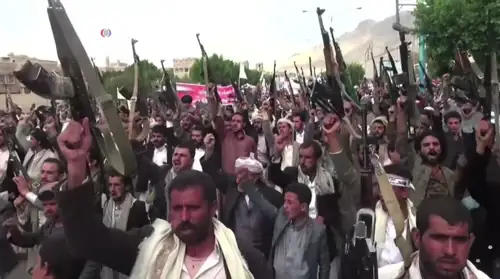
Running alongside all of this is a separate thread that deserves its own attention. The Sudanese army isn't fighting alone. According to teleSURenglish, the conflict has seen growing involvement of armed Islamist groups fighting alongside the military, most prominently the Al-Baraa bin Malik Brigade, a militia that emerged from the Popular Defence Forces created under former dictator Omar al-Bashir.
The U.S. Treasury Department says this brigade contributed more than 20,000 fighters to the war against the Rapid Support Forces, received training and weapons from Iran's Islamic Revolutionary Guard Corps, and has been implicated in arbitrary detentions, torture, and summary executions. Treasury sanctioned the brigade in September 2025. Then in March 2026, the State Department designated both the Al-Baraa bin Malik Brigade and the Sudanese Islamic Movement as Foreign Terrorist Organizations.
So to be very clear about what we're describing here: a military force accused of dropping chemical weapons on civilians is receiving battlefield support from an Iran-backed militia that the United States has officially labeled a terrorist organization. This is the situation on the ground in Sudan right now.
What Investigators Are Asking For
Human rights organizations are calling for investigative missions to be sent to Jabra immediately. The ask is specific: collect munition remnants, take air and soil samples, examine victims and injured survivors. Images and witness testimonies, they argue, are not sufficient on their own to determine whether conventional explosives or prohibited substances were used.
That's a reasonable standard. It's also one that becomes nearly impossible to meet the longer access is denied and the longer the international community treats this as a distant, complicated tragedy rather than an active atrocity requiring an urgent response. Evidence degrades. Witnesses scatter. Governments deny.
The Dingo Take
Let's be honest about what makes Sudan's war so easy to ignore in Western media. It doesn't fit a clean narrative. There's no clear good guy. The Rapid Support Forces, the paramilitary group the Sudanese army is fighting, has its own extensive record of mass atrocities, including documented genocide in Darfur. So the temptation is to call it all impossibly complicated and move on. That framing is doing a lot of work for a lot of governments that would prefer not to act.
But "complicated" is not the same as "unknowable." We know barrel bombs are indiscriminate by design. We know the United States has formally accused Sudan's army of using chemical weapons, through the official channels of the international body specifically created to prevent chemical weapons use. We know an Iran-backed militia designated as a terrorist organization has thrown tens of thousands of fighters into this fight. These are not contested facts requiring further study. They are the situation.
The people of Jabra did not get to weigh the complexity of their geopolitical situation before the bombs landed on their neighborhoods. At some point, the international community has to decide whether "we can't verify every detail" is a good enough reason to let alleged war crimes continue without consequence. Based on the last several years of Sudan coverage, the answer seems to be yes. And that's a damning verdict on all of us watching from a safe distance.


Comments