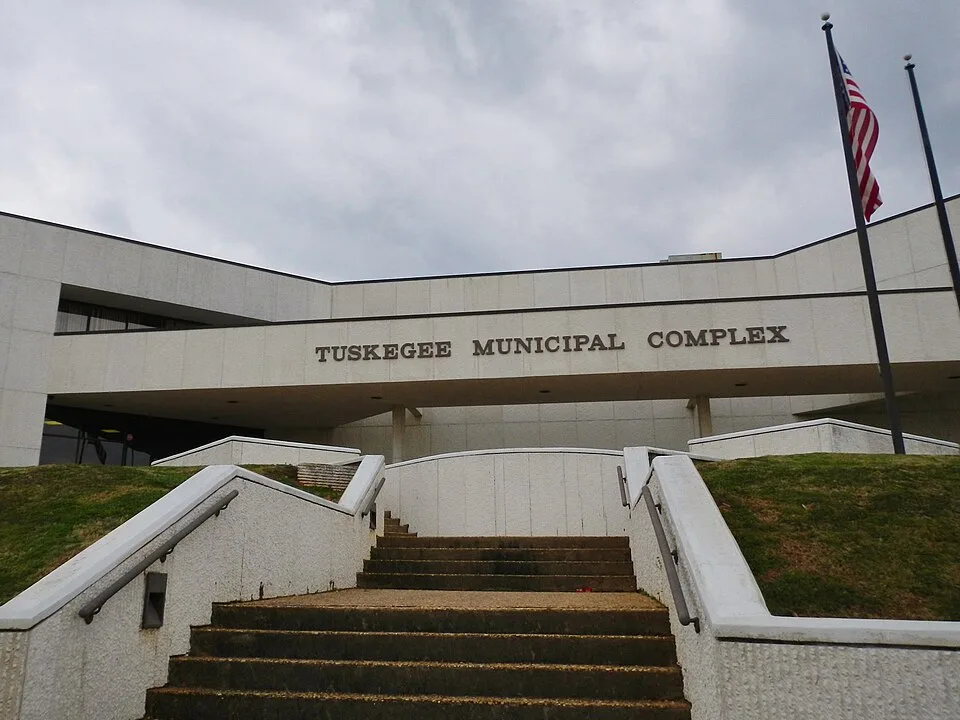
A 19-year-old in Tuskegee, Alabama recently decided to let a gashed, bleeding arm go untreated rather than travel to the nearest hospital and pay a bill he couldn't afford. There is no hospital in Tuskegee. There is no 24-hour clinic. There is a fire department, and that's mostly what people have. For one brief moment in 2024, they also had a congressman who actually showed up. Alabama Republicans are now working hard to take that away too.
What 'Representation' Actually Looks Like When You've Never Had It
Tuskegee is a city of fewer than 9,000 people, over 80% of them Black, and nearly one in three living below the poverty line, according to BBC News. It has no general hospital. The fire department fields calls for bullet wounds and people bleeding out. Captain Dondrell Hopson told the BBC his building is not fit for purpose. It's just what's there.
When Shomari Figures won his House seat in 2024, becoming the first Black person to represent Tuskegee in Congress in modern history, he got to work almost immediately. Within a year, he had secured $1 million in federal funding to build a civic center that would double as a storm shelter and house both the police department and that overworked fire station. A million dollars doesn't sound like much in a federal budget that runs into the trillions. In Tuskegee, it was enormous.
Mayor Chris Lee put it plainly to the BBC: "All of our issues, we do depend on federal funding. It's very important that we have someone who has our back." Before Figures, the mayor said he couldn't even remember seeing their congressman. That congressman was Republican Mike Rogers, who did not respond to the BBC's request for comment. Shocking.
How a Majority-Black District Gets Built, Then Dismantled
Here's the short version of how Figures' district came to exist. In 2023, the Supreme Court ruled that Alabama's Republican-drawn congressional map violated the 1965 Voting Rights Act by splitting Black voters across multiple districts and diluting their power. The state was forced to draw a new map. That new map produced two districts where African Americans were in the majority, or close to it. Figures ran in one of them and won.
That was always going to make Alabama Republicans furious, and in April of this year the Supreme Court handed them their revenge. As the BBC reports, the Court issued a new ruling that makes it dramatically harder to challenge congressional maps on the grounds of racial discrimination. Alabama moved fast. The majority-Black district that sent Figures to Washington is gone. He now heads into November defending a redrawn, white-majority seat.
The political math is not subtle. The BBC notes that roughly 83% of Black voters support the Democratic Party, while non-Hispanic white voters lean Republican. Redrawing a majority-Black district into a majority-white one is not a coincidence. It is the point.
The 'Monkey Town' Text and Other Evidence of Race-Neutral Politics
Alabama Attorney General Steve Marshall wants you to know this is all perfectly fine and absolutely not about race. He told the BBC that Republican efforts to redraw the maps are partisan political battles, not racially motivated, and that Democrats do the same thing in states like California. "Race-neutral principles," he called it.
Figures disagrees, and he has receipts. As the BBC reports, a three-judge panel that originally blocked Alabama's map cited a text message in which state legislators referred to Montgomery as "monkey town" during the redistricting process. Montgomery is over 60% Black and will now be folded into the newly redrawn second district alongside Tuskegee. Race-neutral principles, everyone. Very normal redistricting language.
Figures told the BBC he believes the whole effort is "purely racially motivated." Given the text messages, the history, the timing, and the demographic outcomes, you'd have a hard time mounting a compelling counter-argument.
What the November Midterms Could Actually Mean for a City With No Hospital
The stakes here go well beyond one congressional seat. The BBC reports that Republican-led states across the South are now redrawing maps following the April Supreme Court ruling, erasing majority-Black districts in a coordinated effort that could shift the balance of power in Congress and either accelerate or slow Trump's second-term agenda. This is happening in multiple states simultaneously. It is a strategy, not a series of coincidences.
For Tuskegee, the consequences are immediate and concrete. The civic center is funded. The money is there. But Mayor Lee told the BBC that the city worries about what comes next if Figures loses. They are, as the mayor put it, "really just at the tip of the iceberg of seeing the real impact." Federal funding doesn't flow to communities based on need. It flows based on who's asking, how loudly, and whether anyone in Washington cares enough to answer.
The BBC describes Tuskegee's South Main Street on a drizzly June morning: a two-lane road running into a town square dominated by a towering Confederate monument, vines growing through broken windows on abandoned buildings, street after street of them. The city had started to feel something like optimism. Now it's waiting to see if the map-drawers take that too.
The Dingo Take
Let's be precise about what just happened. A community with no hospital, 30% poverty, and a fire department that stitches up gunshot wounds got its first real congressional representation in modern history. That representative secured a million dollars in federal funding within his first year. And then the Supreme Court handed Alabama Republicans the legal cover they needed to dissolve the district and put Figures into a seat he is far more likely to lose. The mechanism was the Voting Rights Act, the law that exists specifically to prevent this kind of thing. The Court weakened it enough to make the thing it was designed to stop functionally legal again. If you are wondering whether the timing was intentional, the legislators calling Montgomery "monkey town" in their group chats have answered your question.
Alabama's attorney general pointing to California's Democratic gerrymanders as moral cover is the political equivalent of a guy who just robbed a convenience store pointing out that other people have also stolen things. Yes, both parties have played games with district lines. That is true and worth criticizing. It is also not the same as specifically targeting majority-Black communities in states with a well-documented history of voter suppression, using maps that legislators discussed using racial slurs while drawing. The comparison does not hold, and Marshall knows it.
De'Mari Benham is sitting somewhere in Tuskegee right now with a bandaged arm because he couldn't afford the drive and the bill to get stitches. The fire captain who wrapped him up is handling bullet wounds in a building that isn't built for it. A Confederate monument towers over an emptying town square. And the people in charge of drawing the lines just made sure Tuskegee's voice in Washington gets a lot harder to hear. This is the part where someone is supposed to say the system worked. Nobody should be saying that.

Comments