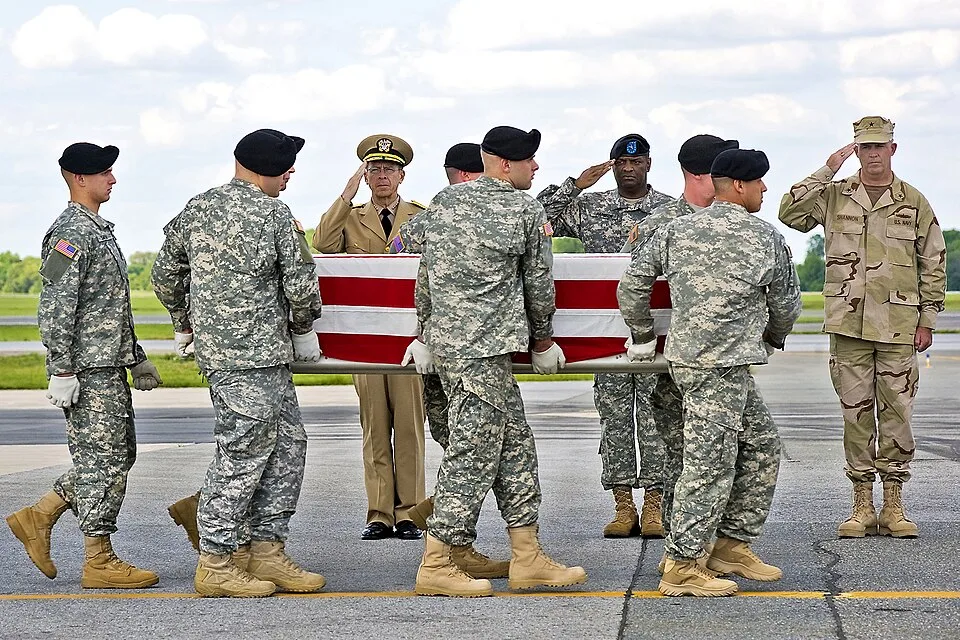
Two American service members are dead, one is missing, and four more were medevaced to hospitals after Iran launched a wave of ballistic missiles and attack drones at a U.S.-hosted airbase in Jordan. It is the first time Americans have died in this fight since Trump tore up the ceasefire last week. The total U.S. death toll in this war just hit 16.
What Happened at Muwaffaq Salti
On July 17, at least two Iranian ballistic missiles struck the Muwaffaq Salti Air Base in Jordan, a facility that hosts U.S. troops and fighter jets. The attack also included Iranian attack drones, according to U.S. Central Command. Videos circulating on social media showed the moment of impact and heavy smoke rising from the base.
CENTCOM confirmed the attack in an official statement Saturday, saying American and partner forces were actively defending against the barrage when the two service members were killed. Four other troops were medically evacuated to hospitals in Jordan, though they have since been released. Personnel with minor injuries have already returned to duty, the military said.
One service member is still listed as missing in action. The military has not disclosed how any of the casualties occurred, saying only that an investigation is ongoing. Names are being withheld until families have been notified, per standard protocol.
The Ceasefire Trump Killed
Here is the critical context. The New York Post reports that these are the first American fatalities since President Trump ended the ceasefire with Iran last week. Before that decision, U.S. deaths in this conflict had stopped. After it, they started again almost immediately.
The ceasefire, whatever its flaws, was keeping Americans alive. Trump ended it. Two weeks later, two more flag-draped coffins are headed home, and one family doesn't even know where their person is yet. That is the direct, traceable line between a presidential decision and a body count.
Axios reports that this attack brings the total number of U.S. service members killed in the war to 16. Sixteen Americans dead in a conflict that, depending on the day, the administration describes with wildly varying levels of urgency and commitment.
Iran Is Not Backing Down
This was not a rogue strike or a miscalculation by some proxy militia operating without orders. This was Iran firing ballistic missiles at an American military installation in a country that is supposed to be a stable U.S. partner in the region. That is a significant escalation in terms of both the weapon type and the target.
According to the New York Post, U.S. forces have faced repeated attacks from Iran and its proxy groups across the Middle East in recent days. Saturday's strike was not an isolated incident. It is part of a sustained campaign, and the frequency and lethality appear to be increasing rather than tapering off.
The combination of ballistic missiles and coordinated drone attacks in a single barrage suggests this was a planned, multi-layered operation, not something thrown together quickly. Tehran is telling Washington something. Whether Washington has a coherent answer remains, at this point, genuinely unclear.
What the Military Is Saying and Not Saying
CENTCOM's official statement confirmed the deaths and the missing service member but declined to specify the exact location within Jordan where the attack occurred. The command cited respect for the families of the fallen as the reason for withholding further details, which is standard and reasonable.
What is less reasonable is the broader information vacuum around U.S. strategy in this war. What is the objective? What does escalation look like to the administration? What is the threshold that triggers a significant response? These are questions reporters have been asking and the Pentagon has been answering mostly with practiced vagueness.
The investigation is ongoing, CENTCOM said. That is true. It is also the kind of sentence that can mean a great deal or absolutely nothing, depending on what comes next.
Jordan Is in the Middle of Someone Else's War
Muwaffaq Salti Air Base has been a critical hub for U.S. air operations in the region for years. Jordan has long been one of America's most reliable Arab partners, a Hashemite monarchy that has walked a careful line between its American alliance and the various fires burning around it. Putting American combat deaths on Jordanian soil creates real diplomatic complications for Amman.
The Jordanian government has not yet issued a public statement on the attack, at least not one captured in the available reporting. But hosting a base that just got hit by Iranian ballistic missiles is not a neutral fact. It raises questions about Jordan's vulnerability, about whether the base remains a viable operating location, and about what Iran is signaling by choosing it as a target.
This is a country that borders Israel, Syria, Iraq, and Saudi Arabia. It does not have the luxury of pretending this war is far away.
The Dingo Take
Let's be precise about what happened here. Trump had a ceasefire. He ended it. Two weeks later, two Americans are dead, one is missing, and the families of those service members are getting the worst phone call a family can receive. You can debate the ceasefire's merits all day long, but you cannot pretend there is no relationship between ending it and the body bags that followed. That is not a political argument. That is a calendar.
The administration will almost certainly respond with some combination of airstrikes, strong statements, and social media posts about how America doesn't back down. None of that will bring back the two people who died at Muwaffaq Salti. None of it will answer the family of the service member still listed as missing in action, who is right now sitting somewhere not knowing if their person is alive. Sixteen Americans dead. A war with no publicly articulated endgame. A ceasefire thrown in the trash.
If you supported blowing up the ceasefire, you own the 16. You don't get to wave the flag and skip the accounting. This is what the decision cost. Write it down.



Comments