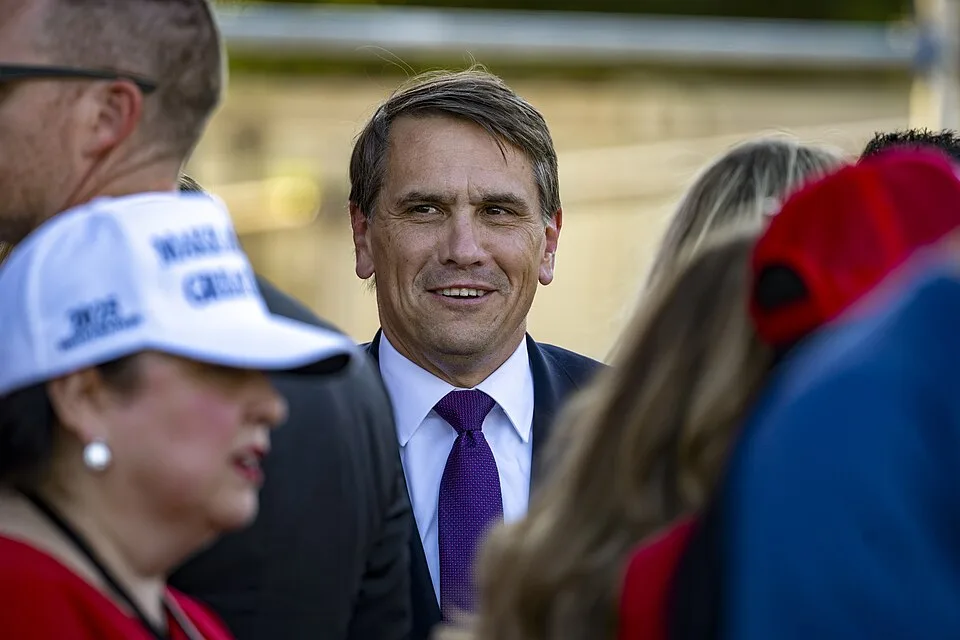
Trump's nominee for attorney general accidentally called himself "Trump's lawyer" during the very hearing where he promised to restore trust to the Justice Department. That is not a metaphor. That is what happened, in real time, on camera, in front of the United States Senate.
The Slip That Said Everything
Todd Blanche was mid-sentence, somewhere between pledging his fidelity to the rule of law and promising to rebuild public confidence in the Justice Department, when he did it. He referred to himself as Trump's lawyer. Then caught himself. Clarified he "was" Trump's lawyer. Past tense. Totally different.
It wasn't. As Robert Reich argues in The Guardian, the momentary slip wasn't a gaffe so much as a diagnosis. The guy spent years as Donald Trump's personal defense attorney, got him through multiple federal indictments, and now wants you to believe that the moment he gets confirmed as attorney general, all of that just evaporates. Clean slate. New man. Pure institutionalist.
The Senate is not obligated to believe that. Neither are you.
Jay Clayton Won't Say Biden Won. Wants to Run Intelligence.
Jay Clayton, Trump's pick for director of national intelligence, had a rougher time explaining himself. During his confirmation hearing, Clayton repeatedly refused to confirm that Joe Biden won the 2020 presidential election. Not a trick question. Not a constitutional gray area. A documented, certified, court-tested historical fact.
Senator Jon Ossoff apparently reached his limit. According to Reich's piece in The Guardian, Ossoff asked Clayton directly: "You refuse to answer a basic question about who won a presidential election? But you ask to lead America's intelligence community? Isn't it humiliating to be unable to answer this question? To have to indulge the president's delusions?"
Ossoff is not wrong. The person Trump wants overseeing the entire intelligence apparatus of the United States government cannot bring himself to say out loud that Biden beat Trump in 2020. That is the baseline. That is the floor. And Clayton couldn't clear it.
The CDC Pick Who Trusts RFK Jr. to Not Destroy Public Health
Erica Schwartz, Trump's nominee to lead the CDC, came into her hearing promising she would never compromise on the science. Strong start. Good words. Then she said she trusted that Trump and Robert F. Kennedy Jr. would not implement policies that hurt public health.
RFK Jr. The guy who has spent years casting doubt on vaccine safety, promoting health misinformation, and turning the Department of Health and Human Services into something that looks less like a public health agency and more like a wellness influencer's fever dream. That guy. Schwartz trusts that guy to not hurt public health.
As Reich points out in The Guardian, that single statement was enough to collapse her entire pledge. You cannot claim fidelity to science while simultaneously vouching for the judgment of someone who treats science as optional.
Loyalty as the Job Description
Reich frames all of this through the lens of integrity, tracing the word back to the Latin "integer" meaning whole or complete. Living by your principles. Maintaining your moral compass even when it costs you something. It's a simple concept. Trump finds it genuinely alien.
In Art of the Deal, Trump praised his mentor Roy Cohn specifically for prioritizing loyalty over integrity. Cohn, for context, was disbarred in New York in 1986 for attempting to defraud a dying client by forcing him to sign a will amendment leaving Cohn his fortune. Trump held this man up as the ideal. The gold standard. The goal.
The nominee roster starts to make a lot more sense once you understand that the hiring criteria is essentially "will you lie for me when it counts?" Blanche, Clayton, and Schwartz all showed up to their hearings and, in different ways, demonstrated that the answer is yes.
Lindsey Graham Gets His Own Paragraph Because He Earned It
Reich also takes a moment to revisit Lindsey Graham, who stood on the Senate floor after January 6th and condemned Trump in terms that were clear, specific, and apparently completely meaningless. Graham then spent the next several years becoming one of Trump's most reliable defenders and apologists.
This is worth naming plainly: Graham knew what he was doing. He is not confused. He is not conflicted. He made a calculated decision that proximity to power was worth more than his stated principles, and he has been cashing that check ever since. Reich calls this trading honesty for influence. That's one way to put it.
The Dingo Take
Here's what the confirmation hearings for Blanche, Clayton, and Schwartz actually revealed: the Trump administration has stopped even pretending that competence or independence are relevant qualifications. The job posting might as well read "must be willing to not know things you clearly know" and "must be comfortable pledging fealty to people actively dismantling your area of expertise." Clayton can't acknowledge a certified election result. Schwartz vouches for RFK Jr.'s judgment on public health. Blanche accidentally tells on himself in the first twenty minutes.
Robert Reich makes the point in The Guardian that you simply cannot have integrity and loyalty to Trump simultaneously. The regime runs on lies. Acknowledging basic facts becomes an act of disloyalty. So everyone around Trump has to choose, and the ones who make it through the selection process are specifically the ones who chose wrong.
What's genuinely alarming here isn't the hypocrisy, though there's plenty of it. It's the institutional rot that follows when the attorney general thinks of himself as the president's lawyer, when the director of national intelligence can't say true things out loud, and when the CDC director has already made peace with RFK Jr. calling the shots. These are not hypothetical dangers. These are the people who are about to run things. Pay attention.
Comments