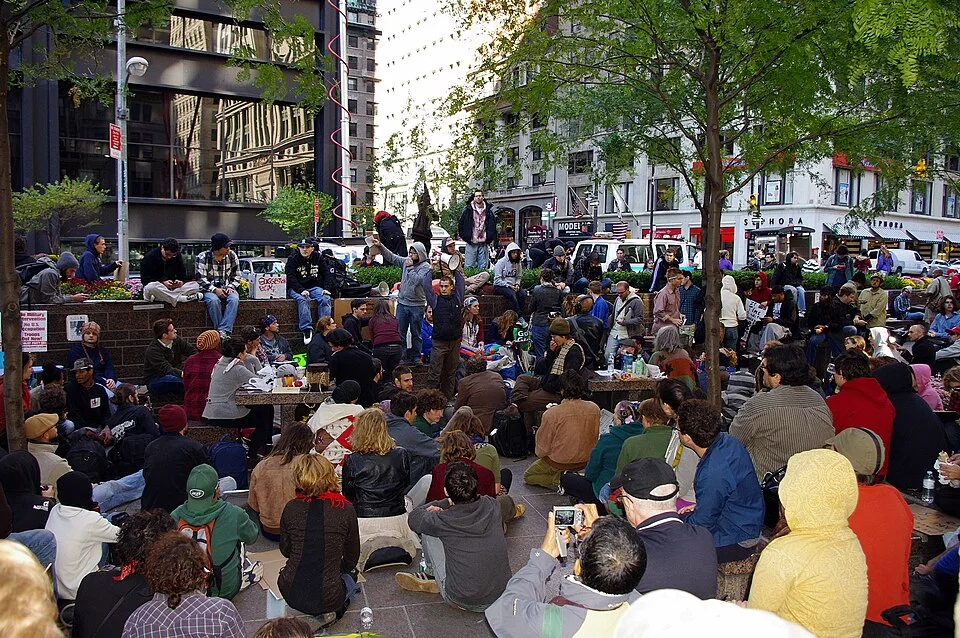
Fifteen years ago, Yotam Marom helped organize tens of thousands of people into Occupy Wall Street, one of the most visible protest movements in American history. Then he watched it fall apart in a matter of months. Now he's written a book explaining exactly why that happened — and, more uncomfortably, why the same self-destructive patterns keep showing up every time the left gets close to something real.
The Movement That Ate Itself
Occupy Wall Street collapsed for several reasons, as Marom explains to The Guardian. Police raids. Eviction orders. A brutal New York winter. But the thing that really did it, he says, was internal: what he calls a 'politics of powerlessness.' That's his phrase for the set of ideas and behaviors that turn movements inward, away from their actual opponents and toward each other.
In practice, this looked like a deep suspicion of any kind of leadership structure, an individualistic rather than systemic understanding of identity and solidarity, and a culture so focused on protecting the spaces of the people already inside the movement that it forgot to make room for the millions of people it needed to actually win anything. Occupy was, in this reading, less a movement that got crushed from outside than one that couldn't quite decide it wanted to exist.
Marom's new book, 'For Louder Days: Reaching Beyond a Politics of Powerlessness,' is his attempt to explain this dynamic, and his work since Occupy has given him plenty of material. He founded the Wildfire Project, a training organization for grassroots groups, and has worked with the Sunrise Movement, the Dream Defenders, the Uncommitted movement, and various tenants unions. He has seen this pattern enough times to know it isn't a quirk of Occupy. It's a feature of the left.
What 'Powerlessness' Actually Means
The politics of powerlessness, as Marom describes it to The Guardian, is essentially what happens when people stop believing they can win. And that is an entirely rational response to getting crushed repeatedly. If you don't believe leftwing political movements can succeed, the natural move is to stop doing the risky, exhausting work of building power and start focusing on being right. On being surrounded by people who already agree with you. On policing the ideological purity of everyone in the room.
That creates, as he puts it bluntly, 'unhealthy movements that people mostly don't want to be a part of.' Which then lose. Which then reinforces the original belief that winning is impossible. You can see how this goes.
The alternative, Marom argues, is deceptively simple: taking winning seriously. Organizations that actually want power build strategy, get past their discomfort with leadership structures, and create processes that let enormous numbers of people feel genuinely included rather than perpetually evaluated. This is less obvious than it sounds. The left has a long, storied tradition of making the perfect the enemy of the possible, and then being surprised when the enemy wins.
From Zuccotti Park to Zohran
Here is where the argument gets genuinely interesting. Marom tells The Guardian he sees a direct through line from Occupy Wall Street in 2011 to the current moment of left electoral insurgency. Occupy, for all its failures, brought thousands of new people into political organizing, trained hundreds of leaders, and fundamentally changed public common sense about class in America. The '99% versus the 1%' framing did not exist before Occupy and then suddenly it was everywhere.
That shift in common sense, he argues, is what made Bernie Sanders' 2016 run conceivable. Which helped make the Squad conceivable. Which helped make Zohran Mamdani winning the New York City mayoral race conceivable, along with a slate of DSA candidates sweeping city council seats. These things don't happen in a vacuum. They happen because previous movements moved the ground even when they didn't survive to see it.
The difference now, Marom says, is that these newer organizations have internalized a lesson Occupy never managed: they actually want to govern. They are doing the hard, unsexy work of building durable power rather than staging spectacular demonstrations of their own righteousness. That distinction matters more than it gets credit for.
Don't Spike the Football Yet
To his credit, Marom is not pretending the New York wins mean the left has figured it all out. He told The Guardian explicitly that overstating this moment is a real risk. Billionaires still hold concentrated power. The planet is still burning. Trump's authoritarian project is not over because Zohran Mamdani is mayor of one city. The border is still brutally militarized. Gaza is still being destroyed.
These are not small asterisks. The left is at the beginning of a trajectory, not the end of one, and Marom seems well aware that movements have declared victory prematurely before. The 'politics of powerlessness' has a cousin called the 'politics of premature celebration,' and it is equally fatal.
What he is arguing, though, is that something structural has shifted: that the American left has more organizational assets, more experienced leaders, and more practice at actually winning than it had fifteen years ago. Whether that infrastructure is enough to hold against what is coming is a different question entirely.
The Dingo Take
Here is what is genuinely striking about Marom's diagnosis. The 'politics of powerlessness' is not a bug in left organizing culture. It is a completely logical response to decades of losing. When you lose enough times, you stop optimizing for victory and start optimizing for moral clarity in defeat. At least then you're right. At least then nobody can blame you. The problem is that moral clarity in defeat still leaves the right in charge, which means it doesn't actually help anyone who needed the movement to win.
The DSA wins in New York are real and they matter. But they are also happening in one of the most left-leaning cities on the planet, at a moment when Trump has managed to make establishment Democrats look toothless enough that even centrist voters are open to something different. That is a specific set of conditions that will not automatically replicate itself in Wisconsin or Arizona. The organizational lessons are transferable. The political environment is not necessarily.
Still, Marom's core point deserves to be heard outside organizing circles where this kind of book usually circulates and then gets argued about forever. Movements that are afraid to lead, afraid to win, and more interested in internal purity than external power will keep losing to people who have no such ambivalence. The right is not squeamish about power. It has not been for a very long time. If the left wants to change anything that matters, at some point it has to stop being squeamish about it too.




Comments