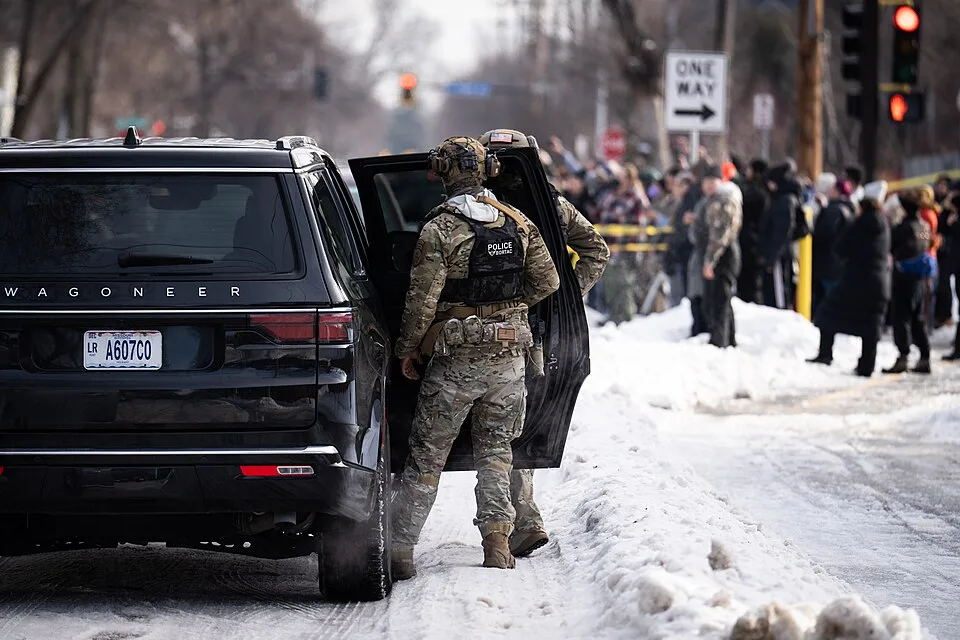
Ruben Ray Martinez was a 23-year-old U.S. citizen celebrating his birthday when an ICE agent shot and killed him at a traffic stop in south Texas. That was March 2025. A grand jury has since declined to charge the agent who pulled the trigger, DHS took 11 months to even admit it was involved, and his mother is watching the exact same thing happen to other families in real time.
Another Traffic Stop, Another Dead American, Same Story
Rachel Reyes saw the headlines about Lorenzo Salgado Araujo and Joan Sebastián Durán Guerrero — two men killed by federal immigration agents during traffic stops within a single week this month — and she didn't need to read past the first paragraph. She already knew exactly what those families were in for.
"It really breaks my heart for the families because I understand the nightmare they're going through," Reyes told NPR.
Her son Ruben Ray Martinez was shot and killed by a Homeland Security Investigations agent in the early hours of March 15, 2025, on South Padre Island, a resort town at the southern tip of Texas. He had just turned 23. He was a U.S. citizen. He is dead. And as of right now, no one has been held legally accountable for it.
What DHS Says Happened vs. What the Camera Shows
The Department of Homeland Security told NPR that Martinez "intentionally ran over" an HSI agent, sending the officer onto the hood of his blue Ford, and that a second agent then fired "defensive shots" to protect his colleague and the public. Clean, justified, case closed. That's the official version.
The body camera footage released by the Texas Department of Public Safety tells a messier story. According to NPR's review of that footage, Martinez was given conflicting directions before he slowly drove forward and to the left. Whether his vehicle actually struck an agent is, to put it generously, unclear from the video.
DHS deployed essentially the same script for the two men killed this month. In both the Texas and Maine cases, the agency said the victims tried to flee and used their vehicles as weapons. In Maine, DHS said the ICE officer feared "for public safety" before firing. No video evidence supporting those claims has been released by the federal government. In both of this month's incidents, ICE agents weren't wearing body cameras. Two passengers in the van driven by Salgado Araujo have disputed the agency's account entirely, according to Houston Public Media.
The Numbers Nobody in the Administration Wants to Talk About
Since Trump returned to office, there have been 29 instances in which immigration agents shot at civilians, at least seven of which were fatal, according to The Trace, a nonprofit journalism outlet focused on gun violence. The Associated Press puts the death toll at least at 10 during Trump's second term. That's not a rounding error. That's a pattern.
The American Civil Liberties Union has documented dozens of additional incidents across eight states since January 2025 where immigration officers rammed vehicles, smashed windows, and struck people with cars. Traffic stops have become one of ICE's primary enforcement tools, and the body count is rising.
After the two deaths earlier this month, NPR reported that DHS was planning to pause nonurgent vehicle stops. That lasted approximately 24 hours. Trump went on Truth Social and shut it down personally. "We CANNOT give up one of I.C.E.'s most important and effective Crime Fighting tools, THE TRAFFIC STOP!" he wrote. White House press secretary Karoline Leavitt backed him up at a press briefing Thursday, calling vehicle stops "a necessary tool that ICE agents need in order to continue their deportation campaign." Good to know where the priorities are.
Eleven Months to Admit Anything, Then Nothing
Here's the part that should make your jaw drop. In Martinez's case, it took DHS eleven months to publicly acknowledge that its own agents were even involved in his death. The agency's involvement only became known after the watchdog group American Oversight filed a public records request. DHS didn't volunteer this information. Someone had to drag it out of them.
In late February 2026, a Texas grand jury declined to bring criminal charges against the agent who shot Martinez. His mother's attorney, Charles Stam, says they're exploring every remaining legal option.
"If a U.S. citizen killed by an ICE agent cannot get a serious federal investigation or an admission of fault, imagine the odds facing families whose immigration status is precarious, who lack legal representation, or whose loved one's death did not happen to be caught on camera," Stam told NPR. Sit with that for a second.
The Accountability Gap Nobody Wants to Close
DHS pledged body cameras for all immigration agents. Months later, according to NPR's own reporting, that hasn't happened. The two agents who killed men in Texas and Maine this month were not wearing body cameras. The agency making claims about what happened in those stops has produced no video to support those claims. And the administration's response to public concern about all of this has been to post on Truth Social that traffic stops must continue.
In Minnesota, according to NPR, it remains unclear whether federal agents responsible for the deaths of U.S. citizens Renee Macklin Good and Alex Pretti back in January will face any charges at all. These aren't isolated incidents being handled by a system working to find the truth. They're a series of unanswered questions that nobody in power appears particularly interested in answering.
Rachel Reyes wrote an op-ed for The New York Times about the need for transparency and accountability in ICE shootings. She is a grieving mother who has now spent 16 months fighting to matter. "It's just really upsetting, the whole thing, because I know what it feels like, and it's incredibly frustrating to be treated like if your loved one's life doesn't matter," she told NPR.
The Dingo Take
Let's be very precise about what is happening here. An arm of the federal government shot and killed a 23-year-old American citizen at a traffic stop, spent nearly a year pretending it had nothing to do with it, released video that contradicts its own official account, watched a grand jury decline to charge anyone, and then had the president of the United States take to social media to demand that the practice responsible for the killing continue at full speed. That is the chain of events. Read it again if you need to.
The body camera pledge is the cherry on top of this particular disaster sundae. DHS announced it. Months passed. The cameras didn't appear. And when two more men were killed this month at traffic stops with no cameras rolling, the administration's solution was not "let's accelerate the camera rollout" but rather "the president is posting about how great traffic stops are." The accountability mechanism that doesn't exist is being defended by the people who were supposed to create it.
Ruben Ray Martinez's mother is still waiting. The families of the men killed in Texas and Maine this month are just starting their wait. In Minnesota, two other American families are waiting to find out if anyone will be charged for killing their people. This is the system working exactly as the people currently running it intend it to work. That's the part that should keep you up at night.


Comments