Twelve straight nights of U.S. airstrikes on Iran, two maritime chokepoints now under active threat, oil up 50% since January, and the president is out in Georgia telling a crowd that America doesn't need the Strait of Hormuz anyway. Everything is fine. Totally fine.
Trump's New Plan: One Bridge Per Tanker Attack
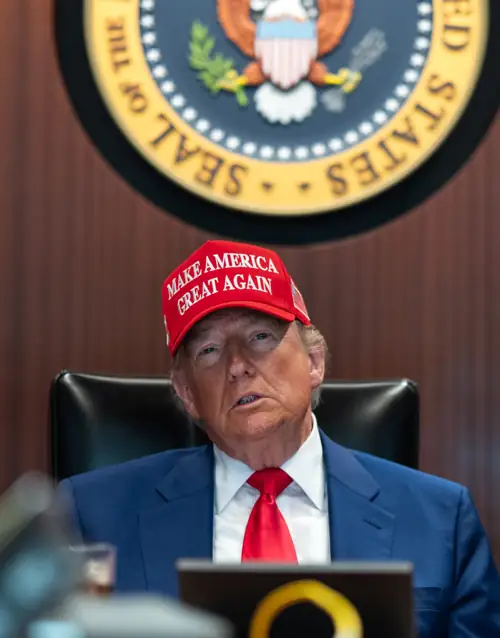
Donald Trump logged onto social media Wednesday and announced what is either a bold military deterrence strategy or the most unhinged game of whack-a-mole in modern history. "Any time the Islamic Republic of Iran shoots at a ship in the Strait of Hormuz, whether it be by Missile, Rocket, Drone, or any other device or weapon, the United States will bomb and destroy ONE BRIDGE OR POWER PLANT, including those located next to, or in, the Capital City of Tehran," he posted, in the all-caps register he reserves for nuclear threats and complaints about cable news.
Later, speaking to supporters in Marietta, Georgia, Trump called the ongoing war a "skirmish" and told the crowd the U.S. doesn't need the Strait of Hormuz at all. "We don't need straits. We don't need anything," he said. He's not wrong that the U.S. produces its own oil. He is significantly wrong that global oil markets, treasury yields, mortgage rates, and the economies of dozens of allied nations feel the same relaxed indifference to a key waterway being functionally blockaded.
On Iran's willingness to deal, Trump told the crowd they'll be ready "very soon." That's the same timeline he gave on replacing the Affordable Care Act, a Middle East peace deal, ending the Ukraine war in 24 hours, and at least a dozen other things. For now, a spokesperson for Iran's Interior Ministry told a state-run news agency Wednesday that there are no negotiations ongoing, though they acknowledged "there may be exchanges of messages taking place." So. Vibes-based diplomacy.
The Numbers That Should Scare You
NBC News reports that international Brent crude surged as much as 4.9% Wednesday, briefly crossing $95 a barrel for the first time in nearly six weeks. U.S. crude climbed close to 5.1% at its peak before settling back. By close, Brent was up 3.4% at $94.07 and U.S. crude closed at $86.83, up 2.9%. Still a bad day if you were hoping prices would calm down.
Since the start of this month alone, oil prices have gained 25%. Since January 1, they are up more than 50%, according to NBC News. That completely wipes out the price drop that followed a temporary U.S.-Iran memorandum of understanding signed in mid-June, which Trump declared "over" on July 8. Cool experiment. Great result.
The ripple effects are spreading fast. Treasury yields spiked Wednesday, with the U.S. 10-year yield hovering around 4.65%, its highest level since May, per NBC News. The average rate on a 30-year mortgage climbed to 6.75%, matching its highest point of the year. And the national average gas price rose 4 cents overnight to $4.06 per gallon, according to AAA data tracked by NBC News. American consumers are now paying for this war at the pump, at the grocery store via shipping costs, and potentially on their next mortgage statement.
The Strait Is Open (Technically)
The Pentagon insists the Strait of Hormuz remains open. And sure, technically, a door is also "open" when there's a guy with a flamethrower standing in it. CBS News reports that shipping traffic through the Strait has slowed sharply again in response to renewed Iranian attacks on vessels. According to an analysis of ship movements by MarineTraffic, only 13 ships crossed the Strait on Monday and nine crossed on Tuesday. Nine. A waterway that normally handles roughly 20% of the world's oil supply.
In the last two days, the U.K.'s Maritime Trade Organization has reported multiple attacks on vessels in the area, and in at least two of those incidents, according to NBC News, crews were forced to abandon ship. Secretary of State Marco Rubio said this week the U.S. is still open to diplomacy with Iran, "but right now they don't seem to be serious about that." He added that Iran is "targeting global shipping in an international waterway and demanding to control which ships can go and which ones cannot," calling it "unacceptable." Strong words. Meanwhile, night 12 of airstrikes, per U.S. Central Command, is now underway with the stated goal of degrading Iran's "ability to threaten civilian mariners and commercial vessels."
The Second Chokepoint Is Now Also a Problem
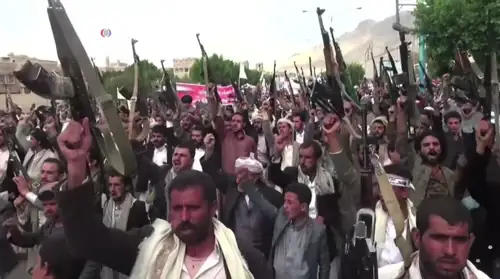
Because one maritime crisis wasn't enough, Yemen's Iran-backed Houthi rebels have now introduced themselves as a second act. The Houthis claimed Wednesday they attacked two Saudi oil tankers in the Red Sea. CBS News reports the U.K. Maritime Trade Operations Centre confirmed receiving reports of a tanker hit by an "unknown projectile" off the Saudi coast, causing an onboard fire with no reported casualties.
Days earlier, the Houthis had threatened a full maritime embargo against Saudi Arabia. Now, according to analytics firm Kpler as cited by CBS News, at least four ships headed toward the Bab al-Mandab strait have recently executed U-turns to avoid it. MarineTraffic analyst Dimitris Ampatzidis wrote Wednesday that "the traffic count should be read alongside growing evidence of route hesitation around vessels approaching the Gulf of Aden and Bab al-Mandab." ING commodities analysts told NBC News that tankers being forced out of the Bab al-Mandab would have to reroute through the Suez Canal, "adding significant time and expense to voyages to Asia." Great. The backup route now also has a problem.
The Bab al-Mandab had been functioning as a crucial relief valve for oil exports, particularly from Saudi Arabia, that could not move through a functionally closed Hormuz. If both straits are compromised simultaneously, there is no third valve. ING analysts put it plainly: between Hormuz and Bab al-Mandab, "oil supply risks appear to be building once again."
One More Thing: We Just Gave Saudi Arabia a Nuclear Deal
Buried in Wednesday's firehose of alarming developments was this: the U.S. and Saudi Arabia signed a commercial nuclear cooperation deal. CBS News reports that Energy Secretary Chris Wright and Saudi Energy Minister Prince Abdulaziz bin Salman signed what the Trump administration is calling a peaceful nuclear cooperation agreement, creating the potential framework for uranium enrichment on Saudi soil, controlled by a contracted corporation and subject to a lengthy study before proceeding.
The agreement is explicitly non-military in nature, the Energy Department says. But Iran, which has long argued for its own right to a civilian nuclear program as a signatory of the Non-Proliferation Treaty, is not going to love seeing its chief regional rival get that green light from Washington. The timing, in the middle of a shooting war with Iran, is a choice. A real, deliberate, almost breathtaking choice.
The Dingo Take
Here's the thing about calling a war a "skirmish": the word loses its charm when nine ships are crossing a global oil chokepoint on a given Tuesday, gas is over four dollars a gallon, mortgage rates are at their yearly peak, and the president is publicly threatening to blow up Tehran's power grid on a per-attack basis like some kind of catastrophic loyalty punch card. You bomb a tanker, we bomb a bridge. You bomb another tanker, we bomb a power plant. What happens when Iran runs out of ships and we run out of infrastructure targets? Nobody seems to have war-gamed that out loud yet.
The economic consequences of this are already landing on real people. The 50% rise in oil prices since January isn't an abstraction. It's at the pump. It's in shipping costs that filter into every product on a grocery store shelf. It's in the mortgage rate that just hit its highest point of the year for anyone trying to buy a house. Trump stood in Georgia and told supporters America doesn't need the Strait of Hormuz. Meanwhile, the rest of the global economy, including plenty of U.S. allies, is very much finding out that it does.
And we're into night twelve with no clear endgame. Iran says there are no negotiations. The U.S. says it's open to diplomacy but keeps bombing. The Houthis just opened a second front. Saudi Arabia just got a nuclear cooperation deal that will enrage Tehran further. The June memorandum of understanding is dead. Brent crude is flirting with $95. If this is a skirmish, someone needs to explain what Trump's definition of a war is, because the rest of us appear to be living in one.



Comments