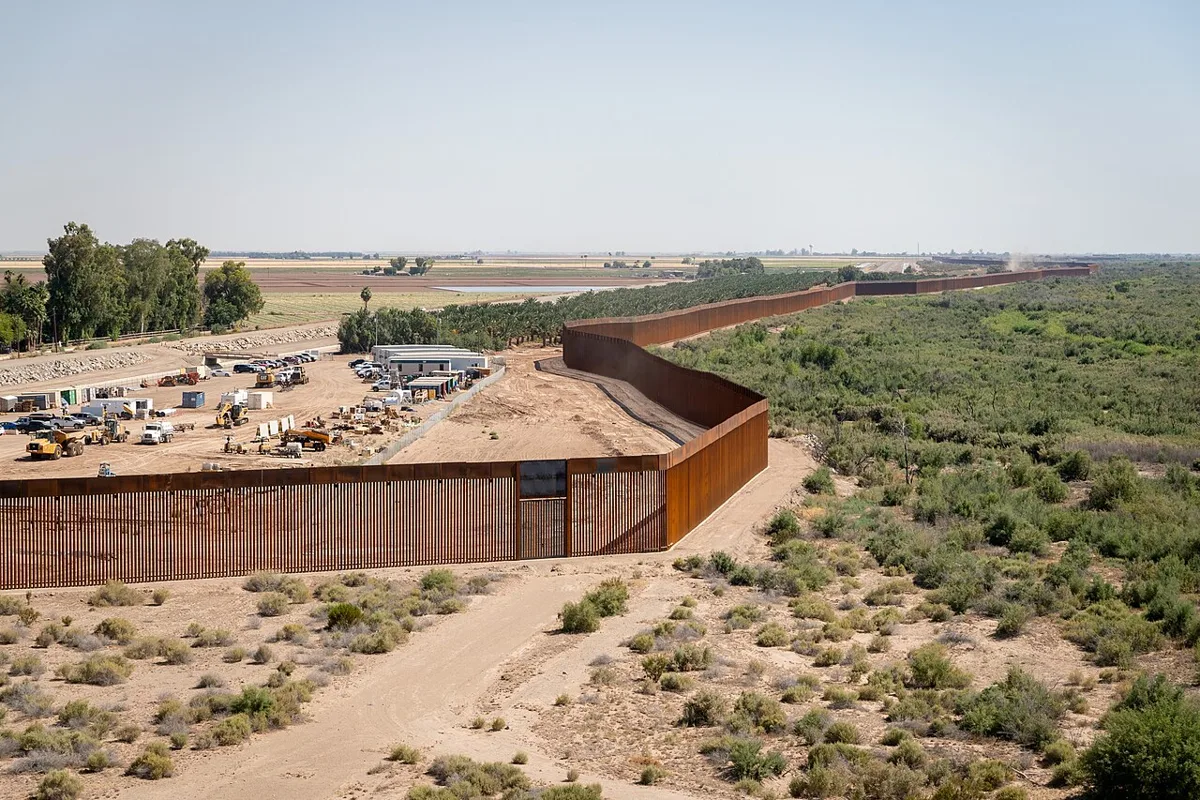
There is exactly one place on Earth where the Sonoyta pupfish and the Quitobaquito springsnail live in the wild. One. And the Trump administration has just awarded a contract to build a 30-foot steel wall directly through it. The construction could begin any day now.
A Place That Shouldn't Be This Easy to Destroy
Quitobaquito Springs sits in the Sonoran desert at the southwestern edge of Arizona, tucked inside Organ Pipe Cactus National Monument, roughly 100 miles from the nearest reliable water source in any direction. The O'odham people call it A'al Vaipia and have held it sacred for longer than the United States has existed as a country. Water seeps out of an aquifer at the base of a hill, runs through a short concrete channel, and collects in a pond that is, against all geological odds, teeming with life.
That pond holds roughly 250 Sonoyta mud turtles, a species that has figured out how to survive in bone-dry desert conditions and absolutely nowhere else. The channel is home to springsnails so small they are compared to chia seeds. According to The Guardian, the entire wild habitat for those springsnails could fit inside the footprint of three parking spaces. The Sonoyta pupfish are silvery and small, with upturned jaws that make them look perpetually startled, which, given current circumstances, seems appropriate.
This is not a metaphor for something broader. This is a literal, specific, irreplaceable biological treasure, and a contractor called Sundt Construction has been handed a federal contract to build a second 30-foot bollard wall between 90 and 150 feet north of the wall that already exists there.
They Already Built One Wall Here. It Nearly Killed the Spring.
This is not even the first rodeo. During Trump's first term, a 30-foot border wall went up in this same remote stretch in 2020. The Guardian reports that during that construction, the spring flow dropped to an all-time recorded low and the pond partially dried up after its lining cracked. The administration literally cracked the floor of the only pond where multiple species exist on this planet, and the lesson learned was apparently: let's do it again, but bigger.
Now the plan is a secondary wall, also 30 feet of steel bollards, sitting just north of the first one. The southern edge of the pond is 190 feet from the Mexican border. Basic math tells you that "90 to 150 feet north of the existing wall" puts heavy construction equipment operating in uncomfortably close proximity to a pond containing animals that have no backup address. There is also a grove of mesquite trees between the pond and the border, federally recognized as critical habitat for the mud turtle, where the animals burrow. According to The Guardian, that grove would likely be leveled.
Tara Harris, director of conservation and science at the Phoenix Zoo, told The Guardian the construction "could destroy the last remaining habitat for multiple imperiled species." That is not environmental hyperbole. That is a scientist describing what happens when you build a wall through the only place something lives.
The Legal Architecture of Not Caring
Here is the part that should make you set this article down and stare at the wall for a minute. Under normal circumstances, construction like this would require extensive review under the Endangered Species Act, the National Environmental Policy Act, and the Native American Graves Protection and Repatriation Act. Those laws exist specifically to prevent this kind of thing. They have teeth. They matter.
Except the 2005 Real ID Act handed the Secretary of Homeland Security the authority to waive all of them. Every single one. No environmental impact study. No consultation with the O'odham people, whose sacred site this is. No review of what happens to the two species that will literally cease to exist on Earth in the wild if this pond is destroyed. The Guardian confirmed that CBP has already awarded the Organ Pipe contract, and locals have observed contractors surveying the area and setting up flagging. The clock is running.
For context on what is supposedly being protected against: The Guardian reports that illegal immigration in the Organ Pipe area has been "extremely minimal since 2025." The area saw tens of thousands of asylum seekers come through in 2023 and 2024, and those numbers collapsed to near zero after the Biden administration restricted asylum pathways. The wall already there did not stop those people. A second wall is being built to stop a problem that has already stopped itself, at the cost of species that cannot be un-extincted.
A Race to Save What's Left
Scientists are not sitting still. Michael Bogan, an aquatic ecologist at the University of Arizona who leads the recovery team for the Sonoyta mud turtle, is working with researchers from the Phoenix Zoo and the Arizona-Sonoran Desert Museum to figure out what can be saved and where it can go. The most extreme scenario being evaluated involves physically removing as many animals as possible before construction begins and housing them in artificial habitats.
The Desert Museum currently holds 20 mud turtles, the only existing backup population for the species, and has agreed to take up to 50 more if necessary, according to The Guardian. The Phoenix Zoo is also prepared to accept turtles. The Phoenix Zoo is also already maintaining the springsnails' only backup population in two tanks. This is what the conservation of a species looks like when government stops doing its job: a handful of institutions running emergency wildlife rescue operations because a federal agency waived the laws designed to prevent this situation.
Erick Meza, the borderlands coordinator for the Sierra Club, told The Guardian that similarly designed secondary fencing is currently going up at about six other locations along the Arizona-Sonora border. "I've never seen something of this magnitude," he said. "It's unbelievable." There are already 34 miles of completed double-wall barriers, with another 390 miles under active construction and 155 more miles with contracts already awarded.
What the O'odham People Are Watching
Wynona Larson Yazzie, an O'odham elder and community organizer, described the planned construction as "sickening" to The Guardian. The O'odham have used A'al Vaipia as a home, gathering place, and site for water ceremonies since time immemorial. They watched the first wall go up through their sacred land. Now they are watching contractors prepare to build a second one.
The 2005 law that made this possible did not ask them. The current administration did not ask them. The laws that would have required consultation were waived. This is the United States federal government treating Indigenous sacred land as a construction site, for a wall being built against a border-crossing problem that the data says has already evaporated, and in the process potentially eliminating species that will never exist on this planet again once they are gone.
The Dingo Take
Let's be precise about what is happening here. The Trump administration is building a second 30-foot steel wall, at significant public expense, through the only wild habitat on Earth for two animal species, on land sacred to the O'odham people, in an area where illegal crossings are already at minimal levels, because a 2005 law lets the Homeland Security secretary wave away every environmental and Indigenous protection law on the books. No review. No consultation. No consequences. Just contractors with flagging tape and a federal contract.
The cruelest part of this is the contingency planning unfolding in the background. Scientists quietly strategizing about how many turtles they can stuff into zoo tanks before the bulldozers arrive. Researchers running worst-case scenarios for a pond the size of three parking spaces. That is what it looks like when the government decides the optics of "tough on the border" are worth more than the actual survival of species. It is not a policy debate. It is a government choosing, deliberately and with full information, to potentially cause extinctions.
The border wall has always been a performance. This stretch of Organ Pipe makes that undeniable. The people it was supposedly built to stop were already gone before the second contract was signed. What remains is a construction project aimed at a problem that no longer exists, about to eliminate things that can never be replaced. That is not border security. That is something considerably uglier, and it is happening right now, 190 feet from a pond in the Arizona desert.
Comments