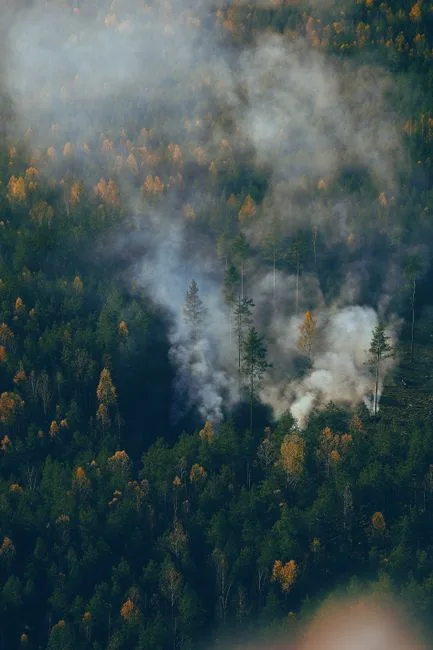
Four wildland firefighters are now dead after a single burnover event on Colorado's Knowles Fire, and the country is barely paying attention. Nathan Matthews, 43, of Lincoln, Nebraska, died this week from burn injuries sustained during a fire that trapped five firefighters at once, killing three at the scene and now claiming a fourth weeks later.
What Actually Happened Out There
CBS News reports that five firefighters were caught in a burnover while conducting initial attack operations on the Knowles Fire near Knowles Canyon in Mesa County, Colorado. A burnover, for anyone who hasn't heard the term before and hopes they never have to again, is when a fire moves so fast and so unpredictably that it cuts off escape routes entirely. You don't outrun it. You survive it or you don't.
Three firefighters assigned to the Rifle Helitack crew died at the scene. Emily Barker, 38, Nick Hutcherson, 27, and Sydney Watson, 27, did not make it out. Matthews was transported and received medical care for his burns for weeks before succumbing to his injuries. The fifth firefighter involved has not yet been publicly identified.
The fire itself started near Knowles Canyon and was later absorbed into the larger Snyder Fire, which originated in Utah before crossing the Colorado border. According to the Department of the Interior, the Snyder Fire has now burned over 28,000 acres along the Colorado-Utah state line. Gusty winds and fast-moving flames created the kind of conditions that turn an already dangerous job into something unsurvivable.
Who These People Were
Emily Barker was 38. Nick Hutcherson was 27. Sydney Watson was 27. Nathan Matthews was 43, from Lincoln, Nebraska, and he spent weeks fighting for his life in a burn unit before dying. These are not abstract statistics. These are people who drove to a fire, got out of a vehicle, and never came home.
U.S. Wildland Fire Service Chief Brian Fennessy said in a statement, as CBS News reports, "We mourn the loss of Nate while continuing to grieve the deaths of Emily, Nick and Sydney. Our hearts are with their families, friends, crewmates and everyone impacted by this tragedy." Fennessy also called it "another heartbreaking loss for our wildland fire family," which is the kind of sentence no one should have to write four times in a month.
The Rifle Helitack crew operates out of western Colorado and does exactly the kind of initial attack work that puts people directly in the path of the most dangerous moments a wildfire can produce. These crews are not sitting in a command center. They are on the ground, in the smoke, in the heat, making decisions in real time with incomplete information and winds that can shift in seconds.
The Fires Keep Getting Worse and the Staffing Hasn't Kept Up
Here's what makes this story harder to sit with than it should be. Wildland firefighters have been sounding alarms for years about understaffing, underpay, and working conditions that do not match the scale of what these fires have become in the era of longer, hotter, drier fire seasons. The federal workforce that fights these fires has been under pressure from every direction, including budget pressures and a federal hiring environment that has grown more chaotic and hostile under the current administration.
We are not saying the deaths of Barker, Hutcherson, Watson, and Matthews are directly attributable to any specific policy decision. Fires are dangerous. Burnovers happen. But four firefighters dead from a single incident on a single fire in a single week is not a normal outcome, and pretending it exists in a vacuum separate from every conversation happening right now about federal workforce capacity and wildfire resource allocation would be dishonest.
The Department of the Interior statement, as reported by CBS News, said the agency remains "committed to supporting those affected and honoring the legacy of all four firefighters who made the ultimate sacrifice in service to our nation." Honoring legacies is the easy part. The harder part is making sure the conditions that produced this outcome don't produce it again next season, and the season after that.
28,000 Acres and a Name Change Nobody Warned You About
One small but telling detail in the CBS News report: the fire is now officially called the Snyder Fire, not the Knowles Fire, because it was overtaken by a larger Utah-originating blaze that crossed state lines. The fire that killed four people technically stopped being the fire that killed four people, administratively speaking, because a bigger fire swallowed it.
That's wildfire in 2026. The fires don't stay where they start. They don't respect state lines, they don't respect containment estimates, and they certainly don't slow down because a crew of five people is trying to stop them. The Snyder Fire has now burned more than 28,000 acres along the Colorado-Utah border and shows exactly the pattern that fire scientists have been warning about for the better part of two decades: faster spread, less predictable behavior, and consequences that arrive before anyone can get out of the way.
The Dingo Take
Four people are dead. They died doing one of the most physically dangerous jobs in the United States federal government, a job that requires running toward the thing everyone else is running away from. Emily Barker, Nick Hutcherson, Sydney Watson, and Nathan Matthews were doing their jobs when a fire moved faster than they could and closed off every exit. That deserves more than a department statement and a news cycle that lasted about forty-eight hours.
We are living through a moment when the federal government is actively shrinking its own capacity to respond to exactly these kinds of crises, when the people staffing the agencies that fight these fires are watching colleagues get laid off and positions go unfilled, when the budgets that fund wildland fire operations are treated as negotiable. None of that is an abstraction anymore. It has names now. Four of them.
The wildfires are not getting smaller. The seasons are not getting shorter. And the people we send to fight them deserve a government that treats their lives as a serious operational and moral priority, not just as an occasion for a press release. We are not there. The gap between what we ask these crews to do and what we give them to do it with is a policy choice, and somebody keeps making it.


Comments