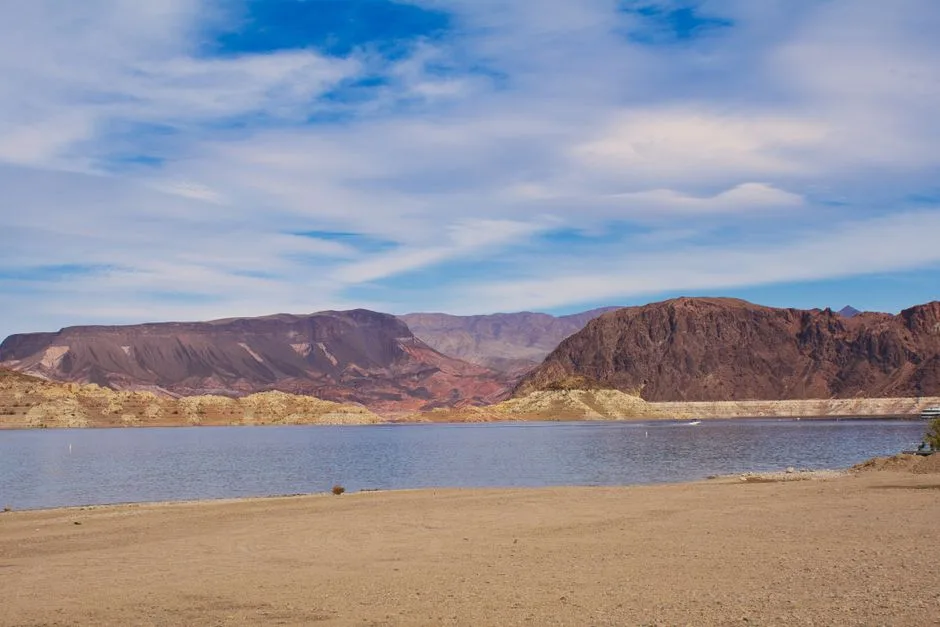
America's two largest reservoirs are at the lowest levels ever recorded, seven states are deadlocked over who has to drink less, and the Trump administration is about to step in with a hacksaw. Welcome to the Colorado River water crisis, now entering its most dangerous and chaotic phase yet.
The Numbers Are Bad. Really Bad.
Lake Mead and Lake Powell, the two reservoirs that together form the backbone of the entire American West's water supply, have both fallen below 30% capacity, CBS News reports. That is not a typo. Less than a third full. These are not just scenic spots for jet skis and vacation photos. They are the reason 40 million people have running water, the reason farms across seven states can grow food, and the reason cities from Las Vegas to Los Angeles function as cities at all.
If Lake Powell drops just 33 more feet, the reservoir will lose the water pressure needed to generate hydroelectric power, meaning it can no longer push water through the dam and into the Colorado River downstream. That's not a distant hypothetical. That's a specific number we are actively approaching right now. Thirty-three feet. Write it down.
Seven States Walk Into a Bar and Cannot Agree on Anything
The Colorado River is carved up between seven states split into two camps. Upper basin: Colorado, Wyoming, Utah, and New Mexico. Lower basin: California, Arizona, and Nevada. They have been negotiating for years over how to divide a shrinking water supply, and they have produced nothing actionable. Years of talks. No deal.
Here's the infuriating part. According to CBS News, California and the other lower basin states have already cut their Colorado River water use by nearly 20% since 2015. Twenty percent. They did the work. Meanwhile, Kelly Shannon McNeill, managing director of LA Waterkeeper, told CBS News that the upper basin states have gone in the opposite direction, actually increasing their use over the same period while insisting they cannot afford cuts. "This is really about political will," McNeill said. Hard to argue with that.
Trump's People Are About to Cut Everyone, Twice as Hard
After years of states failing to sort this out themselves, the Trump administration is now preparing to impose mandatory cuts. The lower basin states stepped up with a joint offer: reduce use by about 1.6 million acre-feet per year, roughly 500 billion gallons, for the next two years. A significant concession from states that have already been cutting for a decade.
Federal officials, per CBS News, are looking at cuts nearly twice that size. That is not a negotiating opener. That is a statement of intent. What those cuts would mean in practice: higher water costs for cities scrambling to find alternative sources, mandatory outdoor watering restrictions, and serious disruptions for agricultural users who currently consume the vast majority of the river's supply. Farmers, cities, and homeowners are all in the crosshairs, and nobody at the state level managed to get ahead of it.
Climate Did This, but Humans Made It Worse
To be clear about cause and effect here: the Colorado River starts as snowpack in the Rocky Mountains. A warming climate means less snow falls, and the snow that does fall melts faster and earlier, with more of it evaporating before it ever reaches the river. Less input, same demand. The math is ugly and it has been ugly for years.
On top of that, CBS News points out that the population of the American West has kept growing. More people, less water, and states that spent the better part of a decade watching the crisis deepen while arguing about whose turn it was to cut back. The crisis was never inevitable. The failure to get ahead of it was entirely a choice, made repeatedly, by people who had every piece of information they needed.
What Happens If Nobody Blinks
McNeill's advice to regular people watching this unfold was direct: contact your elected officials and your state's negotiators and tell them to get a deal done. "I would urge those people living in those states to contact their elected representatives and their negotiators at the table, and really urge them to come to the table and come up with some sort of agreement," she told CBS News.
The alternative is having the federal government impose cuts that nobody at the state level has had any hand in shaping, on a timeline that serves federal interests rather than local ones. If you think the Trump administration is going to handle this with particular sensitivity to the needs of California or Arizona, you have not been paying attention to the last eighteen months. Federal intervention may be unavoidable at this point. The question is just whether states get any say in what it looks like.
The Dingo Take
Here is what makes this story almost cosmically frustrating. This is not a surprise. Scientists have been screaming about the Colorado River for the better part of two decades. The data on declining snowpack, rising temperatures, and overconsumption relative to the river's actual flow has been available, published, and widely circulated for years. States had every opportunity to get ahead of this together, and instead they ran out the clock arguing about who should go first. Now the federal government is going to do it for them, and nobody should expect that to go smoothly.
The upper basin states increasing their water use while the lower basin states were cutting is the part of this story that deserves a lot more attention than it's getting. That is not a water management disagreement. That is one group of states watching their neighbors sacrifice and deciding they'd rather not. Political will, as McNeill put it, is exactly the right frame. The water crisis is a climate problem, yes. But the governance failure wrapped around it is entirely man-made.
Forty million people depend on the Colorado River. Two reservoirs that power cities, irrigate fields, and keep the lights on are sitting at less than 30% capacity. Lake Powell is 33 feet from losing the ability to generate hydroelectric power. And the plan, until very recently, was apparently just to keep having meetings. If there is a silver lining here, it is that the federal government forcing the issue might finally produce actual numbers and actual cuts. That is a grim bar to clear, but at this point, it might be the only bar left.



Comments