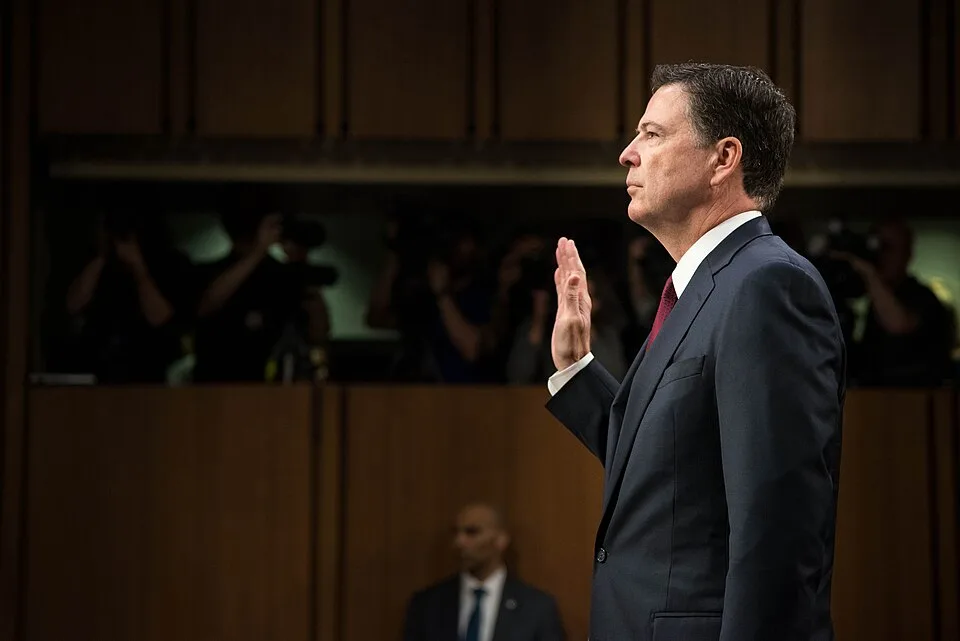
The Trump Justice Department is trying to send a former FBI director to trial over a beach photo. Comey's lawyers just fired back with the most satisfying legal argument imaginable: Donald Trump's own words, used against him, word for word.
A Seashell, a Number, and a Federal Indictment
Here's the situation. James Comey posted a photo on Instagram. It showed seashells arranged in the shape of the numbers 8 and 6 and 4 and 7. The Trump administration looked at that beach photo and decided it was a criminal threat against the President of the United States. A grand jury in the Eastern District of North Carolina indicted him in April.
The theory, such as it is: "86" is slang for killing someone, and Trump is the 47th president. Therefore: threat. Case closed. Off to trial.
Except "86" is, as NBC News notes, widely understood as a restaurant term meaning you're out of something. As in, we're 86'd on the salmon. As in, something that every line cook in America has said approximately nine thousand times. The prosecution is asking a federal jury to believe that a 65-year-old former FBI director posted a covert assassination request in seashells on a public Instagram account.
Eight Lawyers Walk Into Court
Comey's team of eight attorneys filed a motion Monday asking the judge to dismiss the case. Their argument, per NBC News, is that "dictionaries, context, precedent, and common sense" completely gut the government's position. That is not hyperbole. That is the actual phrase they used in a federal filing.
The lawyers argued that even if someone squinted hard enough at the post and saw a threat in it, any reasonable observer would recognize it as political hyperbole, not a genuine call for violence. "The Supreme Court has rejected threats prosecutions based on speech far more directly threatening than Mr. Comey's seashells post here," they wrote.
They also made the argument that forcing Comey to stand trial at all, regardless of the verdict, is itself an unconstitutional punishment of free speech. That's not a fringe legal position either. It goes to the core of what chilling effects look like in practice: you don't have to convict someone to silence them, you just have to make the process expensive and miserable enough that everyone else gets the message.
The Part Where They Use Trump's Own Argument Against Him
This is the part of the story that you need to stop and appreciate fully. Comey's lawyers went looking for precedents about criminalizing core political speech. They found a perfect one. It was filed by Donald Trump's own legal team, during the January 6th criminal case against him.
They quoted it directly in Monday's filing: "An 'indictment must be dismissed' where it 'seeks to criminalize core political speech and advocacy that lies at the heart of the First Amendment.'" That language came from Trump's defense attorneys arguing that Trump himself should not face criminal charges for his conduct surrounding January 6th.
Let that settle in. The legal standard Trump's team invented to protect Trump from prosecution is now being deployed to protect Comey from prosecution. It is objectively, genuinely funny. It is also legally sound.
Trump Said What, Exactly?
The filing also made a move that was either brave or obvious, depending on how you look at it: comparing Comey's seashell post to actual statements Donald Trump has made out loud, on the record, in public.
According to NBC News, Comey's lawyers cited Trump claiming that a congressional video criticizing military policy was "punishable by death" and cause for "hang[ing] them." They cited Trump's 2016 suggestion that "Second Amendment people" might be the only way to stop Hillary Clinton. They cited Trump's remarks about Liz Cheney, in which he described putting her in front of "nine barrels shooting at her" with "guns trained on her face."
None of those statements resulted in a federal indictment. A seashell photo did. The attorneys did not call this a double standard. They didn't have to.
The Rookie Prosecutor Has Already Left the Building
There's one detail buried in NBC's reporting that is doing a lot of work. The prosecutor who originally brought this case, Matthew Petracca, is described as a rookie federal prosecutor and former Republican official. He has since moved off the case.
A DC federal judge separately ruled it was "difficult to fathom" how the number combination 8647 displayed on a flag could constitute a true threat. During oral arguments in that related case, the government itself conceded there were circumstances where those numbers together wouldn't be considered a threat against the president. The government is arguing both sides of its own theory depending on which courtroom it's standing in.
The Justice Department has until August 18th to respond to Comey's motions. His team is also expected to file a separate motion arguing the whole prosecution is the product of selective and vindictive prosecution. Comey himself has already said the case reflects Trump's "bottomless desire" for revenge.
The Dingo Take
Let's be honest about what this case is. It is not a good-faith prosecution. It is a message. The message is: post the wrong thing about the wrong person, and the full weight of the federal government will land on you. Not because you broke a law in any coherent sense, but because you embarrassed someone powerful and that someone now controls the Justice Department. That is the point. That has always been the point.
The seashells prosecution sits in a direct line with the unlawful appointment of Lindsey Halligan to go after Comey over congressional testimony he gave in 2020 — a case a federal judge threw out. Trump's DOJ doesn't need to win these cases. It needs to file them, drain the targets financially and emotionally, and remind everyone else watching what happens when you step out of line. The courtroom is just the venue. The real audience is everybody else.
What Comey's lawyers did Monday was elegant: they handed the judge a clean, devastating argument while making the whole thing as publicly embarrassing for the administration as possible. Using Trump's own defense from January 6th is not just clever lawyering, it's a statement. You want to weaponize the justice system? Fine. Don't be surprised when the weapons start pointing in unexpected directions.


Comments